
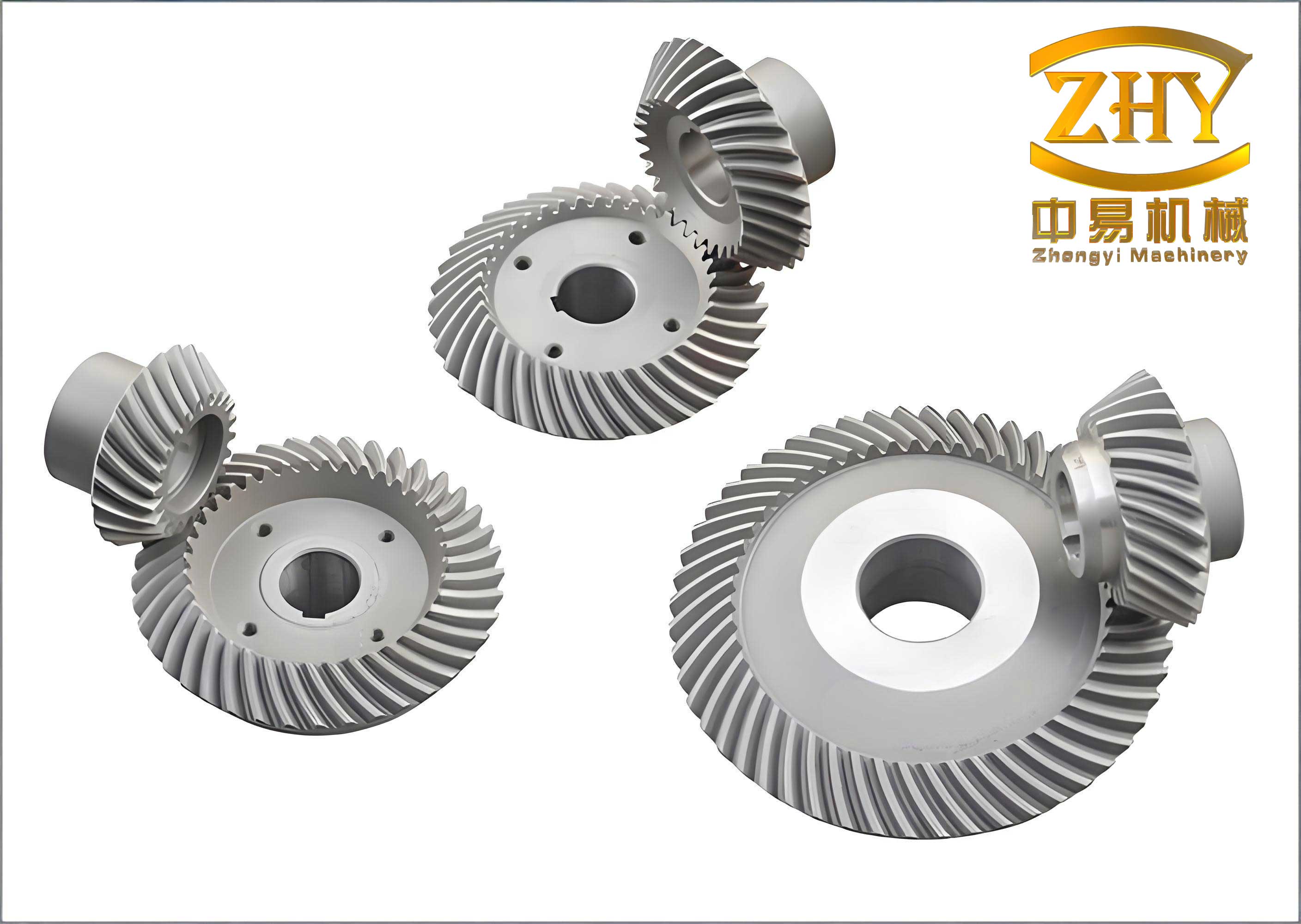
In the field of power transmission systems, hyperbolic gears, also known as hypoid gears, play a critical role due to their ability to smoothly transfer torque between non-intersecting axes. These gears are widely used in automotive, aerospace, and engineering machinery applications. However, one of the persistent challenges in the design and analysis of hyperbolic gears is the difficulty in obtaining accurate three-dimensional (3D) models of their tooth surfaces. Traditional stress calculation formulas often deviate significantly from experimental measurements, leading to over-conservative designs or reliance on costly and time-consuming physical testing. To address this, I propose a comprehensive mathematical modeling approach based on MATLAB that automates the calculation of tooth surface coordinates, enabling the creation of precise 3D models for finite element analysis and other engineering applications. This method leverages the actual machining process of hyperbolic gears using Gleason-style machines, ensuring that the model closely mirrors real-world manufacturing. Throughout this article, I will delve into the details of this methodology, emphasizing the use of coordinate transformations, engagement equations, and numerical solutions to derive tooth surface geometries. The term “hyperbolic gears” will be frequently referenced to highlight the focus on this specific gear type, and I will incorporate tables and formulas to summarize key parameters and mathematical relationships. By the end, this approach aims to provide a robust tool for researchers and engineers working with hyperbolic gears.
The core of my modeling method lies in simulating the machining process of hyperbolic gears, particularly for the HFT (Hypoid Formate) style, where the pinion is generated via a Gleason machine. The machine setup involves a cutter head that rotates to form a imaginary generating gear, which then envelops the tooth surface on the workpiece through coordinated motions. To begin, I establish the mathematical representation of the cutter surface, which is essential for deriving the tooth geometry. The cutter blade, as used in hyperbolic gears manufacturing, can be simplified into straight and circular arc segments. For the straight part, which generates the working tooth surface, the cutter surface in the cutter coordinate system \( S_t \) can be expressed as a conical surface. Let \( s_p \) and \( \theta_p \) be the surface parameters, \( \alpha_p \) the blade angle, and \( R_p \) the cutter point radius. The position vector \( \mathbf{r}_p^{(a)}(s_p, \theta_p) \) for the generating cone is given by:
$$ \mathbf{r}_p^{(a)}(s_p, \theta_p) = \begin{bmatrix} (R_p – \text{sgn}(\alpha_p) s_p \sin \alpha_p) \cos \theta_p \\ (R_p – \text{sgn}(\alpha_p) s_p \sin \alpha_p) \sin \theta_p \\ -s_p \cos \alpha_p \end{bmatrix} $$
where \( \text{sgn}(\alpha_p) \) is 1 for the inner blade (convex side) and -1 for the outer blade (concave side) of hyperbolic gears. The unit normal vector \( \mathbf{n}_p^{(a)} \) to this surface is derived from the partial derivatives and is expressed as:
$$ \mathbf{n}_p^{(a)} = \begin{bmatrix} \cos \alpha_p \cos \theta_p \\ \cos \alpha_p \sin \theta_p \\ -\text{sgn}(\alpha_p) \sin \alpha_p \end{bmatrix} $$
This forms the basis for the generating surface that will later engage with the workpiece. The modeling of hyperbolic gears requires careful consideration of these cutter geometries to ensure accuracy in the final tooth form.
Next, I focus on the coordinate transformations that map points from the cutter to the workpiece. The Gleason machine involves multiple moving parts, including the cradle, eccentric, cutter tilt, and swivel mechanisms. To accurately model hyperbolic gears, I define a series of transformation matrices that account for all machine adjustments. Starting from the cutter coordinate system \( S_t \), the transformation to the cradle coordinate system \( S_c \) involves parameters such as the cradle angle \( \phi_c \), eccentric angle \( \phi_e \), cutter swivel angle \( \phi_s \), and cutter tilt angle \( \phi_t \). The transformation matrix \( \mathbf{M}_{ct} \) is a 4×4 homogeneous matrix that includes rotational and translational components. For a Gleason-style machine, this matrix can be detailed as follows:
$$ \mathbf{M}_{ct} = \begin{bmatrix} a_{11} & a_{12} & a_{13} & a_{14} \\ a_{21} & a_{22} & a_{23} & a_{24} \\ a_{31} & a_{32} & a_{33} & a_{34} \\ 0 & 0 & 0 & 1 \end{bmatrix} $$
where the elements are functions of the machine parameters. For instance, \( a_{11} = \cos \tau (\cos^2 \varepsilon \cos \phi_t + \sin^2 \varepsilon) – \sin \tau \cos \varepsilon \sin \phi_t \), with \( \tau = \phi_c + \phi_e + \phi_s \) and \( \varepsilon = 15^\circ \) being the wedge angle. This transformation is crucial for hyperbolic gears as it aligns the cutter with the machine’s kinematic chain. Subsequently, the cradle coordinate system is transformed to the machine reference coordinate system \( S_m \) via a rotation matrix \( \mathbf{M}_{mc} \) that accounts for the cradle rotation angle \( \psi_c \):
$$ \mathbf{M}_{mc} = \begin{bmatrix} \cos \psi_c & \sin \psi_c & 0 & 0 \\ -\sin \psi_c & \cos \psi_c & 0 & 0 \\ 0 & 0 & 1 & 0 \\ 0 & 0 & 0 & 1 \end{bmatrix} $$
The combined transformation from cutter to machine coordinates is then \( \mathbf{M}_{mt}(\psi_c) = \mathbf{M}_{mc}(\psi_c) \mathbf{M}_{ct} \). This allows me to express any point on the generating surface in the machine reference frame, which is essential for simulating the engagement in hyperbolic gears.
To obtain the tooth surface coordinates on the workpiece, I further transform from the machine coordinate system to the workpiece coordinate system \( S_w \). This involves accounting for machine installation parameters such as the sliding base distance \( X_B \), machine root angle \( \gamma_m \), offset \( E_m \), and workpiece position \( X_p \). The transformation matrix \( \mathbf{M}_{wc}(\psi_c) \) is a product of several matrices: \( \mathbf{M}_{wc}(\psi_c) = \mathbf{M}_{wo} \mathbf{M}_{op} \mathbf{M}_{pr} \mathbf{M}_{rs} \mathbf{M}_{sm} \mathbf{M}_{mc}(\psi_c) \), where each matrix represents a specific adjustment. For example, \( \mathbf{M}_{sm} \) translates along the Z-axis by \( -X_B \), and \( \mathbf{M}_{rs} \) rotates by the machine root angle \( \gamma_m \). The final position vector of a point on the tooth surface of hyperbolic gears in the workpiece coordinate system is:
$$ \mathbf{r}_w^{(a)}(s_p, \theta_p, \psi_c) = \mathbf{M}_{wc}(\psi_c) \mathbf{r}_{ct}^{(a)}(s_p, \theta_p) $$
This equation encapsulates the entire kinematic chain of the machining process for hyperbolic gears. To summarize the key transformation parameters, I present the following table that lists typical machine settings used in the modeling of hyperbolic gears:
| Parameter | Symbol | Description | Typical Value Range |
|---|---|---|---|
| Cradle Angle | \(\phi_c\) | Rotation of the cradle | 0° to 360° |
| Eccentric Angle | \(\phi_e\) | Adjustment via eccentric mechanism | 0° to 90° |
| Cutter Swivel Angle | \(\phi_s\) | Orientation of the cutter swivel | 0° to 360° |
| Cutter Tilt Angle | \(\phi_t\) | Tilt of the cutter axis | 0° to 60° |
| Machine Root Angle | \(\gamma_m\) | Setting for gear root cone alignment | Varies based on gear design |
| Offset | \(E_m\) | Horizontal wheel position | -50 mm to 50 mm |
| Sliding Base Distance | \(X_B\) | Vertical adjustment of the workpiece | -10 mm to 10 mm |
With the coordinate transformations established, I now address the core problem of solving for the tooth surface coordinates. This involves deriving the engagement condition between the generating surface and the workpiece. For hyperbolic gears, the generating surface and the tooth surface are in continuous tangency during machining, meaning their relative velocity lies in the common tangent plane. The engagement equation, also known as the equation of meshing, is given by:
$$ f_1^{(m)} = \mathbf{n}_m \cdot \mathbf{v}_{m}^{cw} = 0 $$
where \( \mathbf{n}_m \) is the unit normal vector of the generating surface expressed in the machine coordinate system, and \( \mathbf{v}_{m}^{cw} \) is the relative velocity of the generating surface with respect to the workpiece. The relative velocity can be expressed as \( \mathbf{v}_{m}^{cw} = (\boldsymbol{\omega}_m^{(c)} – \boldsymbol{\omega}_m^{(w)}) \times \mathbf{r}_m + \boldsymbol{\omega}_m^{(w)} \times \mathbf{R}_m \), where \( \boldsymbol{\omega}_m^{(c)} \) and \( \boldsymbol{\omega}_m^{(w)} \) are the angular velocities of the cradle and workpiece, respectively, and \( \mathbf{R}_m \) is a position vector related to machine offsets. For hyperbolic gears, the angular velocities are defined based on the gear ratio and machine settings. Typically, \( \boldsymbol{\omega}_m^{(w)} = [-\cos \gamma_m, 0, \sin \gamma_m]^T \) and \( \boldsymbol{\omega}_m^{(c)} = [0, 0, m_{cw}]^T \), with \( m_{cw} \) being the roll ratio. This engagement equation provides one constraint for the three unknown parameters \( s_p \), \( \theta_p \), and \( \psi_c \).
To uniquely determine points on the tooth surface of hyperbolic gears, I introduce two additional equations based on the gear blank geometry. The gear blank parameters, such as pitch cone angle, face width, and addendum, define the boundaries of the tooth. I project points onto the X-R plane of the workpiece coordinate system, where X is the axial direction and R is the radial direction. Let \( \gamma_p \) be the pitch cone angle, \( A_O \) the outer cone distance, and \( F_W \) the face width. For a point on the tooth surface with coordinates \( (x_A, R_A) \), I define a parameter \( \xi_1 \) that indicates its position along the tooth length:
$$ \xi_1 = 1 – \frac{A_O}{F_W} + \frac{\cos \gamma_p x_A + \sin \gamma_p R_A}{F_W} $$
This parameter ranges from -1 at the toe (small end) to 1 at the heel (large end) of hyperbolic gears. Thus, a second equation can be written as:
$$ f_2 = 1 – \frac{A_O}{F_W} + \frac{\cos \gamma_p x_A + \sin \gamma_p R_A}{F_W} – \xi_0 = 0 $$
where \( \xi_0 \) is a specified value between -1 and 1. Additionally, to determine the top boundary of the tooth surface, I use the gear face cone equation. When a point lies on the face cone, it satisfies:
$$ f_3^{(F)} = \tan \gamma_F (x_A + x_{pf}) – R_A = 0 $$
where \( \gamma_F \) is the face cone angle and \( x_{pf} \) is the distance from the face cone apex to the pitch cone apex. For hyperbolic gears, these geometric equations are essential for constraining the solution domain.
The system of equations—\( f_1^{(m)} = 0 \), \( f_2 = 0 \), and optionally \( f_3^{(F)} = 0 \) for boundary points—is nonlinear and requires numerical methods to solve. A key challenge in solving for hyperbolic gears is selecting appropriate initial guesses to ensure convergence. I propose an estimation method based on the gear meshing midpoint, which serves as a reliable starting point. The meshing midpoint corresponds to the mean contact point during gear operation. For hyperbolic gears, I estimate its parameters under simplified machine settings: zero offsets (\( E_m = 0 \), \( X_p = 0 \)), zero sliding base (\( X_B = 0 \)), and machine root angle equal to the gear root angle (\( \gamma_m = \gamma_R \)). Under these conditions, the estimated values are:
$$ \theta_p^* = \begin{cases} \frac{\pi}{2} – \beta + q_0 & \text{for right-hand helical gears} \\ \frac{3\pi}{2} + \beta – q_0 & \text{for left-hand helical gears} \end{cases} $$
$$ s_p^* = \frac{A_M \sin(\Delta_2)}{\cos \alpha_p}, \quad \psi_c^* = 0 $$
where \( \beta \) is the mean spiral angle, \( q_0 \) is the initial radial cutter angle, \( A_M \) is the mean cone distance, and \( \Delta_2 \) is the dedendum angle. For hyperbolic gears, this estimation provides a robust initial guess. I then use an optimization approach, such as the simulated annealing algorithm in MATLAB, to minimize the objective function \( F = (f_1^{(m)})^2 + (f_2^{(M)})^2 + (f_3^{(F)})^2 \), where \( f_2^{(M)} \) is evaluated at the midpoint. Once the midpoint is found, I solve for other points along the tooth surface by varying \( \xi_0 \) and \( s_p \) within their ranges. The parameter \( s_p \) ranges from a minimum value \( s_{p,\min} = \rho_f (1 – \sin \alpha_p)/\cos \alpha_p \) (where \( \rho_f \) is the fillet radius) to a maximum value \( s_{p,\max} \) that satisfies the face cone equation for each \( \xi_0 \). I use numerical solvers like fsolve in MATLAB to compute the coordinates for hyperbolic gears.
To automate this process, I developed a MATLAB program named SURFACE. This program calculates tooth surface coordinates for hyperbolic gears by implementing the steps outlined above. The flowchart of the program includes: inputting gear blank and machine parameters, estimating the meshing midpoint, determining \( s_{p,\max} \) for different \( \xi_0 \) values, and solving the engagement and geometric equations for a grid of points defined by BBB (number of points along the tooth length) and CCC (number of points along the tooth height). The program outputs coordinate files that can be imported into CAD software like CATIA to generate 3D solid models of hyperbolic gears. The following table summarizes the key inputs and outputs of the SURFACE program for hyperbolic gears:
| Input Category | Parameters | Output |
|---|---|---|
| Gear Blank | Number of teeth, pitch cone angle, face width, addendum, dedendum, spiral angle | Tooth surface coordinates (X, Y, Z) for convex and concave sides, 3D model files |
| Machine Settings | Cutter diameter, blade angle, cradle angles, tilt angles, offsets, roll ratio | |
| Numerical Settings | BBB, CCC, tolerance for solvers, initial guess parameters |
As an example, I applied this method to a pair of automotive hyperbolic gears. The gear pair consists of a left-hand pinion and a right-hand gear with specifications as shown in the table below. The machine parameters for both convex and concave sides were derived from Gleason-style machining data. Using the SURFACE program, I computed the tooth surface coordinates for both the pinion and gear. The coordinates were then imported into CATIA to construct 3D solid models. To validate the accuracy, I compared the models with physical gears scanned using a 3D optical measurement system. The results showed that the tooth surface errors were within 0.02 mm for most regions, confirming the effectiveness of the method for hyperbolic gears. The table below lists the key gear blank parameters used in this example:
| Parameter | Pinion | Gear |
|---|---|---|
| Hand of Spiral | Left | Right |
| Number of Teeth | 8 | 43 |
| Outer Cone Distance (mm) | 150.69 | 151.26 |
| Mean Cone Distance (mm) | 128.32 | 130.75 |
| Addendum (mm) | 9.00 | 1.59 |
| Dedendum (mm) | 3.17 | 10.45 |
| Pitch Cone Angle (°) | 12.55 | 77.22 |
| Mean Spiral Angle (°) | 45.05 | 33.82 |
The mathematical modeling of hyperbolic gears also involves extensive use of formulas to describe the geometry and kinematics. For instance, the transformation matrices can be combined into a single expression for efficiency. Let me present a consolidated formula for the transformation from cutter to workpiece coordinates for hyperbolic gears. Define \( \mathbf{r}_t \) as a point in the cutter system. Then, in the workpiece system:
$$ \mathbf{r}_w = \mathbf{M}_{wo} \mathbf{M}_{op} \mathbf{M}_{pr} \mathbf{M}_{rs} \mathbf{M}_{sm} \mathbf{M}_{mc}(\psi_c) \mathbf{M}_{ct} \mathbf{r}_t $$
where each matrix is a function of machine parameters. Expanding this fully would be lengthy, but the symbolic representation highlights the complexity involved in modeling hyperbolic gears. Additionally, the engagement equation can be written in terms of the machine parameters. Substituting the expressions for angular velocities, I get:
$$ f_1^{(m)} = \mathbf{n}_m \cdot \left( [0, 0, m_{cw}]^T \times \mathbf{r}_m – [-\cos \gamma_m, 0, \sin \gamma_m]^T \times (\mathbf{r}_m – \mathbf{R}_m) \right) = 0 $$
This equation must be satisfied for all points on the tooth surface of hyperbolic gears. Solving it numerically requires careful handling of the nonlinearities. In my MATLAB implementation, I use iterative methods with the estimated midpoint as the initial guess. For each point on the grid \( (\xi_0, s_p) \), I solve the system \( f_1^{(m)} = 0 \) and \( f_2 = 0 \) using the fsolve function, which employs trust-region or Levenberg-Marquardt algorithms. This approach ensures that all calculated points lie on the exact tooth surface of hyperbolic gears.
Furthermore, the modeling method can be extended to include the fillet region of hyperbolic gears, which is generated by the circular arc part of the cutter. The equation for the circular arc segment in the cutter coordinate system is similar but involves an additional radius parameter. The engagement condition remains the same, but the geometric equations adjust to account for the fillet transition. This allows for a complete 3D model that includes both the working surface and the root fillet of hyperbolic gears, which is crucial for stress analysis. The fillet coordinates can be computed by modifying the cutter surface equations in the SURFACE program.
In conclusion, the proposed mathematical modeling method for hyperbolic gears offers several advantages. First, it establishes a direct link between the actual machining process and the theoretical model, ensuring high fidelity. Second, it provides a systematic approach to solving for tooth surface coordinates through coordinate transformations and engagement equations. Third, the use of estimated meshing midpoints as initial guesses enhances the robustness of numerical solutions. Fourth, the automated MATLAB program, SURFACE, enables efficient computation and 3D model generation for hyperbolic gears. This method can be widely applied in the design, analysis, and optimization of hyperbolic gears, reducing reliance on physical prototyping and enabling advanced simulations like finite element analysis. Future work may involve incorporating manufacturing errors or dynamic effects to further refine the models. Overall, this methodology represents a significant step forward in the precise digital modeling of hyperbolic gears.
To reiterate, hyperbolic gears are complex components that require accurate geometric representation for modern engineering applications. By leveraging mathematical modeling and computational tools, I have demonstrated a practical approach to deriving their 3D geometries. The integration of tables, formulas, and automated algorithms makes this method accessible and reproducible for engineers working with hyperbolic gears. As technology advances, such models will become increasingly important in virtual prototyping and performance optimization of hyperbolic gears in various industries.