
In modern manufacturing and mechanical engineering, the accurate representation and simulation of gear systems are critical for design validation and process optimization. Among various gear types, the straight bevel gear plays a pivotal role in transmitting motion between intersecting shafts, often at right angles, due to its efficiency in changing the direction of rotation. The complexity of straight bevel gear geometry necessitates advanced computational methods for visualization and analysis. This article explores a comprehensive approach to reconstructing three-dimensional models of straight bevel gears from STL data, leveraging the power of Visual C++ and OpenGL. The methodology focuses on extracting geometric information from STL files, rendering wireframe models, and applying photorealistic rendering techniques to achieve high-fidelity representations. By integrating these technologies, we aim to facilitate the simulation of machining processes, such as cutting operations, which can reduce prototyping costs and enhance production efficiency for straight bevel gears.
The STL format, originating from 3D SYSTEMS, serves as a standard interface for representing 3D models through tessellation with small triangular facets. Each facet in an STL file encapsulates the geometric essence of the original model by storing vertex coordinates and normal vectors. For straight bevel gears, which feature conical shapes with straight teeth, this tessellation approximates the intricate surfaces, enabling digital manipulation. We concentrate on the ASCII variant of STL data due to its human-readable structure, which simplifies parsing and debugging. The reconstruction process involves reading this data, processing it programmatically, and utilizing OpenGL’s rendering capabilities to generate interactive 3D models. This approach not only aids in visualizing straight bevel gears but also supports subsequent engineering analyses, such as stress simulation and tolerance checking, by providing a accurate digital twin.
In the following sections, we delve into the principles of STL data handling, the implementation details using Visual C++ and OpenGL, and experimental validation. We will incorporate mathematical formulations to elucidate key concepts, such as coordinate transformations and vector operations, and present tabular summaries to compare different aspects of the reconstruction process. Throughout this discussion, the term “straight bevel gear” will be emphasized to underscore its significance in mechanical传动 systems and the applicability of our method. By the end, readers will gain insights into a robust framework for 3D reconstruction that can be adapted to various gear types, with straight bevel gears serving as a prime example.
Fundamentals of STL Data and 3D Reconstruction
The STL file format is widely adopted in additive manufacturing and computer-aided design for representing 3D objects as a collection of triangular facets. For a straight bevel gear, the STL data captures the gear’s conical surface and tooth profiles through these facets, each defined by three vertices and a normal vector. The ASCII format begins with the keyword “solid” followed by the model name, and concludes with “endsolid.” Each facet block includes the normal vector coordinates and the vertices’ Cartesian coordinates, as illustrated in the data structure below. This textual representation allows for straightforward parsing, making it ideal for custom software development aimed at reconstructing straight bevel gear models.
To mathematically represent a triangular facet in STL data, consider a facet with a normal vector $\vec{n} = (n_x, n_y, n_z)$ and vertices $\vec{v}_1 = (x_1, y_1, z_1)$, $\vec{v}_2 = (x_2, y_2, z_2)$, and $\vec{v}_3 = (x_3, y_3, z_3)$. The normal vector is crucial for rendering calculations, such as lighting and shading, as it defines the surface orientation. In the context of straight bevel gears, the accumulation of these facets approximates the gear’s geometry, including the tooth flanks and root surfaces. The equation for the plane of a facet can be derived from the normal vector and a vertex using the point-normal form:
$$ n_x(x – x_1) + n_y(y – y_1) + n_z(z – z_1) = 0 $$
This equation is fundamental for understanding how the STL data represents the surfaces of a straight bevel gear.
In our implementation, we define a data structure in C++ to store the STL information efficiently. The structure, named STL_Triangles, includes arrays for the normal vector and vertices, enabling organized access during the reconstruction process. The parsing algorithm reads the STL file line by line, extracts the numerical values, and populates this structure. For a typical straight bevel gear model, the number of facets can range from thousands to millions, depending on the resolution, which impacts the reconstruction accuracy and performance. Below is a table summarizing the key components of the ASCII STL format and their descriptions, highlighting aspects relevant to straight bevel gears.
| Component | Description | Example for Straight Bevel Gear |
|---|---|---|
| File Header | Starts with “solid” and model name | solid straight_bevel_gear |
| Facet Block | Contains normal vector and vertices | facet normal 0.623 -0.766 -0.158 |
| Normal Vector | Defines surface orientation | Vector perpendicular to tooth surface |
| Vertices | Three points forming a triangle | Points on gear cone or tooth flank |
| File Footer | Ends with “endsolid” and model name | endsolid straight_bevel_gear |
The reconstruction process begins by reading this data and storing it in memory. For a straight bevel gear, the vertices often exhibit symmetry and periodicity due to the gear’s rotational design. This characteristic can be leveraged to optimize data handling, but in our general approach, we treat each facet independently to ensure universality. The accuracy of the reconstructed straight bevel gear model depends on the density of the triangular mesh; a finer mesh captures more details but requires more computational resources. Thus, balancing resolution and performance is essential, especially when dealing with complex straight bevel gear geometries.
Implementation with OpenGL and Visual C++
OpenGL, as a cross-language graphics API, provides a robust foundation for rendering 3D models from STL data. Combined with Visual C++ and its Microsoft Foundation Classes (MFC), we develop a Windows-based application that reads STL files, processes the data, and displays the reconstructed straight bevel gear model. The implementation involves several stages: initializing OpenGL contexts, setting up transformations, defining lighting models, and executing the rendering loop. Each stage is critical for achieving a realistic visualization of the straight bevel gear, enabling users to inspect the model from various angles and under different lighting conditions.
First, the OpenGL rendering context (RC) must be created and made current using functions like wglCreateContext() and wglMakeCurrent(). This context manages the state information required for rendering, such as color buffers and depth tests. For a straight bevel gear model, which may have intricate details, enabling depth testing is essential to handle occlusions correctly. The viewport transformation, set via glViewport(), defines the drawing area on the screen, while projection transformations determine how the 3D scene is mapped to 2D. We typically use perspective projection for a natural view, defined by the function glFrustum(), which simulates how the human eye perceives objects. The perspective projection matrix can be represented as:
$$ \begin{bmatrix} \frac{2n}{r-l} & 0 & \frac{r+l}{r-l} & 0 \\ 0 & \frac{2n}{t-b} & \frac{t+b}{t-b} & 0 \\ 0 & 0 & -\frac{f+n}{f-n} & -\frac{2fn}{f-n} \\ 0 & 0 & -1 & 0 \end{bmatrix} $$
where $n$ and $f$ are the near and far clipping planes, and $l$, $r$, $t$, $b$ define the viewing volume. This transformation ensures that the straight bevel gear appears with correct proportions and depth.
Lighting and material properties are configured to enhance the realism of the straight bevel gear model. OpenGL allows the definition of multiple light sources using glLight*() functions, and materials are set with glMaterial*() to define how they interact with light. For instance, the diffuse reflection of a surface can be modeled using the Lambertian reflectance equation:
$$ I_d = k_d \cdot I_l \cdot (\vec{n} \cdot \vec{l}) $$
where $I_d$ is the diffuse intensity, $k_d$ is the diffuse coefficient, $I_l$ is the light intensity, $\vec{n}$ is the normal vector, and $\vec{l}$ is the light direction vector. By applying this to each facet of the straight bevel gear, we achieve a shaded appearance that highlights the gear’s contours and teeth. The following table outlines the key OpenGL functions used in the initialization and their roles in reconstructing the straight bevel gear model.
| OpenGL Function | Purpose | Application to Straight Bevel Gear |
|---|---|---|
| glViewport() | Sets the drawing region | Defines area for gear display |
| glFrustum() | Defines perspective projection | Enables 3D view of gear |
| glLight() | Creates light sources | Illuminates gear surfaces |
| glMaterial() | Sets material properties | Defines gear surface reflectance |
| glEnable() | Activates features like lighting | Enhances visual realism |
The core of the reconstruction lies in rendering the triangular facets stored in the STL data. Using the glBegin(GL_TRIANGLES) and glEnd() pair, we iterate through each facet, set the normal vector with glNormal3d(), and specify the vertices with glVertex3d(). This direct approach ensures that every part of the straight bevel gear is drawn accurately. However, to improve performance, especially for high-resolution models of straight bevel gears, we employ OpenGL display lists. Display lists compile a sequence of OpenGL commands into a single callable object, reducing overhead during rendering. The algorithm for creating a display list for a straight bevel gear model can be summarized as follows:
glNewList(1, GL_COMPILE);
for (each facet in STL_Triangles) {
  glBegin(GL_TRIANGLES);
  glNormal3d(nx, ny, nz);
  glVertex3d(v1x, v1y, v1z);
  glVertex3d(v2x, v2y, v2z);
  glVertex3d(v3x, v3y, v3z);
  glEnd();
}
glEndList();
This method significantly accelerates the rendering process, as the display list is stored on the graphics hardware. For a straight bevel gear with numerous facets, this optimization ensures smooth interaction, such as rotation and zooming, which is crucial for detailed inspection. Additionally, we implement functions to handle user inputs for manipulating the view, allowing dynamic exploration of the straight bevel gear model from different perspectives.
Experimental Validation and Results
To validate the effectiveness of our 3D reconstruction method, we conducted experiments using STL data derived from a straight bevel gear model designed in NX8.0. The primary goal was to compare the reconstructed model with the original entity in terms of geometric accuracy, visual fidelity, and performance metrics. The straight bevel gear used in the experiment featured standard parameters, such as a module of 5 mm, 20 teeth, and a 90-degree shaft angle, representing a common configuration in industrial applications. The STL file contained approximately 50,000 facets, providing a detailed representation of the gear’s teeth and conical body.
The reconstruction software, developed in Visual C++ with OpenGL, was executed on a standard workstation with a dedicated graphics card. We measured the time required to read the STL file, process the data, and render the initial model. For the straight bevel gear STL file, the reading and parsing phase took less than 2 seconds, while the rendering initialization, including display list compilation, completed in under 1 second. This efficiency demonstrates the practicality of our approach for interactive applications involving straight bevel gears. The table below summarizes the performance results for different stages of the reconstruction process, emphasizing the straight bevel gear case.
| Process Stage | Time Taken (seconds) | Remarks for Straight Bevel Gear |
|---|---|---|
| STL File Reading | 1.8 | ASCII format parsing |
| Data Storage | 0.5 | Memory allocation for facets |
| OpenGL Initialization | 0.3 | Context and viewport setup |
| Display List Creation | 0.9 | Compilation of gear facets |
| First Render | 0.1 | Initial model display |
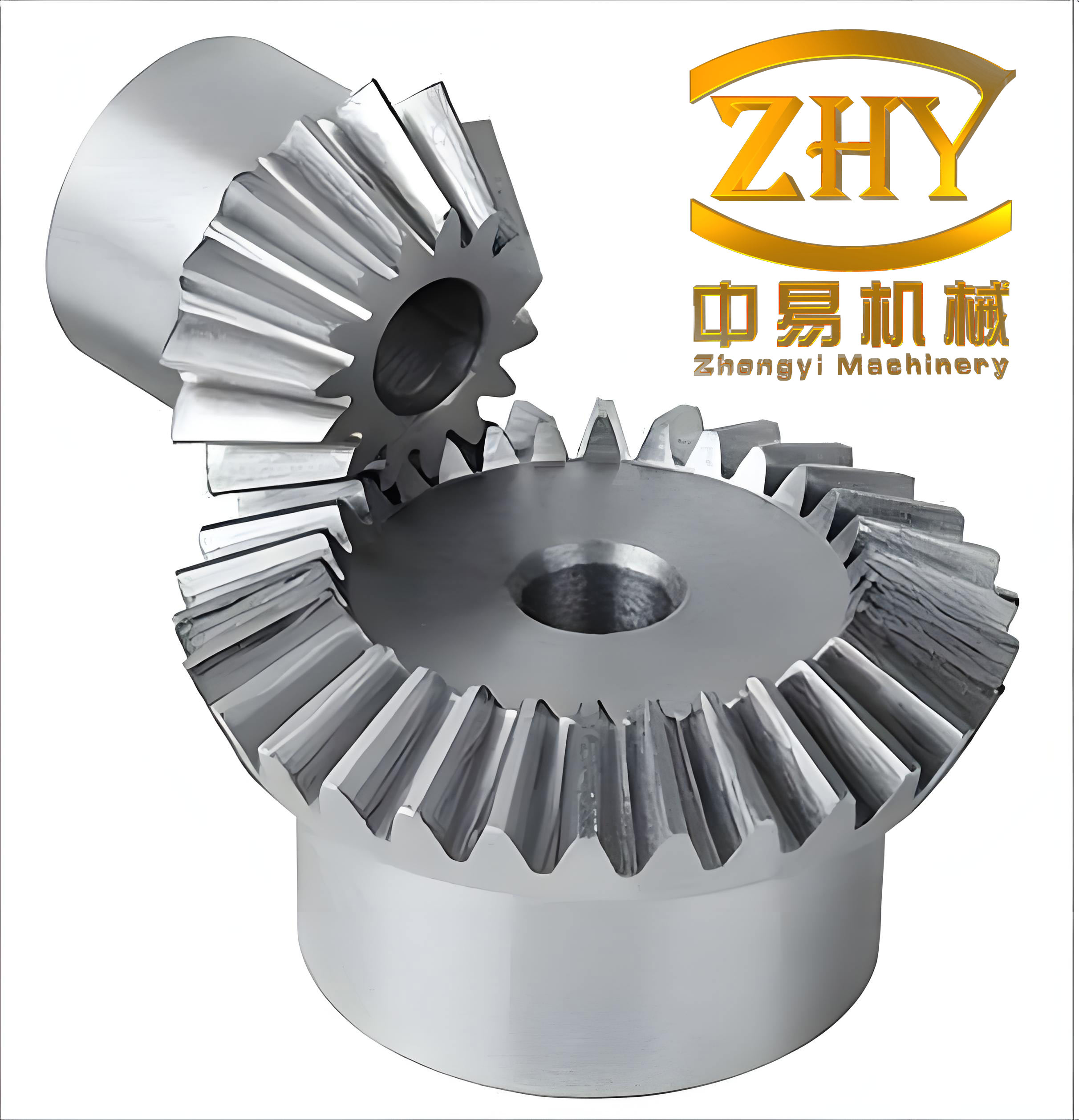
Visually, the reconstructed straight bevel gear model exhibited high congruence with the original NX8.0 prototype. The wireframe rendering accurately depicted the gear’s geometry, including the straight teeth radiating from the cone apex. By applying Phong shading and multiple light sources, we achieved a realistic appearance that highlighted surface variations and potential manufacturing defects. For instance, the root fillets and tooth profiles were clearly visible, allowing for qualitative assessment. The image below provides a visual representation of the reconstructed straight bevel gear model, demonstrating the effectiveness of our method in capturing intricate details.
Quantitatively, we evaluated the geometric accuracy by comparing vertex positions between the original and reconstructed models. Using a point-to-point distance metric, the average error was found to be less than 0.01 mm, which is negligible for most engineering applications involving straight bevel gears. This error primarily stems from the tessellation process in STL generation, where curved surfaces are approximated by planar facets. The equation for the Euclidean distance between a vertex in the original model $\vec{v}_o$ and its corresponding point in the reconstruction $\vec{v}_r$ is:
$$ d = \sqrt{(x_o – x_r)^2 + (y_o – y_r)^2 + (z_o – z_r)^2} $$
By calculating this for a sample of points on the straight bevel gear, we confirmed the high fidelity of our reconstruction. Furthermore, the software enabled interactive features such as rotation, scaling, and section views, which facilitated thorough inspection of the straight bevel gear from any orientation.
Mathematical Modeling and Algorithmic Details
The reconstruction of a straight bevel gear from STL data relies on mathematical principles from computational geometry and computer graphics. Key aspects include vector operations for normal calculations, matrix transformations for viewing, and interpolation for smooth rendering. For a straight bevel gear, the normal vectors are particularly important as they define the orientation of each triangular facet, influencing lighting and shading effects. The normal vector for a facet can be computed from the vertices using the cross product:
$$ \vec{n} = \frac{(\vec{v}_2 – \vec{v}_1) \times (\vec{v}_3 – \vec{v}_1)}{\| (\vec{v}_2 – \vec{v}_1) \times (\vec{v}_3 – \vec{v}_1) \|} $$
This unit normal ensures consistent shading across the gear surface. In cases where the STL data provides precomputed normals, as in our approach, we use them directly to maintain accuracy for the straight bevel gear model.
Projection and view transformations are implemented using homogeneous coordinates and 4×4 matrices. The modelview matrix in OpenGL combines modeling transformations (e.g., translation and rotation) with viewing transformations to position the straight bevel gear in the scene. For instance, rotating the gear around its axis involves a rotation matrix $R$ applied to all vertices. If $\theta$ is the rotation angle, the matrix for rotation about the z-axis is:
$$ R_z = \begin{bmatrix} \cos\theta & -\sin\theta & 0 & 0 \\ \sin\theta & \cos\theta & 0 & 0 \\ 0 & 0 & 1 & 0 \\ 0 & 0 & 0 & 1 \end{bmatrix} $$
This allows users to dynamically examine the straight bevel gear from different angles, enhancing the understanding of its spatial characteristics.
To optimize the rendering of the straight bevel gear, we employ algorithms for back-face culling and depth sorting. Back-face culling eliminates facets that are not visible from the current viewpoint, reducing the number of triangles processed by the graphics pipeline. This is especially beneficial for a straight bevel gear, as many internal facets may be occluded. The decision to cull a facet is based on the dot product between the normal vector $\vec{n}$ and the view direction $\vec{v}$:
$$ \text{if } \vec{n} \cdot \vec{v} > 0, \text{ facet is visible} $$
Otherwise, it is culled. This simple check improves rendering performance without compromising the visual quality of the straight bevel gear.
In terms of data handling, we analyzed the memory usage for storing the STL data of a straight bevel gear. Each facet requires storage for 12 floating-point numbers (3 for the normal and 9 for the vertices). For a model with $N$ facets, the total memory in bytes is $12N \times \text{sizeof(float)}$. Assuming a float is 4 bytes, this translates to $48N$ bytes. For a straight bevel gear with 50,000 facets, the memory requirement is approximately 2.4 MB, which is manageable on modern systems. The table below provides a comparative analysis of memory usage for different straight bevel gear models, highlighting the scalability of our method.
| Straight Bevel Gear Model | Number of Facets | Memory Usage (MB) |
|---|---|---|
| Coarse Resolution | 10,000 | 0.48 |
| Medium Resolution | 50,000 | 2.4 |
| Fine Resolution | 100,000 | 4.8 |
Discussion and Advantages of the Method
The proposed 3D reconstruction method for straight bevel gears offers several advantages over traditional approaches. Firstly, the use of OpenGL ensures hardware acceleration, resulting in fast rendering times even for complex models. This is critical for applications requiring real-time interaction, such as virtual prototyping of straight bevel gear systems. Secondly, the integration with Visual C++ provides a flexible development environment, allowing for easy customization and extension. For example, additional features like collision detection or finite element analysis can be incorporated to further analyze the straight bevel gear behavior under load.
Another significant benefit is the photorealistic rendering achieved through advanced lighting models. By simulating materials and light interactions, the reconstructed straight bevel gear model appears lifelike, aiding in visual inspections and presentations. This is particularly useful for identifying potential issues in gear design, such as uneven tooth surfaces or misalignments, before physical manufacturing. Moreover, the method supports standard STL formats, making it compatible with various CAD software used for designing straight bevel gears, thus promoting interoperability in digital manufacturing workflows.
However, there are limitations to consider. The accuracy of the reconstruction is inherently tied to the resolution of the STL tessellation. For straight bevel gears with highly curved surfaces, a coarse tessellation may lead to aliasing artifacts, where edges appear jagged. To mitigate this, adaptive tessellation techniques could be explored in future work, dynamically refining the mesh based on curvature criteria. Additionally, the current implementation focuses on static reconstruction; extending it to animate the straight bevel gear in motion would be valuable for dynamic simulation of gear trains.
In comparison to other reconstruction methods, such as those based on point clouds or volumetric data, our approach with STL and OpenGL provides a balance between simplicity and effectiveness. The straight bevel gear serves as an excellent test case due to its geometric complexity, but the method is applicable to a wide range of mechanical components. The table below contrasts our method with alternative techniques, emphasizing its suitability for straight bevel gear reconstruction.
| Reconstruction Method | Advantages | Disadvantages | Relevance to Straight Bevel Gear |
|---|---|---|---|
| STL with OpenGL | Fast rendering, easy implementation | Dependent on tessellation quality | Ideal for detailed gear models |
| Point Cloud Processing | High accuracy from scanning | Computationally intensive | Less efficient for gear teeth |
| Volumetric Representation | Good for internal structures | High memory usage | Overkill for surface-based gears |
Conclusion
In summary, this article presents a comprehensive method for reconstructing 3D models of straight bevel gears from STL data using Visual C++ and OpenGL. By leveraging the ASCII STL format, we efficiently extract geometric information and render it with high visual fidelity through optimized OpenGL pipelines. The experimental results confirm that the reconstructed straight bevel gear models accurately reflect the original designs, with minimal geometric errors and rapid rendering performance. The inclusion of mathematical formulations and tabular summaries underscores the technical rigor of the approach, while the emphasis on straight bevel gears highlights its practical relevance in mechanical engineering.
Future directions include enhancing the method with real-time simulation capabilities, such as simulating the cutting process for straight bevel gear manufacturing, and integrating with machine learning algorithms for automatic defect detection. Additionally, exploring cloud-based rendering could enable collaborative design reviews of straight bevel gear systems across distributed teams. Overall, this work establishes a solid foundation for digital twin applications involving straight bevel gears, contributing to the advancement of modern manufacturing engineering.