
Abstract:
The gear forming methods, gear shaving has been characterized by high processing efficiency and high economic value. This paper takes a certain type of helical gear as the research object, analyzes the axial gear shaving of helical gears, and investigates the dynamic characteristics during this process. The research and analysis results show that during the axial machining of the helical gear, with the increase in roll angle, the key processing parameters of the shaving cutter gradually decrease, while the key parameters of the processed helical gear remain basically unchanged. At different roll angles, the shaving cutters exhibit varying dynamic characteristic parameters such as force, acceleration, and speed. This research provides a theoretical basis and technical support for helical gear shaving processes and vibration noise reduction during the shaving process.
1. Introduction
Helical gears, as commonly used components in mechanical transmissions, possess advantages such as strong carrying capacity, durability, smooth transmission, low impact vibration noise, and high carrying capacity. These characteristics make them widely used in heavy-load applications. To obtain helical gears with high processing accuracy and excellent overall performance, numerous scholars at home and abroad have optimized and improved the materials, forming processes, heat treatment, and structural optimization of helical gears. Based on research into the gear shaving process of helical gears, this paper takes a specific type of helical gear as the research object and studies the dynamic characteristics of axial gear shaving, providing an important reference for the axial gear shaving process of helical gears.
2. Principle of Axial Gear Shaving Forming for Helical Gears
During the axial gear shaving process of helical gears, there exists a certain angle, known as the axial intersection angle, between the axis of the helical gear and the axis of the shaving cutter.
The axial intersection angle between the helical gear and the shaving cutter varies continuously depending on the processing position and the depth of the tooth profile being machined. To ensure high transmission accuracy of the helical gear processed by axial gear shaving, the corresponding parameters of the axial gear shaving process must change dynamically, thereby ensuring the high precision of the helical gear produced by axial gear shaving.
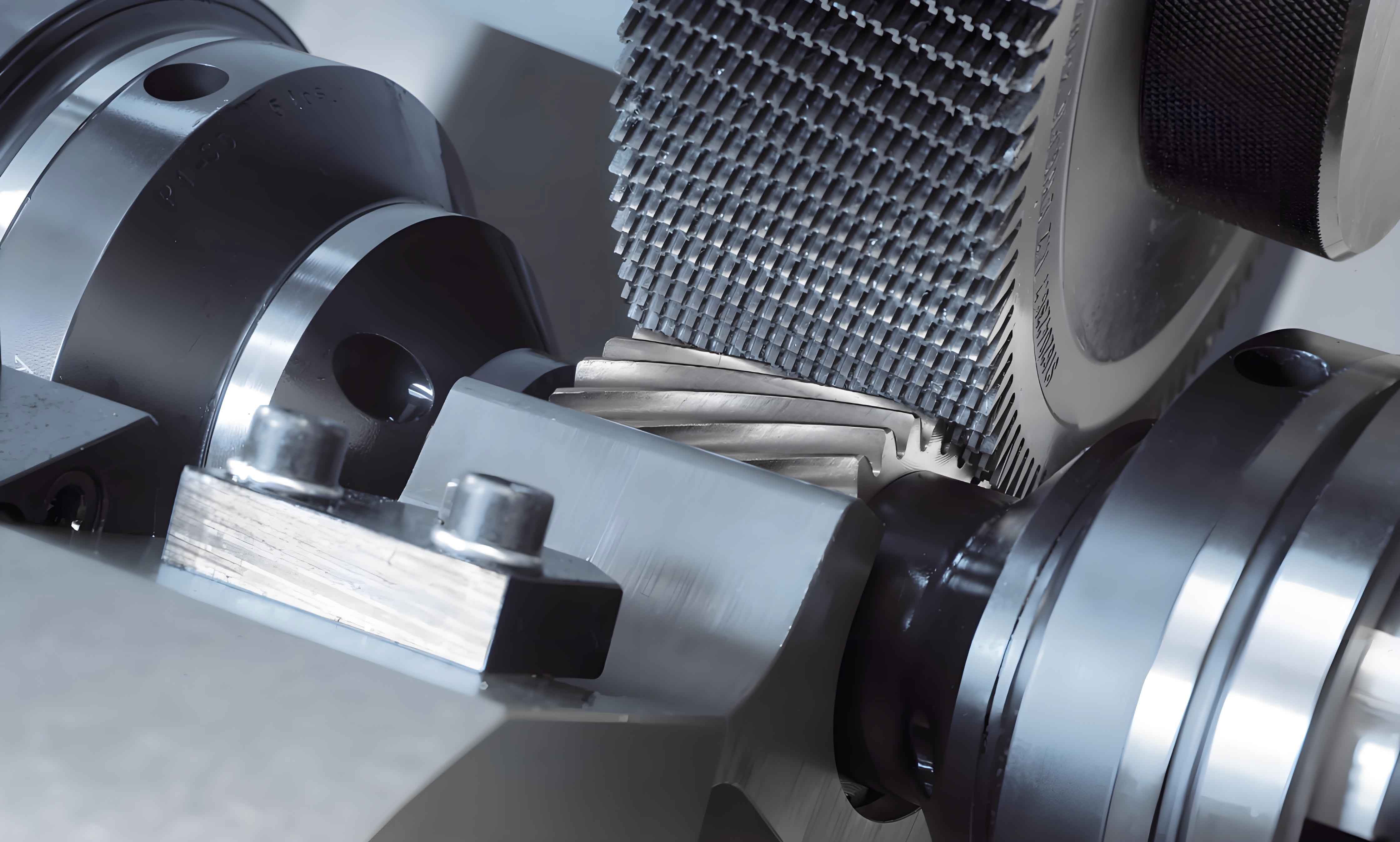
The axial gear shaving process of helical gears mainly consists of a shaving cutter and a helical gear to be processed with a fixed seat. The shaving cutter performs rotational motion around its own axis and translational motion along the axis of the helical gear, while the helical gear to be processed rotates around its own axis. The shaving cutter comes into contact with the helical gear to be processed, gradually forming the helical gear under the action of the shaving force and through simultaneous rotational and translational movements.
3. Axial Gear Shaving Forming of Helical Gears
Axial gear shaving forming is an economical and efficient precision forming method for helical gears. The shaving cutter is designed in the form of a helical cylindrical gear with a serrated tooth surface. To efficiently and precisely form the helical gear through gear shaving, the shaving cutter needs to undergo multiple刃磨, typically 4 to 10 times. In the axial gear shaving process of helical gears, the feed motion of the shaving cutter towards the helical gear to be processed is parallel to the axis of the helical gear, without radial motion of the shaving cutter. This makes the axial gear shaving process suitable for processing large gears with a wide width. The parameters of the shaving cutter studied in this paper for the axial gear shaving process of helical gears are presented in Table 1.
Table 1. Parameters of the Shaving Cutter for Axial Gear Shaving Process of Helical Gears
| Parameter | Value |
|---|---|
| Number of teeth | 43 |
| Normal module (mm) | 4.25 |
| Normal pressure angle (°) | 20 |
| Helix angle (°) | 15 |
| Normal tooth thickness at the pitch diameter of the shaving cutter (mm) | 6.579 |
| Final normal tooth thickness at the pitch diameter of the shaving cutter after刃磨 (mm) | 6.079 |
| Tip diameter of the shaving cutter (mm) | 197.7 |
| Final tip diameter of the shaving cutter after刃磨 (mm) | 195.961 |
Based on the parameters of the shaving cutter and the principle of axial gear shaving forming, the axial gear shaving process is performed on the helical gear. During the forming process, the shaving cutter undergoes resharpening to obtain the key parameters under different resharpening times, as shown in Table 2.
Table 2. Key Parameters under Different resharpening Times for Axial Gear Shaving Process of Helical Gears
| Item | New shaving cutter | 1st resharpening | 2nd resharpening | 3rd resharpening | 4th resharpening | Final resharpening |
|---|---|---|---|---|---|---|
| Starting diameter of the effective tooth form of the shaving cutter (mm) | 158.465 | 158.328 | 158.19 | 158.051 | 157.912 | 157.771 |
| Ending diameter of the effective tooth form of the shaving cutter (mm) | – | – | – | – | – | 84.775 |
| Required ending diameter of the effective tooth form of the shaving cutter (mm) | – | – | – | – | – | 84.539 |
| Starting diameter of the effective tooth form of the processed gear (mm) | 206.898 | 206.512 | 206.122 | 205.728 | 205.328 | 204.924 |
| Ending diameter of the effective tooth profile of the processed gear (mm) | 196.161 | 195.982 | 195.808 | 195.634 | 195.463 | 195.924 |
| Center distance (mm) | 100.15 | 100.15 | 100.15 | 100.15 | 100.15 | 100.15 |
| Axial intersection angle (°) | 15.0109 | 14.9981 | 14.9853 | 14.9724 | 14.9594 | 14.9463 |
From Table 2, it can be seen that during the axial gear shaving process, as the number of resharpening increases, the normal tooth thickness at the pitch diameter of the processed gear, the center distance between the helical gear and the shaving cutter, and the axial intersection angle between them all exhibit a gradual decreasing trend. The fine-tuning of these parameters in actual processing allows the coordinate parameters of the shaving cutter to better match the required coordinate parameters of the helical gear to be processed, resulting in higher accuracy of the processed helical gear.
4. Study on Dynamic Characteristics of Axial Gear Shaving Process of Helical Gears
Based on the process and parameters of the axial gear shaving of helical gears, simulation calculations were performed to obtain the force acting on the shaving cutter at different roll angles.
It can be seen that during the axial gear shaving process, the force acting on the shaving cutter varies at different roll angles. Overall, as the roll angle increases, the force acting on the shaving cutter exhibits alternating periodic changes in positive and negative tooth shapes.
To better understand the dynamic characteristics during the axial gear shaving process of helical gears, simulation calculations were performed to obtain the variation laws of acceleration and speed of the shaving cutter at different roll angles.
It can be seen that during the axial gear shaving process, the acceleration and speed of the shaving cutter vary at different roll angles. Overall, as the roll angle increases, both the acceleration and speed of the shaving cutter exhibit a trend of first increasing and then decreasing.
5. Conclusion
As an important component in the helical gear transmission system, helical gears directly impact the transmission efficiency, accuracy, and smoothness of the system. Helical gear transmission systems are widely used in heavy-load fields such as shipping, coal mining, engineering machinery, aerospace, and others, due to their excellent characteristics of high load-bearing capacity and fatigue life. Taking a certain type of helical gear as the research object and based on the axial gear shaving process for helical gears, this study investigates and analyzes the key parameters and dynamic characteristics of the axial machining and forming of helical gears. The study obtains the variation rules of key parameters and dynamic characteristics during the axial machining and forming process of helical gears. This provides valuable insights and technical support for aspects such as the shaping of helical gears through shaving, extending the life of shaving cutters, and reducing machining vibration and noise.