
Abstract
The research of topology modification method of internal gearing power honing based on multi-axis linkage. By establishing a mathematical model of the tooth surface for internal gearing power honing, analyzing the influence rule of each axis movement of the honing machine on the tooth profile, and proposing a topology modification method for internal gearing power honing based on multi-axis linkage, this thesis aims to improve the applicability of honing and reduce processing costs.
1. Introduction
With the continuous development of manufacturing technology, gear transmission systems are widely used in various industrial fields. The quality of gear tooth surfaces directly affects the transmission efficiency, noise, and service life of gear systems. Therefore, the research on gear tooth surface modification technology has become increasingly important. This thesis takes internal gearing power honing as the research object and proposes a topology modification method based on multi-axis linkage to improve the accuracy and performance of gear tooth surfaces.
Table 1. Research Background and Significance
| Research Background | Research Significance |
|---|---|
| Development of manufacturing technology | Improvement of gear transmission efficiency and service life |
| Wide application of gear transmission systems | Reduction of gear transmission noise |
| High requirements for gear tooth surface quality | Enhancement of gear system stability |
2. Basic Theory of Internal Gearing Power Honing
2.1 Overview
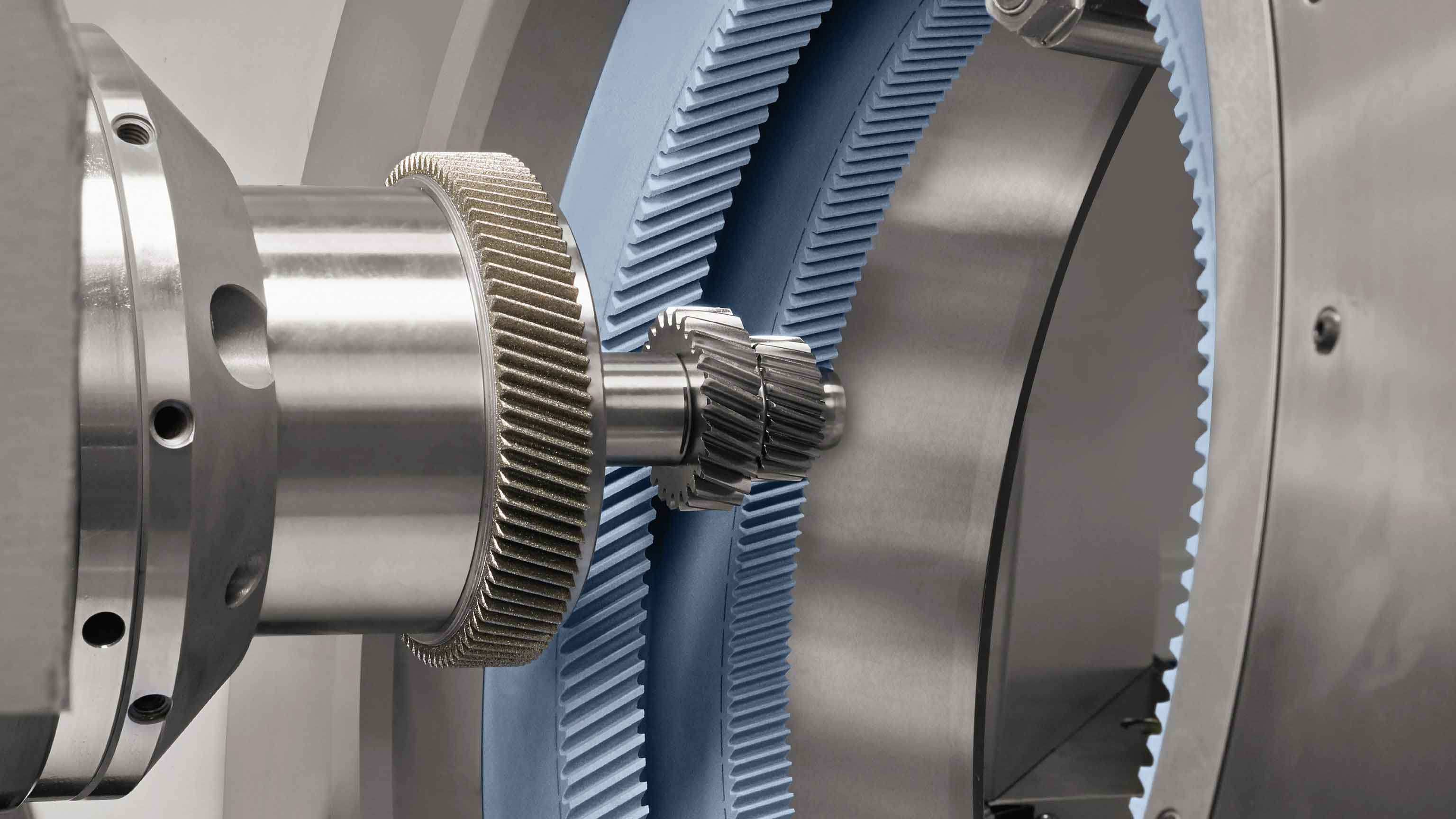
Internal gearing power honing is a precision machining method for gear tooth surfaces. It uses a honing wheel to mesh with the workpiece gear and perform honing processing through relative movement between the two. This method can effectively improve the accuracy and surface quality of gear tooth surfaces.
2.2 Principle of Internal Gearing Power Honing
The basic principle of internal gearing power honing is based on the conjugate meshing principle of spatial curved surfaces. A diamond dressing wheel with high manufacturing accuracy and the same parameters as the workpiece gear is used to dress the honing wheel. Then, the honing wheel is used to perform secondary enveloping processing with the tooth surface of the workpiece to obtain the desired tooth surface.
Table 2. Basic Principles of Internal Gearing Power Honing
| Principle | Description |
|---|---|
| Conjugate meshing principle | The relative movement between the honing wheel and the workpiece gear forms a conjugate tooth surface |
| Diamond dressing wheel | Used to dress the honing wheel to obtain the desired tooth profile |
| Secondary enveloping processing | The honing wheel and the workpiece gear mesh to form the final tooth surface |
2.3 Machining Methods
The machining methods of internal gearing power honing mainly include honing wheel dressing process and internal gearing power honing processing motion method. The dressing process determines the tooth profile of the honing wheel, while the processing motion method affects the final tooth surface quality.
3. Research Status
3.1 Research Status of Gear Honing Technology
In recent years, gear honing technology has been continuously developed and improved. Many scholars have conducted in-depth research on honing process parameters, honing wheel materials, and dressing methods to improve honing efficiency and accuracy.
3.2 Research Status of Tooth Surface Modification Technology
Tooth surface modification technology is an important means to improve gear performance. Traditional modification methods mainly rely on the modification of cutting tools, which leads to high manufacturing costs and long research and development cycles. Therefore, research on flexible modification methods has become a hot topic in recent years.
4. Mathematical Model and Sensitivity Analysis
4.1 Establishment of Mathematical Model
In this thesis, a mathematical model of the tooth surface for internal gearing power honing is established. Based on the conjugate meshing principle, the tooth surface mathematical model of the honing wheel is established, and the three-dimensional geometric model of the honing wheel is constructed.
4.2 Sensitivity Analysis
Sensitivity analysis is performed to study the influence of each axis movement of the honing machine on the tooth profile error. A sensitivity matrix is established to quantify the influence of each movement parameter on the tooth profile.
Table 3. Sensitivity Analysis Results
| Movement Axis | Influence on Tooth Profile Error |
|---|---|
| C1 (Honing Wheel Rotation Axis) | Significant influence on tooth profile shape |
| C2 (Workpiece Gear Rotation Axis) | Influence on tooth profile position |
| Lz (Axial Movement of Honing Wheel) | Influence on tooth profile curvature |
| Ewh (Radial Movement of Honing Wheel) | Influence on tooth width |
| φA (Inclination Swing of Honing Wheel) | Influence on tooth inclination |
5. Topology Modification Method Based on Multi-axis Linkage
5.1 Overview
To reduce interference and impact during meshing, improve lubrication conditions on the tooth surface, and reduce load and other adverse effects during gear meshing, topology modification of the gear is required. This thesis proposes a topology modification method for internal gearing power honing based on multi-axis linkage.
5.2 Modeling of Topology Modification Method
Based on the sensitivity analysis results, a dynamic programming model is established for the honing modification process. The tooth surface modification process is abstracted and established as a dynamic programming model, combined with the topological modification mathematical model and sensitivity matrix established in Chapter 4.
5.3 Simulation Calculation of Topology Modification Method
Three numerical simulation examples are given to verify the feasibility and universality of the proposed modification method. The same standard honing wheel is used to perform topology modification on different workpiece gears.
Table 4. Simulation Calculation Results
| Example | Average Modification Amount (μm) | Maximum Drum-shaped Difference (μm) | Average Modification Error (μm) | Iteration Convergence Times |
|---|---|---|---|---|
| Example 1 | 10.82 | 21.71 | 3.05 | 11 |
| Example 2 | 10.86 | 25.0 | 3.58 | 10 |
| Example 3 | 10.82 | 21.71 | 4.23 | 13 |
5.4 Flexibility Analysis of Topology Modification Method
The flexibility analysis of the topology modification method is performed based on the comparison and calculation results of the three groups of examples. The results show that the method can adapt to different workpiece gears and target tooth surfaces, demonstrating good flexibility in modification.
6. Conclusion and Outlook
This thesis proposes a topology modification method for internal gearing power honing based on multi-axis linkage. By establishing a mathematical model of the tooth surface, analyzing the influence rule of each axis movement on the tooth profile, and using dynamic programming to optimize the movement parameters, the desired tooth surface modification can be achieved. Simulation calculation results verify the feasibility and universality of the proposed method.
In future research, further optimization of the dynamic programming model and improvement of the calculation efficiency will be explored to better meet the needs of practical production.