
Abstract
The precision machining technology of gears directly affects the manufacturing accuracy of gears, which are fundamental industrial components. Currently, the most advanced precision gear machining processes include CNC gear grinding and CNC internal gearing power honing. While domestic research and application of CNC gear grinding equipment are well-established, the complexity of the internal gearing power honing process has led to long-term monopolization of key honing technologies by advanced foreign manufacturing companies. This significantly hinders the development of internal gearing power honing technology, numerical control systems, and machine tools in China. Therefore, research on key technologies such as CNC internal gearing power honing is crucial.
1. Introduction
Gear manufacturing accuracy is vital for the performance and lifespan of gear transmission systems. Among the advanced precision machining processes, internal gearing power honing stands out due to its ability to achieve high precision and surface quality. However, the complexity of this process and the lack of domestic research have restricted its widespread application. This thesis aims to systematically study the basic theory and key technologies of CNC internal gearing power honing, paving the way for domestic development and application of this technology.
Table 1: Comparison of Gear Precision Machining Processes
| Process | Advantages | Disadvantages |
|---|---|---|
| CNC Gear Grinding | High precision, good surface quality | High equipment costs, complex process |
| CNC Internal Gearing Power Honing | High efficiency, good surface finish | Complex technology, less research |
2. Basic Theory of Internal Gearing Power Honing
2.1 Process Principles
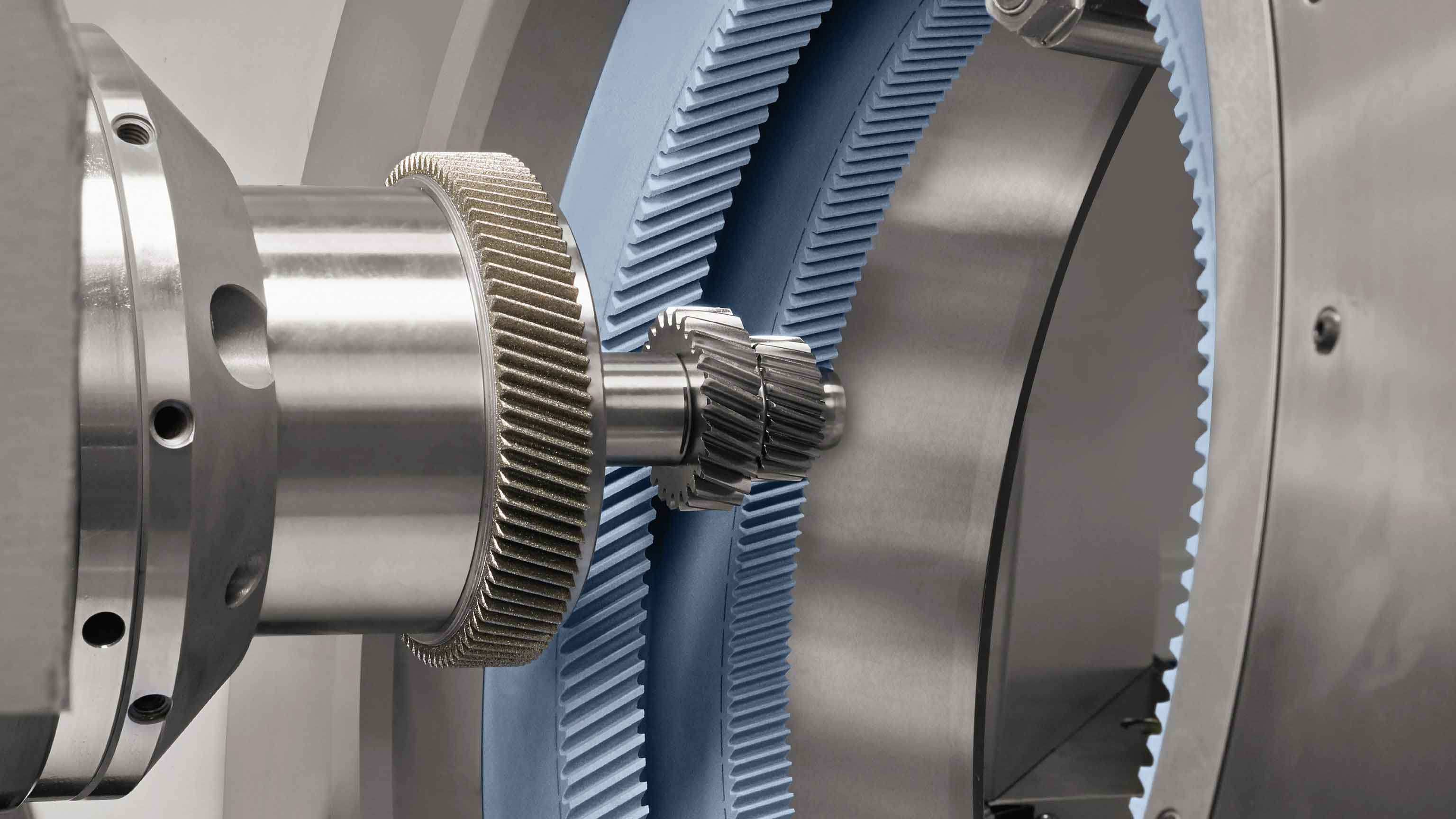
In internal gearing power honing, the tooth profile of the workpiece gear is mainly mapped from the tooth profile of the honing wheel. The contact between the honing wheel and the workpiece tooth surface is linear, allowing full tooth surface honing without axial feed of the honing wheel. However, to ensure uniform wear of the honing wheel grains and avoid damage, axial reciprocating feed motion is sometimes required.
2.2 Coordinate System and Mathematical Model
Based on the Y4830CNC machine tool, a spatial coordinate system for internal gearing power honing was established. Using the theory of conjugate surface engagement and standard helical involute gears, models for honing contact lines, honing texture, and honing wheel tooth surface were developed.
Table 2: Movement Axes of the CNC Internal Gearing Power Honing Machine
| Axis Label | Description |
|---|---|
| C1 | Honing wheel rotational axis |
| C2 | Workpiece rotational axis |
| X | Radial feed axis of honing wheel |
| Z1 | Axial feed axis of honing wheel |
| B | Swing axis of honing wheel base |
| A | Tilt axis of honing wheel |
| Z2 | Axial auxiliary movement axis of workpiece base |
3. Development of CNC System for Internal Gearing Power Honing
3.1 Hardware and Software Platform
The CNC system was developed on an ARM+DSP+FPGA embedded hardware platform using object-oriented programming. The system includes modules for human-machine interface (HMI) design, automatic programming for honing and dressing processes, and more.
3.2 Automatic Programming Technology
Automatic programming for internal gearing power honing reduces workload and error probability compared to manual programming. The process involves parameter input, calculation, code generation, compilation, and program downloading.
Table 3: Automatic Programming Steps
| Step | Description |
|---|---|
| Parameter Input | Enter basic parameters of workpiece, honing wheel, and dressing tool |
| Parameter Calculation | Calculate key path points based on process theory |
| Code Generation | Generate NC code based on calculated parameters |
| Compilation | Compile NC code for machine execution |
| Program Downloading | Download NC code to the machine for execution |
4. Study on the Formation Mechanism of Honing Texture
Through experimental validation and theoretical analysis, the influence of variable axis intersection angle honing on workpiece tooth surface texture was revealed. This provides a theoretical basis for improving tooth surface texture in internal gearing power honing.
5. Research on Tooth Surface Roughness Based on Engagement Grinding Theory
By analyzing the kinematics of engagement grinding in internal gearing power honing and combining it with grinding roughness theory, mathematical models for tooth profile and tooth orientation roughness were established. Experimental validation confirmed the models’ accuracy.
6. Optimization of Internal Gearing Power Honing Process
Based on advanced experimental design methods, honing experiments were conducted to establish a mathematical model for tooth surface profile error. Optimization algorithms were applied to determine the best honing parameters, achieving optimal process performance.
Table 4: Key Process Parameters and Their Influence
| Parameter | Influence on Process |
|---|---|
| Honing Wheel Speed | Affects material removal rate and surface quality |
| Axial Feed Rate | Influences texture uniformity and roughness |
| Radial Feed Rate | Determines the depth and efficiency of honing |
7. Conclusion
This thesis conducted in-depth research on the basic theory and key technologies of CNC internal gearing power honing. By developing a mathematical model, designing a CNC system, studying the formation mechanism of honing texture, analyzing tooth surface roughness, and optimizing process parameters.