
Abstract
In the automotive industry, spiral bevel gears play a crucial role in the drive system of vehicles, particularly in the rear axle assembly. However, distortion in these gears can lead to significant noise, reduced efficiency, and even failure of the entire drive system. Therefore, effective control of spiral bevel gear distortion is essential for ensuring driving safety and vehicle performance. This paper proposes a distortion control method for spiral bevel gears in automotive rear axles based on phased array ultrasonic technology. By leveraging the unique advantages of phased array ultrasonic technology, this method achieves high-precision distortion control of spiral bevel gears.
Keywords: phased array ultrasonic; spiral bevel gear; distortion control; vibration signal; noise reduction
1. Introduction
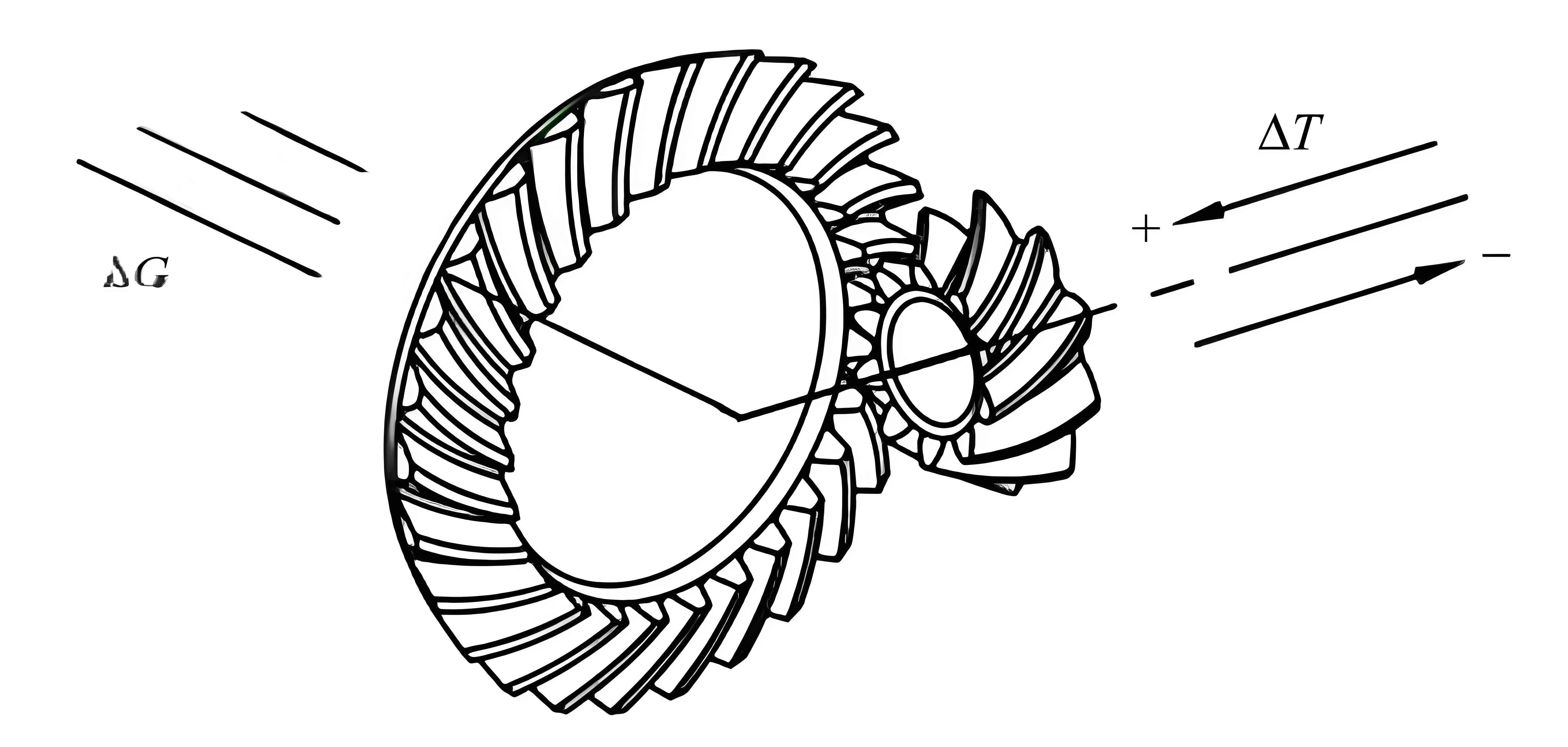
The spiral bevel gear is a complex and precision component widely used in automotive drive systems. During operation, due to various factors such as manufacturing errors, wear, and load changes, spiral bevel gears may experience distortion, affecting the normal transmission of torque and leading to noise, vibration, and even gear failure. Therefore, research on distortion control methods for spiral bevel gears has become a critical issue in the automotive industry.
Existing distortion control methods for spiral bevel gears have various limitations. For example, some methods rely on finite element analysis to measure the signal parameters of gear distortion but fail to eliminate noise in the signal, resulting in poor control effects. Other methods utilize chaos control algorithms or heat treatment distortion algorithms but lack multiple sampling processing of distortion orbits, leading to low control accuracy. To address these issues, this paper proposes a distortion control method for spiral bevel gears in automotive rear axles based on phased array ultrasonic technology.
2. Literature Review
Previous research on distortion control methods for spiral bevel gears has mainly focused on the following aspects:
| Reference | Method | Limitations |
|---|---|---|
| Fang X.R. et al. | Finite element analysis | Failure to eliminate noise in signals |
| Tian Y.P. et al. | Improved OGY chaos control algorithm | Lack of multiple sampling processing of distortion orbits |
| Mo Y.M. et al. | Offset principle and heat treatment distortion algorithm | Failure to extract features of distortion variables |
3. Methodology
3.1 Vibration Signal Acquisition and Preprocessing of Spiral Bevel Gears
3.1.1 Vibration Signal Acquisition Based on Phased Array Ultrasonic Technology
Phased array ultrasonic technology is used to collect vibration signals of spiral bevel gears. The specific steps are as follows:
- A phased array ultrasonic sensor is used to collect vibration signals of the gear and form an array element model with a fixed sequence.
- The phased array ultrasonic sensor can automatically control the beam of the vibration signal. Its basic structure includes a crystal array plane, a sound absorber, a matching layer, and electrode leads.
- The sensor probe can rotate 360°, and the wedge of the phased array probe uses an arcuate wedge matching the curvature of the gear surface, enabling the collection of circumferential and axial signal sound fields.
3.1.2 Noise Reduction Processing of Gear Vibration Signals
Due to the presence of a large number of noise signals in the vibration signals collected by phased array ultrasonic technology,异性diffusion noise reduction method is adopted to eliminate the noise. The specific steps are as follows:
- The anisotropic diffusion noise reduction algorithm uses partial differential equations to diffuse the local dispersion operator of the vibration signals of the spiral bevel gear.
- The adaptive algorithm is introduced into the edge measurement parameter to obtain an updated measurement parameter.
- The improved edge measurement parameter is used to make the proportion of noise signals in their corresponding areas infinitely reduced, completing the noise reduction of the vibration signals of the spiral bevel gear.
3.2 Feature Extraction of Gear Distortion Signals
After noise reduction, the curve matrix echo algorithm is used to extract the features of the distortion signals of the spiral bevel gear. The specific steps are as follows:
- When the surface of the gear is distorted, scattering waves are generated on its surface. The distortion scattering algorithm is used to calculate the scattering amplitude of the scattering waves to obtain the echo characteristics of the distortion signals.
- The curve matrix echo algorithm is used to locate the distortion signals, and the distance between the array element and the distortion position is calculated.
- The coordinates of the distortion signal position points are obtained, and the features of the distortion signals are extracted based on the coordinates.
3.3 Gear Distortion Control
Based on the extracted features of the distortion signals of the spiral bevel gear, this paper adopts resampling distortion control technology to control the distortion of the spiral bevel gear. The specific steps are as follows:
- Due to the relative motion between the signal and the phased array during the collection of vibration signals of the spiral bevel gear by phased array ultrasonic technology, Doppler effect exists in the extracted distortion signal features.
- The frequency variation formula of the Doppler effect is used to calculate the frequency deviation curvature of the distortion signal features.
- The frequency deviation curvature of the distortion signal of the spiral bevel gear is divided into m parts, and resampling is performed according to the frequency deviation benchmark points of different segments to obtain the corrected relevant parameters and complete the distortion control of the spiral bevel gear.
4. Experimental Verification
4.1 Experimental Setup
To verify the effectiveness of the proposed method, an experimental setup was established. The spiral bevel gear of a Volkswagen rear axle was selected as the test object. The phased array ultrasonic sensor was used to collect vibration signals of the spiral bevel gear. The experimental parameters are shown in Table 1.
| Hardware | Model | Quantity | Parameters |
|---|---|---|---|
| Phased array ultrasonic sensor | OLVMPUS | 1 | Resolution: 0.6μm; Output voltage: 0.3~10.0V; Channel number: 10; Range: 2mm |
| Signal transmission line | NNI | 1 | Length: 10m; Function: signal shielding |
| Data acquisition card | NNI 254 | 1 | Supply voltage: 30.0V |
4.2 Experimental Results
The vibration signals of the spiral bevel gear collected by the phased array ultrasonic sensor. It can be seen that there are two distortions in the collected vibration signals of the spiral bevel gear, which need to be controlled.
The distortion control effects of the proposed method, the method in reference, and the method in reference. It can be seen that the gear signal fluctuation is stable after the distortion control using the proposed method, and there is no distortion phenomenon. The distortion control effect of the proposed method is better than that of the methods.
The distortion control errors of the three methods are shown in Table 2. It can be seen that the control error of the proposed method is within 8μrad, which is smaller than the control errors of the methods. This indicates that the distortion control accuracy of the proposed method is higher.
| Experiment Number | Proposed Method / μrad | Method in Ref. / μrad | Method in Ref. / μrad |
|---|---|---|---|
| 1 | 8 | 17 | 27 |
| 2 | 7 | 16 | 27 |
| 3 | 6 | 18 | 25 |
| 4 | 8 | 19 | 25 |
| 5 | 7 | 17 | 26 |
| 6 | 7 | 18 | 24 |
| 7 | 7 | 20 | 25 |
| 8 | 6 | 19 | 25 |
| 9 | 8 | 17 | 24 |
| 10 | 7 | 19 | 24 |
Table 2: Gear Distortion Control Errors of Three Methods
5. Conclusion
The distortion control method for spiral bevel gears in automotive rear axles based on phased array ultrasonic technology. The method first collects vibration signals of the gear using phased array ultrasonic technology and eliminates noise using the anisotropic diffusion noise reduction method. Then, the curve quantitative algorithm is used to extract the features of the distortion signals of the spiral bevel gear. Finally, the resampling method is used to obtain the corrected relevant parameters and complete the distortion control of the spiral bevel gear. Experimental results show that the proposed method has good distortion control effect and high control accuracy.
The proposed method has significant advantages in distortion control of spiral bevel gears. It not only improves the control accuracy but also enhances the stability of the gear transmission system. This method has broad application prospects in the automotive industry and can provide important technical support for ensuring driving safety and improving vehicle performance.