
Abstract:
The dynamic impact of tooth surface wear on herringbone gear systems. By establishing a 12-degree-of-freedom bending-torsional-axial coupling model, we investigate the changes in vibration displacement and vibration velocity of herringbone gears under different operational cycles. Experimental validation is conducted using a vibration testing platform, revealing trends in vibration acceleration amplitude across various torque and speed conditions. The findings contribute to a deeper understanding of herringbone gear dynamics under wear conditions.
1. Introduction
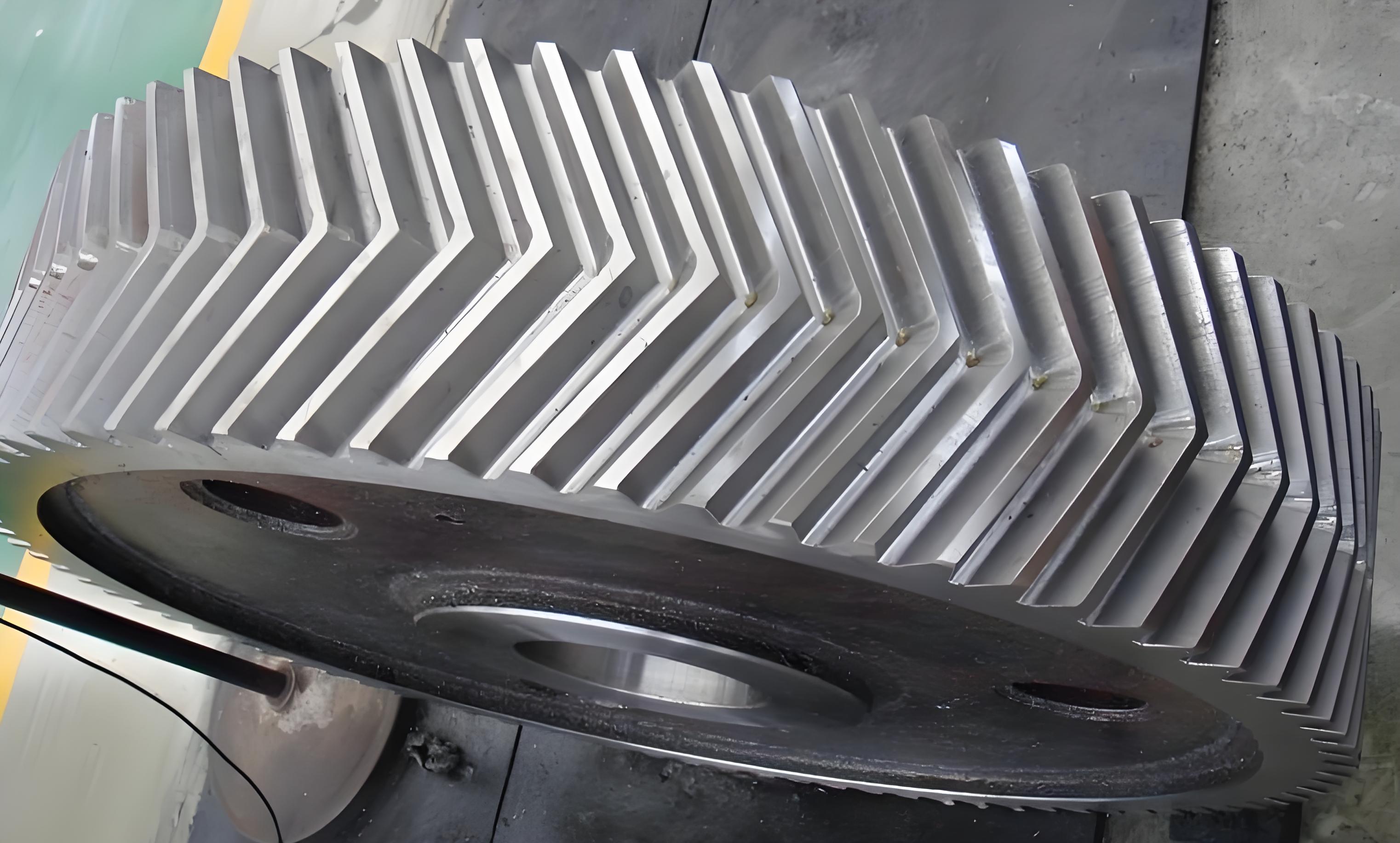
Herringbone gears, characterized by their zigzag tooth arrangement, offer enhanced load-carrying capacity and smooth operation in mechanical systems. However, tooth surface wear, a common phenomenon in gear transmissions, can significantly affect the dynamic performance of herringbone gear systems. Despite extensive research on gear dynamics, there remains a lack of comprehensive studies focusing on the impact of wear on herringbone gears, particularly with experimental validation. This paper addresses this gap by combining theoretical modeling and experimental testing to analyze the vibration characteristics of herringbone gear systems under wear conditions.
2. Literature Review
Previous studies on herringbone gears have primarily focused on theoretical modeling, with limited experimental validation. For instance, Liang, Ma, and Chen proposed various computational models to investigate the dynamics of herringbone gear systems, considering factors such as mesh stiffness, manufacturing errors, and support stiffness. However, these studies lacked experimental data to validate their theoretical findings. Wang et al. analyzed the influence of tooth surface friction on the periodic vibration of herringbone gear pairs, but their model simplified certain components, leading to discrepancies with real-world applications. Sun et al. numerically simulated the wear process of helical gears and studied its impact on dynamic characteristics using an 8-degree-of-freedom model, but their focus was not on herringbone gears.
3. Theoretical Modeling
3.1 Dynamics Model of Herringbone Gear Systems
The herringbone gear system studied in this paper consists of a driving gear and a driven gear, with power input at the left end of the driving gear shaft and output at the right end of the driven gear shaft. A 16-degree-of-freedom bending-torsional-axial coupling model is established, incorporating translations and rotations along the x, y, and z axes for both gears. The model considers parameters such as spiral angle (β), composite mesh error (ei), transverse pressure angle (αt), installation phase angle (ψ), and the angle between the end-face mesh line and the y-axis (φ).
Table 1: Gear Transmission Parameters and Performance
| Parameters and Performance | Gear 1 | Gear 2 |
|---|---|---|
| Number of teeth | 34 | 31 |
| Mass (m/kg) | 1.63 | 1.28 |
| Moment of inertia (I/kg·m^-2) | 0.0028 | 0.0019 |
| Transverse module (mt/mm) | 3.46 | 4 |
| Transverse pressure angle (αt/°) | 22.79 | – |
| Spiral angle (β/°) | 30 | – |
| Tooth width (B/mm) | 12×2+10 | – |
| Backlash (b/mm) | 0.05 | – |
| Manufacturing accuracy | IT5/IT6 | – |
| Material | 17CrMnTi | – |
| Heat treatment | Carburizing and quenching | – |
3.2 Deformation Analysis
The deformation of individual teeth under load is calculated by considering bending, shear, axial compression, and elastic contact deformation. The total deformation along the mesh line (δΞj) is given by:
δΞj = δBr,j + δBt,j + δR,j + δpe,j + hi,j
where δBr,j, δBt,j, δR,j, and δpe,j represent deformations due to bending, shear, base deformation, and contact at the load application point, respectively. hi,j accounts for additional factors.
4. Experimental Setup
4.1 Vibration Testing Platform
Tests were conducted using a gear contact fatigue test bench from Strama GmbH, Germany. The test bench comprises a servo gearbox and a test gearbox with two pairs of test gears. The test gearbox is driven by an electric motor, and the required load torque is provided by a hydraulic torque converter. Acceleration sensors (Kistler Typ 870350M5) are used to capture vibration signals from the test gearbox.
4.2 Sensor Placement
Acceleration sensors are positioned to measure vibrations in specific directions. For instance, Sensor 1 corresponds to the vibration in the x-direction of the driving gear, while Sensor 2 measures the vibration in the x-direction of the driven gear.
5. Results and Discussion
5.1 Vibration Displacement Analysis
By analyzing the vibration displacement of herringbone gears along the mesh line, we observed significant changes with increasing operational cycles. Initially, as the gears wear in, the vibration displacement decreases due to the conforming of tooth surfaces. However, as wear progresses, the vibration displacement increases, indicating a deterioration in gear performance.
5.2 Vibration Velocity Analysis
Vibration velocity measurements reveal similar trends. From an initial running state to 3×10⁷, the vibration velocity increases by 1.6 times, highlighting the significant impact of wear on gear dynamics.
5.3 Vibration Acceleration Analysis
The vibration acceleration amplitude of herringbone gear systems was measured under different input torque and speed conditions. The results indicate that, when the input torque is constant, the vibration acceleration amplitude increases with the input speed. Conversely, when the input speed is constant, the vibration acceleration amplitude remains unchanged with increasing input torque.
5.4 Comparison of Theoretical and Experimental Data
Theoretical calculations of vibration acceleration amplitudes were compared with experimental data. The results show good agreement between the two, validating the accuracy of the theoretical model. This comparison reinforces the reliability of the findings presented.
6. Conclusion
The vibration characteristics of herringbone gear systems considering tooth surface wear. By combining theoretical modeling and experimental testing, we revealed significant trends in vibration displacement, vibration velocity, and vibration acceleration amplitude with increasing operational cycles. The findings highlight the importance of considering tooth surface wear in the design and analysis of herringbone gear systems to ensure optimal performance and reliability.
Future Work:
Further research is needed to investigate the impact of different wear patterns and severity on herringbone gear dynamics. Additionally, the integration of advanced materials and surface treatments to mitigate wear and extend gear life should be explored.