
Abstract
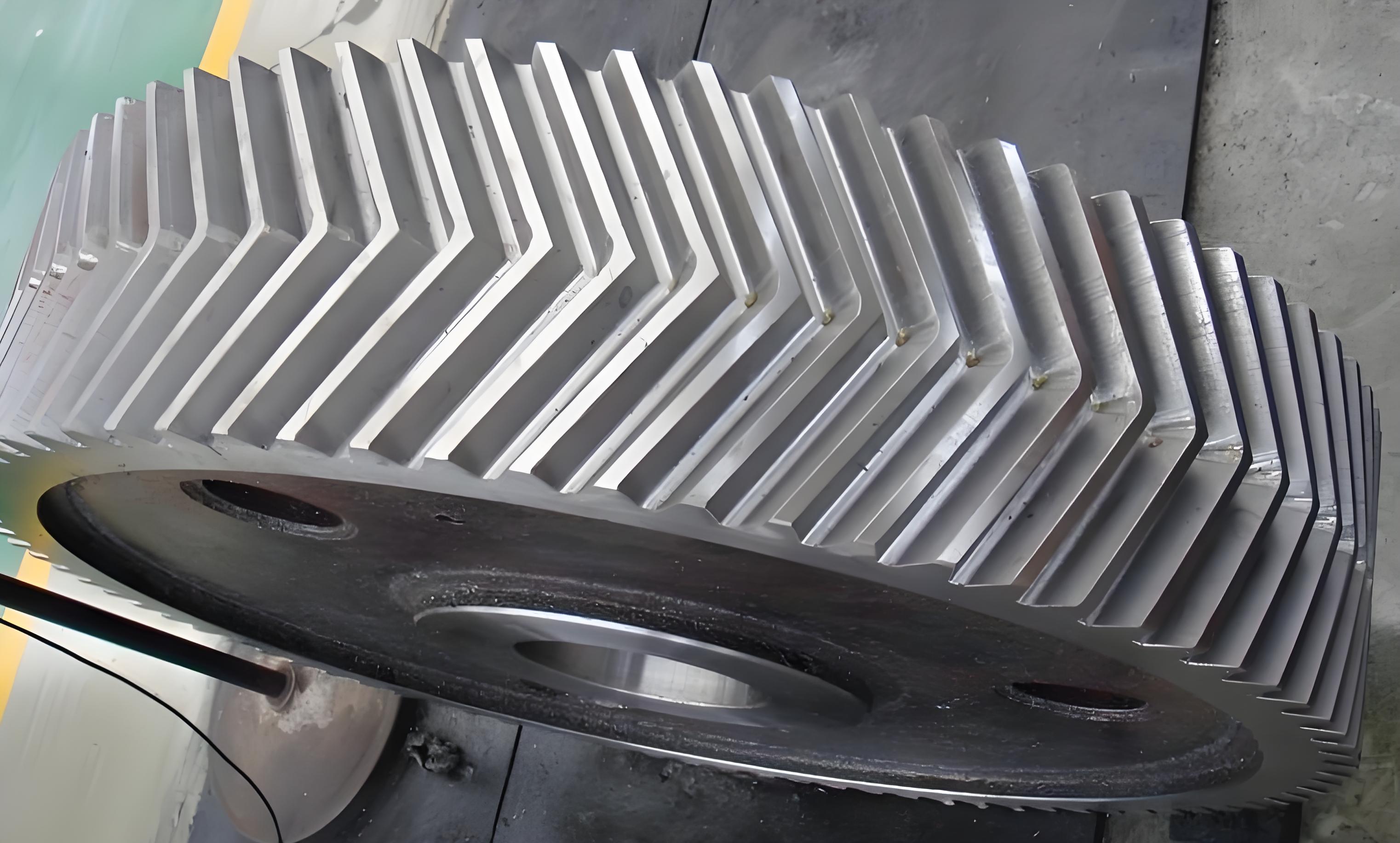
Herringbone gears, characterized by high bearing capacity and minimal axial load, are widely utilized in heavy-duty equipment such as ship power systems and aerospace applications. The neutrality of the tooth surfaces on both sides of a herringbone gear directly influences the uniformity of contact load distribution, impacting vibration, noise, and ultimately, the service life of the gear. Due to不对称 issues in the contact line of the same-side tooth surface across gear teeth on both sides of a herringbone gear after processing, eccentric loads, axial vibrations, and other issues arise during meshing transmission, reducing the stability and reliability of the transmission system. Therefore, this paper holds significant theoretical and engineering importance for the design and manufacture of herringbone gears by exploring the measurement and evaluation of symmetry errors in gear teeth from a performance-oriented perspective.
1. Introduction
1.1 Research Background and Significance
Herringbone gears are critical components in various mechanical transmission systems. Ensuring the symmetry of their tooth surfaces is vital for stable and reliable transmission. However, due to processing imperfections, symmetry errors often occur, leading to issues such as uneven load distribution, vibration, and noise. Therefore, researching accurate measurement and evaluation methods for the symmetry of herringbone gears is crucial for improving transmission performance and extending equipment life.
1.2 Research Status at Home and Abroad
With technological advancements, scholars at home and abroad have conducted in-depth research on the measurement of herringbone gears. Due to limitations in automation and accuracy, herringbone gears are still considered special cases, akin to two helical gears. Additionally, new methods have been proposed to improve the processing and manufacturing of herringbone gears, enhancing the symmetry of their tooth surfaces. Ma Wei et al. discussed a method for measuring large-diameter herringbone gears using small-diameter ones, addressing the challenge of measuring end symmetry for large-module, large-diameter herringbone gears.
1.3 Main Research Content of This Paper
This paper focuses on the measurement and evaluation of symmetry errors in herringbone gears, aiming to provide a theoretical and experimental basis for improving transmission performance. The main research contents include:
- Defining the contact line and symmetry error of herringbone gears.
- Establishing a mathematical model for the contact line of herringbone gears.
- Developing a measurement method for the symmetry error of the contact line.
- Conducting experimental verification and uncertainty analysis.
2. Definition of Contact Line and Its Symmetry Error
2.1 Definition of Contact Line of Herringbone Gear
The contact line of a herringbone gear refers to the trajectory formed by the contact point between a pair of meshing gears as they rotate. It is crucial for analyzing the load distribution and transmission performance of herringbone gears.
2.2 Symmetry Error of Contact Line
2.2.1 Symmetry Error of Individual Gear Teeth
The symmetry error of an individual gear tooth refers to the deviation of the contact line from the ideal symmetrical position. This deviation can be quantified by measuring the distance between the actual contact line and the ideal symmetrical line.
2.2.2 Difference in Symmetry Error Between Adjacent Teeth
In addition to the symmetry error of individual gear teeth, the difference in symmetry error between adjacent teeth is also important. This difference reflects the uniformity of the symmetry error along the tooth profile, which affects the overall transmission performance of the herringbone gear.
3. Theoretical Research on Evaluation Method Based on Contact Line Symmetry
3.1 Mathematical Model of Herringbone Gear Contact Line
Based on the definition of the contact line, a mathematical model is established to describe its trajectory in a three-dimensional coordinate system. This model is essential for subsequent measurements and evaluations.
3.2 Determination of Evaluation Interval for Contact Line
To ensure the accuracy of measurements, it is necessary to determine an appropriate evaluation interval for the contact line. This interval should cover the entire tooth profile while avoiding redundancy.
3.3 Extraction of Discrete Measurement Points on Contact Line
Based on the mathematical model, discrete measurement points are extracted along the contact line. These points serve as the basis for subsequent fitting and error calculations.
3.4 Least Squares Fitting and Error Calculation of Measurement Points
Using the least squares method, the actual contact line is fitted based on the discrete measurement points. The symmetry error is then calculated by comparing the fitted line with the ideal symmetrical line.
3.4.2 Symmetry Error of Contact Line
The symmetry error of the contact line is obtained by quantifying the deviation between the actual contact line and the ideal symmetrical line. This error provides a quantitative basis for evaluating the symmetry of herringbone gears.
4. Measurement Principle of Contact Line Symmetry
4.1 Measurement Instrumentation and Coordinate System
To measure the symmetry error of the contact line, specialized measurement instrumentation is required. A coordinate system is established to describe the position and orientation of the herringbone gear during measurement.
4.2 Axial Measurement Reference
To ensure the accuracy of measurements, an axial measurement reference is established. This reference serves as the basis for positioning and aligning the herringbone gear during measurement.
4.3 Measurement Principle of Contact Line
The measurement principle of the contact line involves using a sensor to detect the position of the contact point between the meshing gears as they rotate. The sensor data is then processed to obtain the trajectory of the contact line.
5. Measurement Software
5.1 Overall Structural Design of Measurement Software
The measurement software is designed to automate the measurement process, reduce human error, and improve measurement efficiency. The software includes modules for data acquisition, processing, and analysis.
5.1.2 Library Functions of Measurement Software
The measurement software incorporates various library functions to facilitate data processing and analysis. These functions include mathematical operations, data fitting, and error calculation.
5.1.3 Measurement Motion Control Program
The measurement motion control program controls the movement of the measurement instrumentation during the measurement process. It ensures that the sensor follows the predetermined trajectory and collects data at the required intervals.
5.2 Measurement Process Control
5.2.1 Establishment of Axial Measurement Reference
Before starting the measurement, the axial measurement reference is established to ensure the accuracy of subsequent measurements.
5.2.2 Contact Line Measurement Motion Control
During the measurement process, the sensor follows the predetermined trajectory to collect data on the contact line. The measurement data is then processed to obtain the symmetry error.
6. Measurement Experiments
6.1 Experimental Conditions
The experimental conditions include the selection of measurement instrumentation, the preparation of herringbone gears, and the setup of the measurement system.
6.2 Measurement Results of Contact Line Symmetry Error
The measurement results show the symmetry error of the contact line for different gear teeth. Tables and charts are used to present the data intuitively.
Table 1: Measurement Results of Contact Line Symmetry Error (Small Module Gear)
| Tooth Number | Measured Symmetry Error (mm) | Standard Deviation (mm) | Standard Uncertainty (mm) | Expanded Uncertainty (mm) |
|---|---|---|---|---|
| 1 | -0.0098 | 0.0002 | 0.0002 | 0.0004 |
| … | … | … | … | … |
| 18 | -0.0085 | 0.0010 | 0.0010 | 0.0020 |
Table 2: Measurement Results of Contact Line Symmetry Error (Large Module Gear)
| Tooth Number | Measured Symmetry Error (mm) | Standard Deviation (mm) | Standard Uncertainty (mm) | Expanded Uncertainty (mm) |
|---|---|---|---|---|
| 1 | -0.0257 | 0.0010 | 0.0017 | 0.0034 |
| … | … | … | … | … |
| 27 | -0.0274 | 0.0008 | 0.0008 | 0.0016 |
6.3 Comparison of Two Measurement Methods
To verify the accuracy and reliability of the proposed measurement method, it is compared with the traditional cross-sectional method. The results show that the proposed method has higher measurement accuracy and stability.
6.4 Verification Experiments
Verification experiments are conducted to further validate the proposed measurement method. The experimental results are consistent with the theoretical analysis, confirming the feasibility and accuracy of the method.