
Abstract
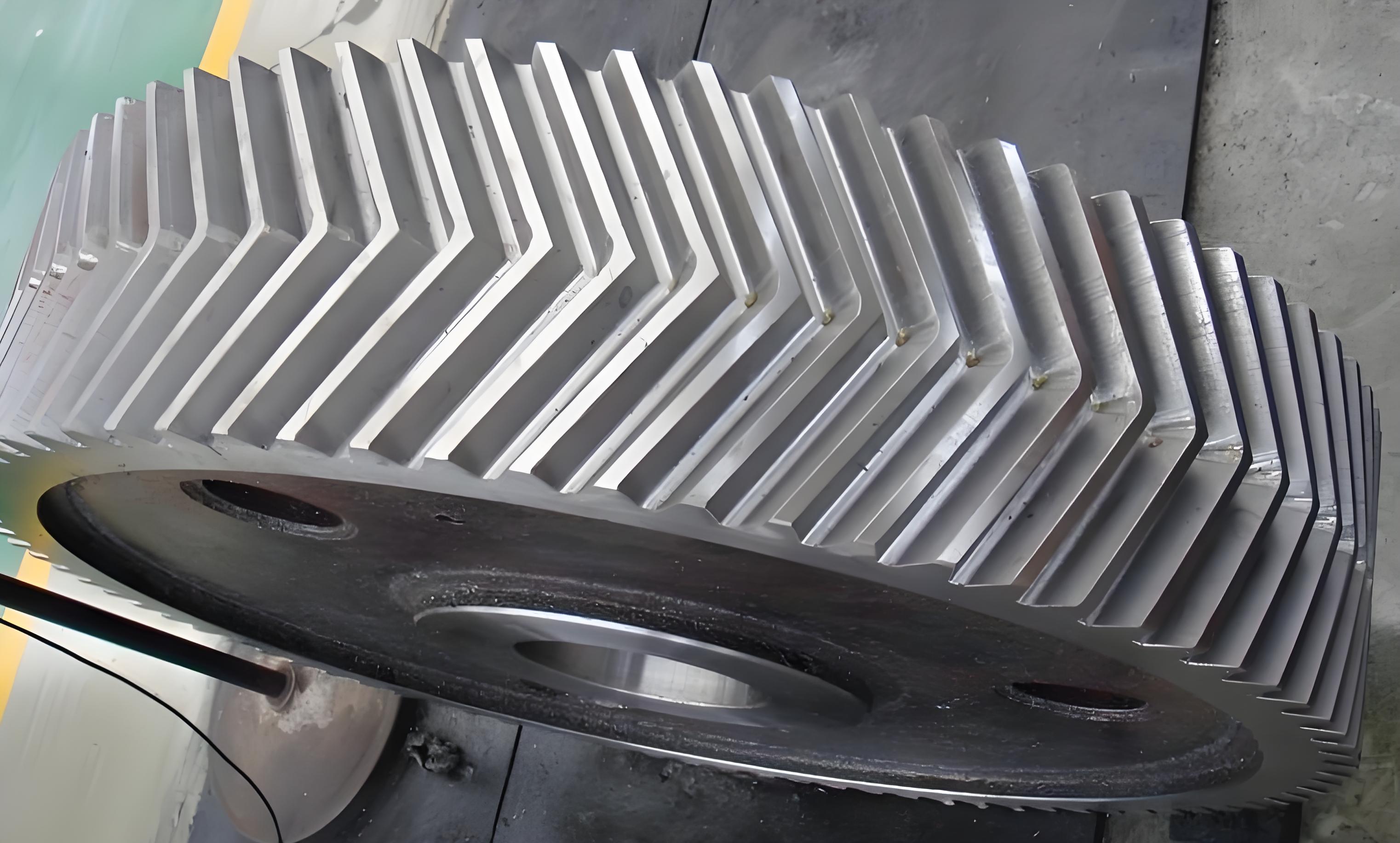
Tooth surface twisting is a processing error that arises during the formation and grinding of spiral herringbone gears. To minimize this distortion and enhance grinding accuracy, a gear reverse twisting processing calculation method is proposed. Based on reverse thinking, this method aims to reduce processing errors caused by tooth surface twisting. By analyzing the meshing coordinate system of herringbone gears during form grinding, solving for the contact line at multiple positions on the standard gear tooth surface, and considering tooth surface twisting and anti-twisting, a reverse distortion model is established. This model improves herringbone gear grinding accuracy through curvature calculations, spiral modification amounts, and adherence to herringbone gear principles.
1. Introduction
Herringbone gears are widely used in industrial applications due to their high torque capacity, smooth operation, and ability to handle heavy loads. However, tooth surface twisting, a common processing error, can significantly affect gear performance. This error arises due to variations in the spiral path of the grinding wheel during the manufacturing process. To address this issue, various methods have been proposed, including contact line optimization and tooth profile modification. However, there is a need for a comprehensive approach that can effectively reduce tooth surface twisting while maintaining high grinding accuracy.
2. Contact Line Analysis in Form Grinding of Herringbone Gears
2.1 Establishment of Spatial Meshing Coordinate System
To understand tooth surface twisting, it is crucial to establish a spatial meshing coordinate system for herringbone gears. This system allows for the accurate representation of the gear’s geometry and motion during grinding. The coordinate system is based on the gear’s axis of rotation, and it takes into account the spiral nature of the herringbone gear teeth.
2.2 Solving for the Contact Line
The contact line is the path where the grinding wheel interacts with the gear tooth surface. It is critical to solve for this line accurately to identify potential sources of tooth surface twisting. Using spatial coordinate system transformation matrices, the grinding process equation for herringbone gears can be derived. Unlike straight-cut gears, the contact line on a herringbone gear’s tooth surface is not a straight line but a complex curve.
2.3 Equation of the Tooth Surface
Based on the relationship between the grinding wheel and the tooth surface, the tooth surface equation can be derived. This equation describes the shape and orientation of the tooth surface, taking into account factors such as the angle between the grinding wheel and the tooth surface and the axial feed of the grinding wheel along the workpiece.
3. Tooth Surface Twisting and Counter-Twisting
3.1 Principle of Tooth Surface Twisting
Tooth surface twisting occurs when the spiral path of the grinding wheel deviates from the intended path, resulting in a distorted tooth surface. This distortion can lead to increased transmission errors and reduced gear efficiency.
3.2 Calculation of Tooth Surface Twisting Amount
To quantify tooth surface twisting, the twisting amount at any point on the tooth surface needs to be calculated. This is done by considering the changes in the center distance between the grinding wheel and the gear during spiral line drum-shaped modification. The rotation angle and distance of a point on the tooth surface are determined, and the twisting amount is calculated based on these parameters.
3.3 Calculation of Tooth Surface Counter-Twisting Amount
To counteract tooth surface twisting, a counter-twisting method is proposed. This method involves reversing the grinding process and observing the effect of counter-twisting on the tooth surface. A new spatial meshing coordinate system is established, and the grinding wheel’s equation is modified to account for counter-twisting. The counter-twisting amount is calculated similarly to the twisting amount but in the opposite direction.
Table 1. Parameters of the Herringbone Gear
| Parameter | Large Gear | Small Gear |
|---|---|---|
| Number of teeth (z) | 57 | 35 |
| Module (m) | 3 mm | 3 mm |
| Pressure angle (α1) | 20° | 20° |
| Helix angle (β1) | 20° | 20° |
| Tooth width (b1) | 35 mm | 35 mm |
Table 2. Different Working Conditions
| Condition | Speed (r/min) | Power (kW) |
|---|---|---|
| Condition 1 | 900 | 10 |
| Condition 2 | 1,500 | 15 |
| Condition 3 | 1,200 | 20 |
| Condition 4 | 1,000 | 22 |
4. Case Study Analysis
4.1 Monte Carlo Method Optimization
The Monte Carlo method is used to optimize the modification parameters and analyze their impact on manufacturing tolerances. The results show that increasing spiral line modification amount is not conducive decreasing transmission errors, K_Hβ, and maximum tooth surface load, all of which tend to increase. In contrast, increasing involute drum-shaped modification amount is beneficial for reducing transmission errors and K_Hβ but leads to an increase in maximum tooth surface load. Neither spiral line slope nor involute slope has a significant impact on transmission errors, K_Hβ, or maximum tooth surface load. The optimal modification values obtained using the Monte Carlo method are a modification amount of 1.6 μm and a spiral line slope of 2°.
4.2 Reduction of Machining Errors through Tooth Surface Counter-Twisting
To verify the effectiveness of tooth surface counter-twisting in reducing machining errors, experimental comparisons are conducted. The results show that the distance between the twisted tooth profile and the standard tooth profile is 32.15 μm, while the distance between the counter-twisted tooth profile and the standard tooth profile is 18.12 μm. This represents a 43.63% reduction in gap error, proving that tooth surface counter-twisting can effectively minimize tooth surface twisting errors.
4.3 Finite Element Analysis
Finite element analysis is performed on the herringbone gears after modification, including both tooth surface twisting and counter-twisting, as well as the unmodified gears. The results show that tooth surface counter-twisting can significantly reduce transmission error peak-to-peak values by 71.95% compared to tooth surface twisting. Additionally, the transmission error decreases as the gear is modified, and after tooth surface counter-twisting, the transmission error is significantly reduced. The contact area of tooth surfaces increases under different working conditions, resulting in more uniform tooth surface contact and reduced tooth surface loads for conditions 1, 3, and 4 by 16.9%, 39.3%, and 16.7%, respectively. This demonstrates that counter-twisting enhances gear transmission stability and extends gear lifespan.
5. Conclusion
The design method for reducing tooth surface twisting in herringbone gears during form grinding is proposed and verified through experimental and finite element analysis. The method involves establishing a spatial meshing coordinate system, solving for the contact line, and calculating tooth surface twisting and counter-twisting amounts. The results show that tooth surface counter-twisting can effectively minimize tooth surface twisting errors, reduce transmission errors, and improve gear transmission stability and lifespan.
This research contributes to the field of herringbone gear manufacturing by providing a comprehensive approach to reducing tooth surface twisting errors. Future work could focus on optimizing the counter-twisting method further and exploring its application in other types of gears.