
Abstract
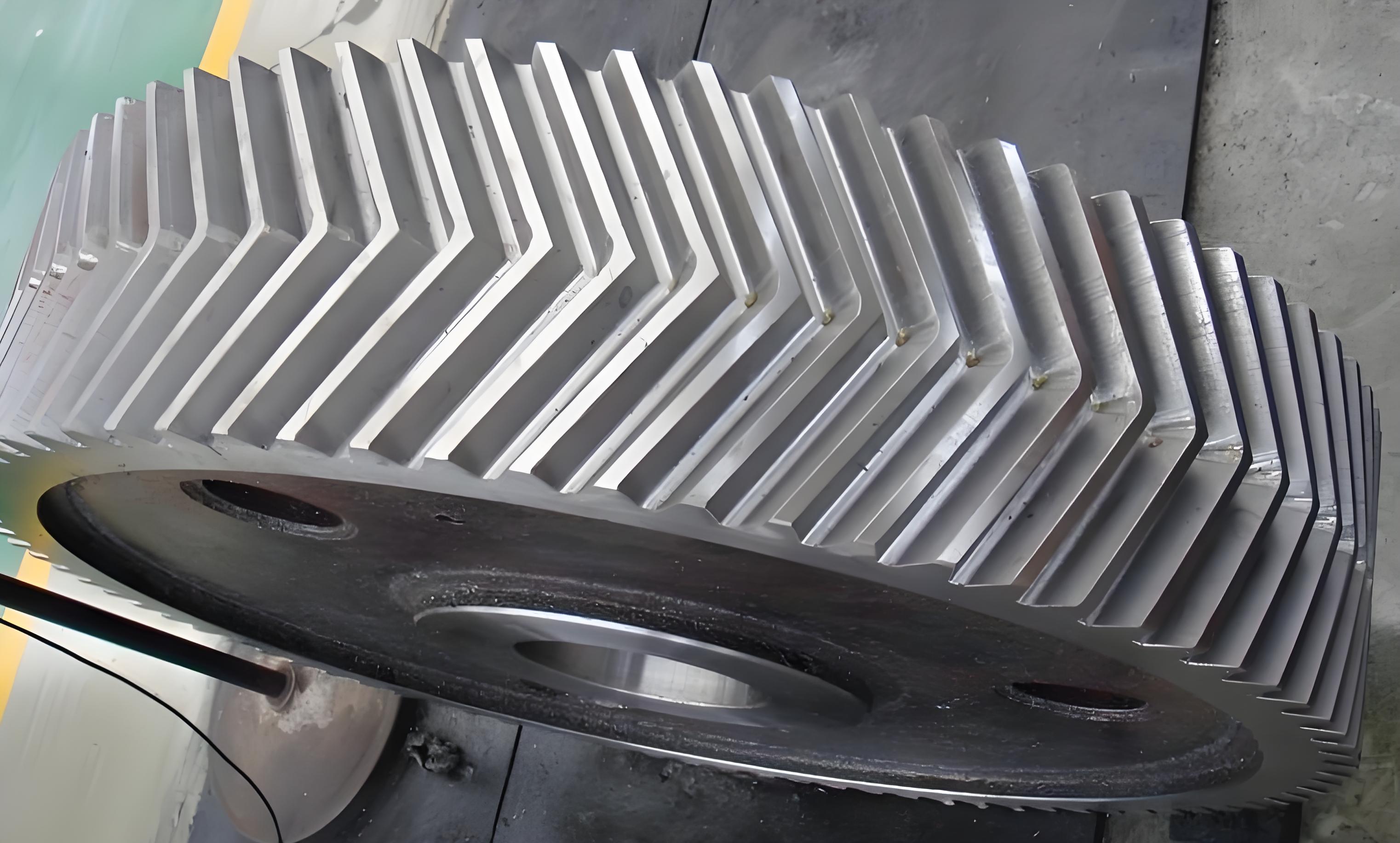
The use of herringbone gear planetary systems is prevalent in high-speed and heavy-duty transmissions, such as in aerospace, ships, and construction machinery, due to their stable transmission performance, compact structure, and strong bearing capacity. However, the complex structure and demanding working conditions of these systems can lead to cracks and pitting corrosion concentrated on the same tooth, ultimately affecting the gear auxiliary transmission system’s stability. This paper presents a comprehensive study on the time-varying mesh stiffness and vibration characteristics of herringbone gear planetary systems with crack-pitting coupling.
Keywords: Crack-pitting coupling; Herringbone gears; Planetary gear systems; Time-varying mesh stiffness; Vibration characteristics; Vibration test
1. Introduction
1.1 Research Purpose and Significance
The stability and reliability of herringbone gear planetary systems are crucial for the performance of various industrial applications. However, cracks and pitting corrosion are common failure modes in such systems, especially when they occur simultaneously on the same tooth. This coupling effect can significantly alter the time-varying mesh stiffness and vibration characteristics of the gear system. Therefore, it is essential to understand and study the impact of crack-pitting coupling on herringbone gear planetary systems.
1.2 Research Status at Home and Abroad
1.2.1 Research Status of Time-Varying Mesh Stiffness Calculation Methods
The calculation of time-varying mesh stiffness is a fundamental aspect in the study of gear dynamics. Various methods have been proposed, including the potential energy method, finite element method (FEM), and analytical methods. However, the accuracy and efficiency of these methods can vary depending on the complexity of the gear system and the specific failure modes present.
1.2.2 Research Status of Dynamic Modeling of Gear Transmission Systems
Dynamic modeling of gear transmission systems has been an active research area for decades. Models with increasing complexity have been developed to capture various phenomena, such as time-varying mesh stiffness, error, torsional stiffness, backlash, and comprehensive meshing errors. However, the inclusion of crack-pitting coupling in these models remains challenging.
1.3 Existing Research Problems
Despite the significant progress in the field, there are still several challenges and limitations in the study of herringbone gear planetary systems with crack-pitting coupling. These include the lack of accurate models to capture the coupling effect, the complexity of the gear system, and the difficulty in conducting experimental validation.
2. Theoretical Background and Methodology
2.1 Working Principle of Herringbone Gear Planetary Systems
The herringbone gear planetary system consists of a fixed internal gear ring, a rotating sun gear, three equally spaced planetary gears, and a planetary carrier. The power is input through the sun gear, distributed to each planetary gear, and then combined at the planetary carrier for output. The internal gear ring remains stationary.
2.2 Calculation of Time-Varying Mesh Stiffness
2.2.1 Integral Method for Herringbone Gears
Due to the spiral angle of herringbone gears, the integral method is generally adopted for stiffness calculation. This method involves slicing the gear into thin sections and calculating the stiffness of each section individually. The total stiffness is then obtained by summing up the stiffnesses of all sections.
2.2.2 Time-Varying Mesh Stiffness of Sun and Planetary Herringbone Gear Pairs
The time-varying mesh stiffness of sun and planetary herringbone gear pairs is calculated using the potential energy method. The bending stiffness, shear stiffness, axial compressive stiffness, and Hertzian stiffness are derived, and the total time-varying mesh stiffness is obtained by combining these stiffness components.
2.2.3 Time-Varying Mesh Stiffness of Internal Gear Ring and Planetary Herringbone Gear Pairs
Similarly, the time-varying mesh stiffness of the internal gear ring and planetary herringbone gear pairs is calculated using the potential energy method. The consideration of crack-pitting coupling is crucial in this calculation, as it affects the stiffness components.
2.3 Crack-Pitting Coupling Effects
2.3.1 Classification of Crack-Pitting Coupling Conditions
Based on the extent of crack and pitting damage, crack-pitting coupling conditions can be classified into mild, moderate, and severe. The impact of these conditions on the time-varying mesh stiffness and vibration characteristics is studied in detail.
2.3.2 Calculation of Time-Varying Mesh Stiffness with Crack-Pitting Coupling
The time-varying mesh stiffness of herringbone gear planetary systems with crack-pitting coupling is calculated using both analytical and finite element methods. The results from both methods are compared and analyzed to verify the accuracy of the calculation model.
Table 2.1: Classification of Crack-Pitting Coupling Conditions
| Condition | Crack Scale | Pitting Degree |
|---|---|---|
| Mild | Small | Small |
| Moderate | Medium | Medium to Large |
| Severe | Large | Large |
3. Dynamic Modeling of Herringbone Gear Planetary Systems
3.1 Dynamic Model Development
A 55-degree-of-freedom bending-torsional-axial-swing dynamic model is developed for herringbone gear planetary systems with crack-pitting coupling. This model considers various factors, such as time-varying mesh stiffness, error, torsional stiffness, backlash, comprehensive meshing error, and escape.
3.2 Model Assumptions and Simplifications
To ensure the accuracy and practicality of the model, several assumptions and simplifications are made. These include ignoring the instantaneous collision impact force during gear meshing, neglecting the inertia force of the prime mover and load on the system’s input and output components, and assuming identical geometric shapes, mass distributions, and moments of inertia for the same type of gears.
3.3 Differential Equations of Motion
The differential equations of motion for the planetary carrier, sun gear, planetary gears, and internal gear ring are derived based on Newton’s second law and the principle of momentum conservation. These equations are used to analyze the vibration characteristics of the system.
4. Simulation and Analysis
4.1 Simulation Setup
The proposed dynamic model is simulated using appropriate software. The crack angle and pitting diameter are set to 45° and 1 mm, respectively, for all simulation cases. The internal gear ring is fixed, and the sun gear serves as the input, while the planetary carrier serves as the output.
4.2 Results and Discussion
The simulation results are analyzed to study the impact of crack-pitting coupling on the time-varying mesh stiffness and vibration characteristics of herringbone gear planetary systems. The vibration displacement, velocity, and acceleration of the system are investigated, and the sensitivity of different signal indexes to crack-pitting coupling conditions is analyzed.
Table 4.1: Simulation Parameters
| Parameter | Value |
|---|---|
| Sun Gear Teeth (z_s) | 18 |
| Planetary Gear Teeth (z_p) | 27 |
| Internal Gear Ring Teeth (z_r) | 72 |
| Gear Modulus | 2 |
| Crack Angle (v) | 45° |
| Pitting Diameter (p_d) | 1 mm |
5. Experimental Validation
5.1 Experimental Setup
An experimental platform is built to validate the simulation results. The herringbone gear planetary system is mounted on the platform, and the crack-pitting coupling herringbone gear is processed using wire cutting and electrical discharge machining technology. Accelerometers are installed at the input and output ends of the gearbox to measure the vibration response signal.
5.2 Hardware System Introduction
The hardware system includes a driving motor, torque sensor, magnetic powder brake, herringbone gear planetary gearbox, and data acquisition system. The gearbox consists of a sun gear, three planetary gears, and two internal gear rings with opposite helical directions.
5.3 Gear Processing and Vibration Response Test Flow
The gears are processed to introduce crack-pitting coupling, and the vibration response test is conducted according to a predefined flow. The experimental results are compared with the simulation results to assess the accuracy and reliability of the proposed model.
6. Conclusion
The time-varying mesh stiffness and vibration characteristics of herringbone gear planetary systems with crack-pitting coupling. A dynamic model is developed, and simulations are conducted to analyze the impact of crack-pitting coupling on the system’s vibration characteristics. Experimental validation is also performed to confirm the simulation results. The findings of this study provide valuable insights into the behavior of herringbone gear planetary systems with crack-pitting coupling and contribute.