
Abstract:
The design and manufacture of face-milling spiral bevel gears. A mathematical model for the machining method based on a free-form surface machine tool is established. The active design and manufacture of spiral bevel gears are completed by fixing the workpiece shaft on the free-form surface machine tool. Taking meshing performance parameters as input variables, a mathematical model of gear meshing is constructed, and the gear tooth surfaces are actively designed according to the desired contact properties. This method ensures each contact path point on the commonly used drive side of the pinion, avoiding errors and manufacturing difficulties caused by poor workpiece shaft motion accuracy. Finally, the method is effectively verified through tooth contact analysis (TCA) and rolling tests.
1. Introduction
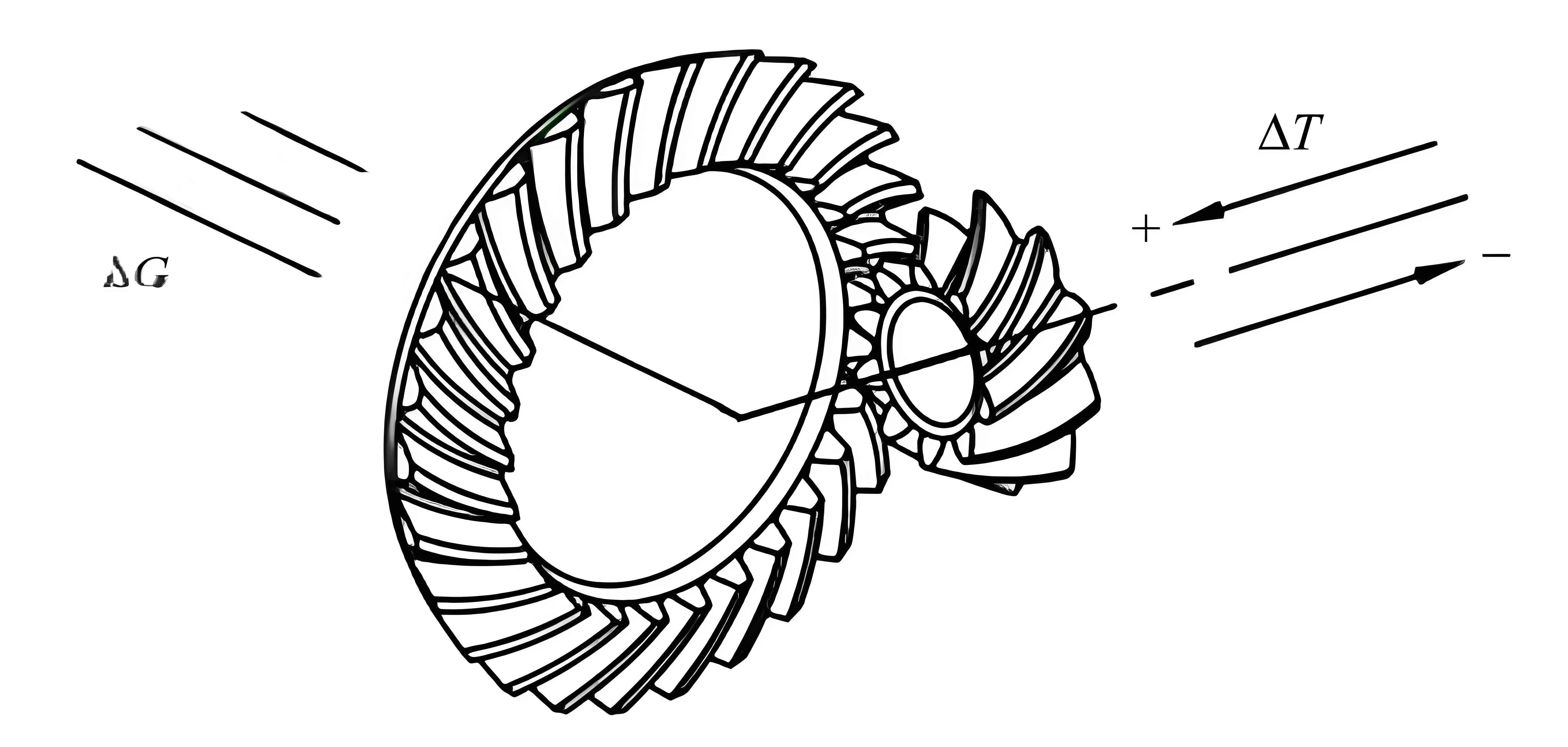
Spiral bevel gears are crucial components for transmitting rotation and torque in aviation and automotive fields. With the development of numerical control technology, free-form surface machine tools have been widely used in the design and manufacture of spiral bevel gears. These machine tools can execute any desired tool motion on the workpiece, providing almost unlimited freedom for the tooth surface design and manufacture of spiral bevel gears.
2. Literature Review
Researchers have conducted extensive studies on spiral bevel gears. Some studies have focused on the root cutting problem of involute spiral bevel gears, established algorithms for solving the number of root cutting teeth, and provided theoretical analysis methods for the design and manufacture of spiral bevel gears. Others have studied tooth surface modification methods based on the contact characteristics of spiral bevel gears, proposed discrete tooth surface calculation methods, and demonstrated the effectiveness of these methods in controlling contact characteristics. Numerical models and virtual simulation models have also been used to study contact characteristics, and optimal machining paths have been analyzed to improve processing efficiency and accuracy.
3. Active Design of Pinion Tooth Surface Based on Contact Properties
In this study, meshing performance parameters are taken as input variables to describe the active design of the microgeometry of the pinion tooth surface. The contact properties of the gear pair include contact path location and shape, long axis length of the instantaneous contact ellipse at the average contact point, and transmission error function for the drive side, as well as position and direction of the contact path, long axis length of the instantaneous contact ellipse, and angular acceleration at the average contact point for the slip side.
The transmission error (TE) is designed as a quadratic parabola function, with the TE value at the average contact point during meshing instants set to 0. Due to the presence of second-order convexity, the TE value is not 0 when other areas of the side engage. The maximum transmission error (TE_max) is represented at the meshing input and output points, and the range from meshing input to meshing output corresponds to one-half of the pinion tooth.
Table 1: Contact Property Targets for the Gear Pair
| Contact Property | Drive Side | Slip Side |
|---|---|---|
| Contact Path Location and Shape | Designed as straight or curved lines in the rotational projection section | Adjusted through subsequent modifications |
| Long Axis Length of Instantaneous Contact Ellipse | Targeted value | Targeted value |
| Transmission Error Function | Designed as a quadratic parabola or higher-order polynomial | – |
| Position of Average Contact Point | Known | Known |
| Direction of Contact Path | – | Adjusted through subsequent modifications |
| Angular Acceleration | – | Targeted value |
4. Machining Method for Pinion Based on Fixed Workpiece Axis
4.1 Determination of Tool Parameters for the Drive Side of the Pinion
Based on the design targets for the concave surface of the pinion, the machining motion curve, i.e., a series of relative positions between the pinion and the tool, is determined. The outer blade parameters of the tool for machining the concave surface of the pinion are also determined.
Table 2: Constraint Equations for Machining the Concave Surface of the Pinion
| Constraint Equation | Description |
|---|---|
| r_PM = r_cM | Ensures consistency between the target position vector of the pinion side and the position vector of the blade |
| n_PM = n_cM | Ensures consistency between the target unit normal vector of the pinion side and the unit normal vector of the blade |
| r_PfM = r_cbM | Ensures that the point generated by the pinion cutter tip round is located on the designed pinion root cone |
| n_PfM ⋅ t_cbM = 0 | Ensures that the tangent to the pinion cutter tip round is perpendicular to the normal vector of the designed pinion root cone |
The position coordinates (X_Oc, Y_Oc, Z_Oc) of the pinion cutter center are calculated using elimination and iterative methods. Polynomials of the fifth degree are fitted to the X_Oc, Y_Oc, and Z_Oc coordinates using the least squares method.
4.2 Determination of Tool Parameters for the Slip Side of the Pinion
Based on the design targets for the convex surface of the pinion, the inner blade parameters of the tool for machining the convex surface are determined. The constraint conditions for machining the average contact point on the convex surface of the pinion include two independent vector equations, ensuring consistency between the position vector and unit normal vector of the generated pinion tooth surface and the design targets.
Table 3: Constraint Equations for Machining the Convex Surface of the Pinion
| Constraint Equation | Description |
|---|---|
| r_PM = r_cM | Ensures consistency between the target position vector of the pinion tooth surface and the position vector of the blade |
| n_PM = n_cM | Ensures consistency between the target unit normal vector of the pinion tooth surface and the unit normal vector of the blade |
The inner blade radius (r_cPX) and inner blade pressure angle (α_cPX) are solved using the elimination and iterative method, and the motion curve of the pinion cutter is determined.
5. Verification and Results
The proposed method is verified on a hypoid gear pair for a main reducer. The basic parameters of the gear pair and the preset tool parameters of the grinding wheel are listed in Tables 1 and 2, respectively. The preset contact property targets for the gear pair are listed in Table 3.
A rolling test is conducted between the grinding wheel and the pinion on a rolling test machine. The real contact pattern during the rolling test is consistent with the contact form calculated by the TCA software, verifying the feasibility and correctness of the proposed method.
Conclusion
This study addresses the issues in existing spiral bevel gear machining methods by proposing a method based on a free-form surface machine tool with a fixed workpiece axis for active design and manufacture of spiral bevel gears. Taking meshing performance parameters as input variables, the active design of the microgeometry of the pinion tooth surface is described, and machining parameters for both the target tooth surface and tooth depth are obtained. The proposed method ensures each contact path point on the commonly used drive side of the pinion, avoiding errors and manufacturing difficulties caused by poor workpiece shaft motion accuracy. Finally, the consistency between the contact property results and design attributes is verified through rolling tests, demonstrating the effectiveness of the proposed method.