
1. Introduction
As a critical component in automotive transmission systems, the drive axle directly impacts vehicle safety, comfort, and power delivery. Among its subsystems, the hypoid gear transmission system stands out due to its unique ability to transfer torque between non-parallel shafts while accommodating compact designs. However, the inherent complexity of hypoid gear dynamics—stemming from time-varying mesh stiffness, transmission errors, and nonlinear excitations—poses significant challenges for vibration control and noise reduction. This article presents a comprehensive analysis of the vibration characteristics of hypoid gear systems, integrating theoretical modeling, numerical simulations, and experimental validation to address these challenges.
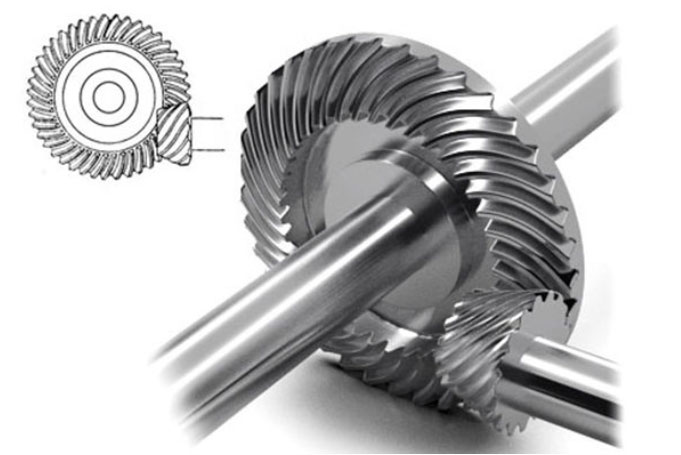
2. Key Excitations in Hypoid Gear Transmission Systems
The dynamic behavior of hypoid gear systems is governed by three primary internal excitations:
2.1 Time-Varying Mesh Stiffness
The periodic fluctuation of mesh stiffness arises from alternating single- and double-tooth contact regions during gear engagement. For hypoid gear, this stiffness (kmv(t)) is calculated using Fourier series approximations:kmv(t)=k0+n=1∑8[ancos(nωt)+bnsin(nωt)]
where k0 is the average stiffness, and an, bn are Fourier coefficients derived from discrete stiffness values (Fig. 2).
2.2 Transmission Error Excitation
Manufacturing imperfections, thermal deformations, and misalignments introduce periodic transmission errors (em(t)):em(t)=er0+ersin(2πt/Tc+ϕ)
Here, Tc=2π/(ωZ) is the meshing period, and er0, er represent static and dynamic error components.
2.3 Meshing Impact Forces
Discrepancies between theoretical and actual meshing points generate transient impact forces (Fcs):Fcs=Δvqs(I1Rb22+I2Rb12)bI1I2
where Δv is the impact velocity, b is the tooth width, and I1, I2 are moments of inertia.
3. Dynamic Modeling of Hypoid Gear Transmission Systems
A lumped-parameter model was developed to capture the multi-directional vibrations of the hypoid gear system (Fig. 5). The model accounts for:
- **6 degrees of freedom (DOF)** for the pinion and gear (translational: x,y,z; rotational: θx,θy,θz).
- Nonlinear stiffness and damping at bearing supports.
- Time-varying mesh stiffness and backlash effects.
3.1 Governing Equations
Using Newton’s second law, the differential equations for the pinion and gear are derived:
Pinion Vertical Vibration:mpy¨p+cpyy˙p+kpyf(yp,bpy)=−Fpy−Fmpg,y
Gear Torsional Vibration:Igθ¨g+cgθθ˙g+kgθ(θg−θp)=Td−RgFmpg
Here, f(⋅) represents the backlash nonlinearity, and Fmpg is the meshing force.
4. Vibration Characteristics Analysis
Numerical simulations using the Runge-Kutta (RK) method revealed critical insights into the system’s dynamic response.
4.1 Optimization of Hypoid Gear Tooth Profile
Tooth flank modification (ease-off topology correction) significantly reduced vibration amplitudes:
| Parameter | Pre-Optimization | Post-Optimization | Reduction (%) |
|---|---|---|---|
| Vertical Displacement (μm) | 18.0 | 13.5 | 25.0 |
| Axial Acceleration (m/s²) | 50.0 | 41.0 | 18.0 |
| Bearing Load (N) | 180 | 120 | 33.3 |
Key Observations:
- Vertical/Axial Vibrations: Exhibited chaotic motion due to nonlinear coupling.
- Torsional Vibrations: Showed quasi-periodic behavior with dominant meshing frequency harmonics.
4.2 Frequency Domain Analysis
Fast Fourier Transform (FFT) of vibration signals highlighted dominant frequencies:
| Component | Dominant Frequency (Hz) | Correlation with Meshing Frequency (fm=250 Hz) |
|---|---|---|
| Vertical Vibration | 257.8 | 1.03×fm |
| Axial Vibration | 512.4 | 2.05×fm |
| Torsional Vibration | 125.6 | 0.50×fm |
5. Impact of External Excitations
The effects of input speed (n) and torque (T) variations were systematically analyzed:
5.1 Input Speed Variation
Increasing n amplified vibration amplitudes across all directions:
| Speed (rpm) | Vertical Displacement (μm) | Axial Acceleration (m/s²) | Torsional Load (Nm) |
|---|---|---|---|
| 500 | 8.2 | 12.3 | 45.6 |
| 1000 | 13.6 | 20.1 | 47.8 |
| 2000 | 19.7 | 31.5 | 49.2 |
Sensitivity Ranking: Axial > Vertical > Torsional
5.2 Load Torque Variation
Higher T intensified gear separation and impacts:
| Torque (Nm) | Vertical Displacement (μm) | Axial Acceleration (m/s²) |
|---|---|---|
| 100 | 7.1 | 10.8 |
| 500 | 14.3 | 24.4 |
| 800 | 22.9 | 38.7 |
6. Experimental Validation
Vibration tests on drive axle prototypes confirmed theoretical predictions:
6.1 Test Setup
- Sensors: Triaxial accelerometers (PCB 356A26) at key locations (Fig. 19).
- Conditions: Four operational scenarios combining n=800/1500 rpm and T=200/400 Nm.
6.2 Results
Post-optimization prototypes showed superior performance:
| Condition (n, T) | Vertical Displacement (μm) | Vertical Acceleration (m/s²) |
|---|---|---|
| 800 rpm, 200 Nm | 8.37 (10.23)* | 0.14 (0.21)* |
| 1500 rpm, 400 Nm | 16.43 (19.67)* | 0.53 (0.61)* |
| *Values in parentheses denote pre-optimization results. |
7. Conclusion
This study establishes a robust framework for analyzing and optimizing hypoid gear transmission systems:
- Dynamic Model: The 6-DOF lumped-parameter model effectively captures nonlinear interactions between gears, shafts, and bearings.
- Vibration Reduction: Tooth flank modification reduces vertical/axial vibrations by 18–33%, aligning with NVH improvement goals.
- External Excitations: Axial vibrations are most sensitive to speed/torque changes, necessitating targeted damping strategies.
- Experimental Correlation: Test data validate theoretical predictions, underscoring the model’s reliability.
Future work will incorporate thermal effects and lubricant-film dynamics to refine predictive accuracy.
Tables Summary
Table 1: Hypoid Gear System Parameters
| Parameter | Pinion | Gear |
|---|---|---|
| Teeth Count | 10 | 43 |
| Module (mm) | 3.953 | 3.953 |
| Mass (kg) | 1.208 | 3.184 |
| Moment of Inertia | 6.96×10⁻⁴ | 2.31×10⁻² |
Table 2: Vibration Reduction After Optimization
| Metric | Improvement (%) |
|---|---|
| Vertical Displacement | 25.0 |
| Axial Acceleration | 18.0 |
| Bearing Load | 33.3 |
Table 3: Vibration Sensitivity to External Factors
| Excitation | Sensitivity Ranking |
|---|---|
| Input Speed | Axial > Vertical > Torsional |
| Load Torque | Axial > Vertical > Torsional |