
1. Introduction
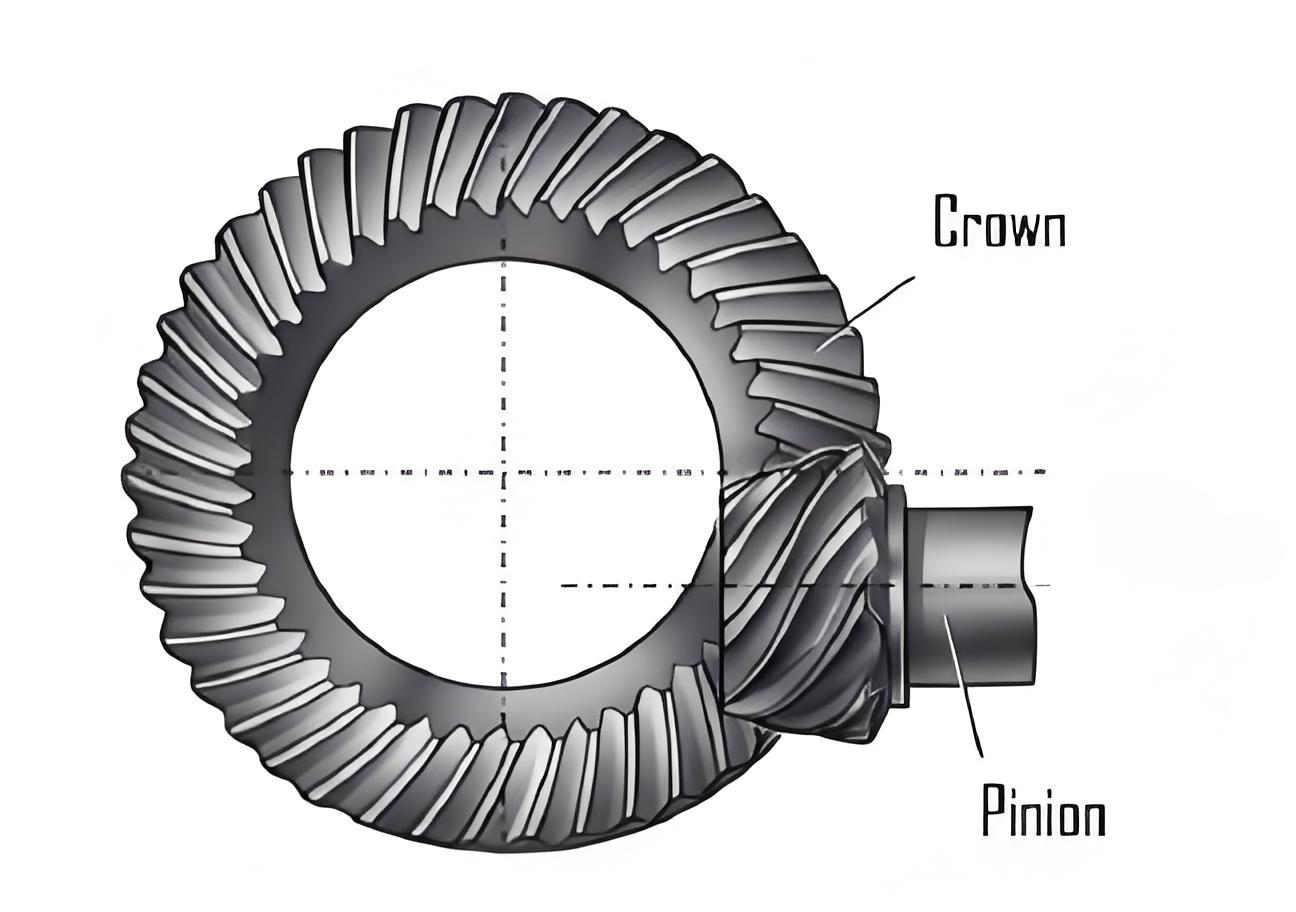
Hypoid gear is widely used in automotive differential systems due to their high contact ratio, smooth transmission, and strong load-bearing capacity. As a mechanical engineer specializing in automotive NVH analysis, I have always been intrigued by the dynamic behavior of hypoid gear, particularly those with extended epicycloid tooth profiles. These gears are critical in reducing vibration and noise in drivetrains, yet their meshing characteristics under varying loads remain underexplored. This study aims to bridge this gap by combining finite element analysis (FEA) and experimental validation to investigate key meshing parameters such as contact patterns, bending stress, contact ratio, and transmission error. The findings will provide actionable insights for optimizing hypoid gear design and enhancing drivetrain performance.
2. Literature Review
Previous studies on hypoid gear has primarily focused on Gleason-type spiral bevel gears, with limited attention to extended epicycloid variants. Researchers like Wang et al. employed loaded tooth contact analysis (LTCA) to study load distribution and meshing efficiency, while Ding et al. integrated thermal elastohydrodynamic lubrication theory to simulate meshing behavior. However, these works predominantly addressed traditional hypoid gear, leaving extended epicycloid designs underrepresented. Recent advancements by Liang et al. [7] in mathematical modeling of Oerlikon-type hypoid gear laid a foundation, but dynamic meshing characteristics under operational loads remain unclear. This study builds on existing methodologies while introducing novel FEA approaches to address these limitations.
3. Methodology
3.1 Finite Element Modeling
3.1.1 Mesh Generation
To balance computational accuracy and efficiency, I utilized HyperMesh to generate a hexahedral mesh for the hypoid gear pair. Key parameters included:
- Jacobian Ratio: >0.7 to ensure mesh quality.
- Element Type: 8-node linear brick elements (C3D8R in ABAQUS).
Table 1: Mesh Parameters
| Parameter | Value |
|---|---|
| Number of Nodes | ~520,000 |
| Element Size | 0.5 mm (tooth face) |
| Jacobian Threshold | 0.7 |
3.1.2 Material Properties
The gears were modeled using 20CrMnTi alloy steel, with properties defined in ABAQUS:
- Young’s Modulus: 210 GPa
- Poisson’s Ratio: 0.3
- Density: 7,850 kg/m³
3.1.3 Contact Configuration
Surface-to-surface contact was defined between the concave face of the pinion and the convex face of the gear. Frictional behavior followed Coulomb’s law (µ = 0.1).
3.2 Experimental Setup
Transmission error (TE) was measured using a drivetrain test rig under varying torque conditions (10–1,000 Nm). To eliminate differential effects, the planetary gears were welded to lock the axle rotation.
4. Results and Discussion
4.1 Contact Pattern Analysis
The elliptical contact area observed during meshing aligns with theoretical predictions. Key trends include:
- Forward Meshing: Contact initiates at the toe (large end) and transitions to the heel (small end).
- Reverse Meshing: Contact shifts from heel to toe, with stress migrating from the root to the tip.
Table 2: Contact Area Dynamics
| Meshing Direction | Initial Contact | Maximum Area (mm²) | Final Contact |
|---|---|---|---|
| Forward | Toe | 12.5 | Heel |
| Reverse | Heel | 11.8 | Toe |
4.2 Bending Stress Distribution
Root bending stress analysis revealed distinct stress patterns:
- Pinion: Tensile stress dominates initially, transitioning to compressive stress.
- Gear: Compressive stress precedes tensile stress.
Table 3: Stress Magnitudes at Critical Points
| Component | Max Tensile Stress (MPa) | Max Compressive Stress (MPa) |
|---|---|---|
| Pinion | 420 | -380 |
| Gear | 390 | -410 |
4.3 Contact Ratio vs. Load
The contact ratio (ε) increases with load, enhancing meshing smoothness:ϵ=ΔTΔtϵ=ΔtΔT
Table 4: Contact Ratio Trends
| Load (Nm) | Contact Ratio (ε) |
|---|---|
| 10 | 1.0 |
| 500 | 2.1 |
| 1,000 | 2.5 |
4.4 Transmission Error (TE) Characteristics
TE exhibits a nonlinear relationship with load:TE=(φ2−φ2(0))−Z1Z2(φ1−φ1(0))TE=(φ2−φ2(0))−Z2Z1(φ1−φ1(0))
Key Observations:
- Low Load (10 Nm): TE peaks at ±15 arcmin.
- Mid Load (500 Nm): TE minimizes to ±3 arcmin.
- High Load (1,000 Nm): TE stabilizes at ±8 arcmin.
Table 5: TE Amplitude vs. Load
| Load (Nm) | TE Amplitude (arcmin) |
|---|---|
| 10 | ±15 |
| 400 | ±5 |
| 1,000 | ±8 |
5. Conclusion
Through FEA and experimental validation, this study provides critical insights into the meshing behavior of hypoid gear with extended epicycloid profiles:
- Contact Dynamics: Elliptical contact areas transition predictably during meshing, with load-dependent size variations.
- Stress Reversal: Pinion and gear exhibit opposing stress sequences, necessitating asymmetric material treatments.
- Enhanced Contact Ratio: Hypoid gear achieve ε > 2.5 under high loads, outperforming spur gears.
- TE Minimization: Optimal load ranges (400–500 Nm) minimize TE, reducing NVH in drivetrains.
These findings underscore the importance of load-specific design strategies for hypoid gear in automotive applications. Future work will explore thermal effects and microgeometry optimizations.