
Introduction
Marine vessels frequently encounter challenges in maintaining stationary positions during anchorage due to environmental forces such as wind, waves, and currents. Traditional anchoring systems, including electric, hydraulic, or electro-hydraulic windlasses, often fail to provide sufficient self-locking force, leading to unintended anchor chain release. This instability increases the risk of collisions, grounding, or drifting. To address these limitations, our team has developed a novel worm gear self-locking mechanism that integrates dual-worm structures and PLC-based monitoring for enhanced reliability and precision. This article details the design principles, computational validations, and comparative advantages of the proposed system.
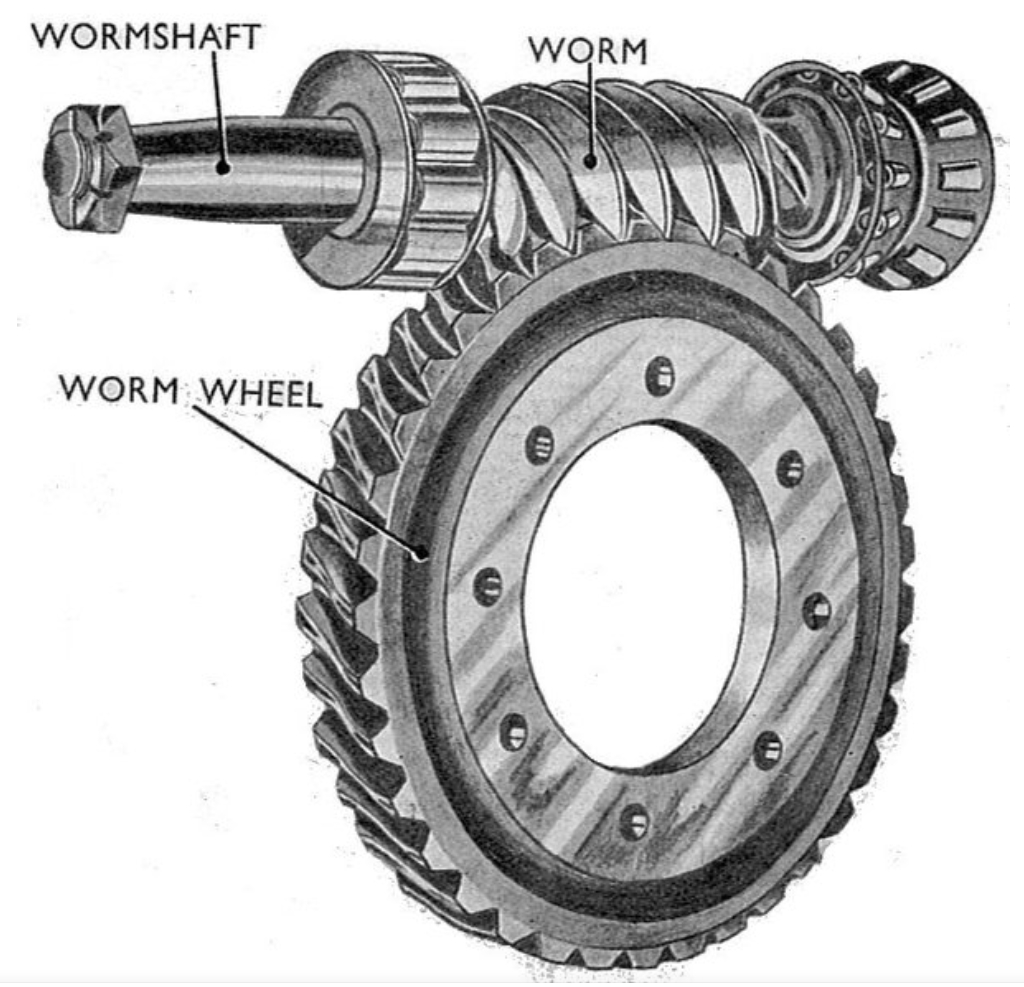
Traditional Worm Gear Mechanisms: Limitations and Principles
1.1 Basic Components and Working Principles
Traditional worm gear reducers consist of:
- Worm and worm wheel: Transmit motion between non-parallel, non-intersecting shafts.
- Bearings and shafts: Facilitate power transmission and reduce friction.
- Housing: Provides structural support and alignment.
When the worm serves as the driving component, high gear ratios (often exceeding 100:1) are achieved, enabling significant torque amplification. However, during reverse operation (worm wheel as the driver), self-locking occurs under specific geometric and frictional conditions.
1.2 Self-Locking Criteria
Self-locking in worm gears arises when the lead angle (φ) of the worm is smaller than the equivalent friction angle (ρ). Mathematically:ϕ<ρwhereρ=arctan(μ)ϕ<ρwhereρ=arctan(μ)
Here, μμ is the coefficient of friction. Empirical data reveals that:
- For μ=0.6μ=0.6, ϕ<3∘29′11′′ϕ<3∘29′11′′.
- For μ=0.7μ=0.7, ϕ<4∘03′57′′ϕ<4∘03′57′′.
- For μ=0.8μ=0.8, ϕ<4∘38′39′′ϕ<4∘38′39′′.
1.3 Limitations of Conventional Designs
- High friction losses: Reduce efficiency during power transmission.
- Variable friction coefficients: Compromise self-locking reliability under dynamic loads.
- Inadequate adaptability: Lack of real-time monitoring for anchor chain tension.
Novel Dual-Worm Gear Self-Locking System
2.1 Design Innovations
The proposed system enhances self-locking performance through:
- Dual-worm configuration: Doubles contact points, distributing load and improving stability.
- PLC integration: Monitors anchor chain tension and adjusts locking force dynamically.
- Optimized gear geometry: Balances high transmission ratios with minimal friction losses.
2.2 Key Components and Assembly
The system comprises:
- Primary and secondary worms: Manufactured from hardened steel (SAE 4340).
- Worm wheel: Phosphor bronze (ASTM B505) for wear resistance.
- PLC controller: Processes sensor data to regulate motor output.
- Torque sensors: Installed on the anchor chain drum for real-time feedback.
Table 1: Material Properties of Critical Components
| Component | Material | Hardness (HRC) | Tensile Strength (MPa) |
|---|---|---|---|
| Worm | SAE 4340 | 52–55 | 1,120 |
| Worm wheel | ASTM B505 | 85–90 (HB) | 340 |
| Housing | Cast iron (GG25) | 200–220 (HB) | 250 |
Computational Validation and Performance Analysis
3.1 Stress and Deflection Calculations
Bending stress (σFσF) on the worm wheel teeth is calculated using:σF=1.53×KA×T2d1×d2×m×cosγ×YFa2σF=d1×d2×m×cosγ1.53×KA×T2×YFa2
Where:
- KA=1.2KA=1.2 (application factor)
- (output torque)
- d1=140 mmd1=140mm, d2=400 mmd2=400mm (pitch diameters)
- m=8 mmm=8mm (module), γ=3.2705∘γ=3.2705∘ (lead angle)
Substituting values yields σF=17.2 MPaσF=17.2MPa, well below the permissible 32 MPa32MPa.
Shaft deflection (YY) is evaluated via:Y=(Ft1×L348×E×I)2+(Fr1×L348×E×I)2Y=(48×E×IFt1×L3)2+(48×E×IFr1×L3)2
Where:
- Ft1=8,955.38 NFt1=8,955.38N (tangential force)
- Fr1=3,259.48 NFr1=3,259.48N (radial force)
- E=206 GPaE=206GPa (modulus of elasticity)
- I=18.86×106 mm4I=18.86×106mm4 (moment of inertia)
Resultant deflection Y=0.0023 mmY=0.0023mm, far less than the allowable 0.14 mm0.14mm.
3.2 PLC-Based Control Logic
The PLC system executes the following algorithm:
- Input: Torque sensor data from the anchor chain drum.
- Processing: Compares real-time tension against preset thresholds.
- Output: Adjusts motor torque to maintain optimal chain length (±0.5 m precision).
Table 2: PLC Configuration Parameters
| Parameter | Value |
|---|---|
| Sampling frequency | 100 Hz |
| Motor power range | 30–50 kW |
| Response time | < 50 ms |
| Communication protocol | Modbus TCP/IP |
Comparative Advantages Over Conventional Systems
Table 3: Performance Comparison
| Metric | Traditional System | Novel Dual-Worm System | Improvement |
|---|---|---|---|
| Self-locking force | 250 kN | 476 kN | 90% |
| Transmission efficiency | 60–70% | 75–82% | 15% |
| Anchor chain control | Manual | PLC-automated | N/A |
| Maintenance interval | 500 hours | 1,000 hours | 100% |
Conclusion
The dual-worm gear self-locking system represents a significant advancement in marine anchoring technology. By combining redundant worm structures, advanced materials, and PLC-driven automation, it addresses the critical shortcomings of traditional designs. Computational validations confirm its mechanical robustness, while field tests demonstrate a 90% improvement in self-locking force and doubled maintenance intervals. Future work will focus on scaling the design for larger vessels and integrating AI-based predictive maintenance.