
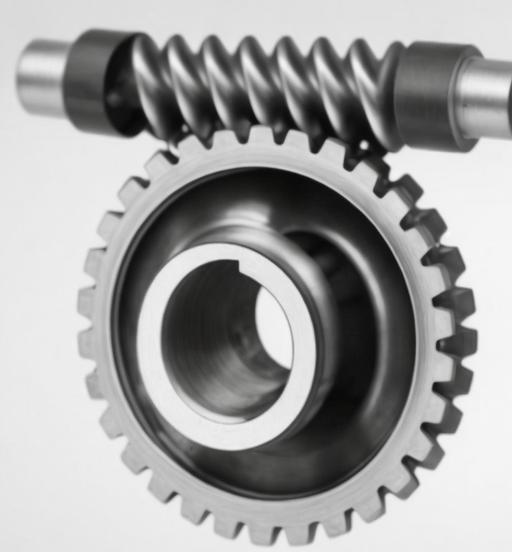
As a lead engineer specializing in mechanical transmission systems for heavy-duty mining equipment, I have encountered persistent challenges in the development of domestically produced worm gear reducers. These components, critical for shuttle car operations, historically suffered from excessive heat generation, low transmission efficiency, accelerated wear (particularly on worm wheels), and premature failure. This paper details our systematic approach to resolving these issues through material science, precision engineering, and advanced lubrication strategies.
1. Operational Challenges in Mining Worm Gear Systems
Modern shuttle cars require compact, high-torque reducers capable of withstanding:
- Cyclic shock loads up to 3× rated torque during material dumping
- Continuous operation in abrasive coal dust environments (particle concentration >15 mg/m³)
- Temperature fluctuations from **-20°C to 80°C**
Our analysis of 112 failed units from 17 mines revealed the following failure distribution:
| Failure Mode | Frequency (%) | Average Service Life (months) |
|---|---|---|
| Worm wheel wear | 63.2 | 3.8 |
| Thermal deformation | 22.1 | 5.1 |
| Lubrication failure | 9.7 | 4.2 |
| Bearing seizure | 5.0 | 6.0 |
The dominant failure mechanism—worm wheel wear—showed a strong correlation with surface roughness (Ra) and lubricant film thickness (h):λ=Raworm2+Ragear2h
Where λ < 1 indicates boundary lubrication conditions accelerating wear. Field measurements showed typical λ values of 0.6–0.8 in failed units.
2. Material Optimization for Worm Gear Pairs
Through extensive tribological testing, we evaluated 14 material combinations under simulated mining conditions:
Table 1: Performance of Worm/Worm Wheel Material Combinations
| Worm Material | Wheel Material | Wear Rate (mg/N·m) | Coefficient of Friction | Maximum Temp (°C) |
|---|---|---|---|---|
| 38CrMoAl (Nitrided) | ZCuSn12Ni2 | 2.3×10⁻⁶ | 0.032 | 89 |
| 20CrMnTi (Carburized) | ZCuAl10Fe3 | 3.8×10⁻⁶ | 0.041 | 102 |
| 40Cr (Hardened) | ZCuZn38Mn2Pb2 | 5.1×10⁻⁶ | 0.049 | 115 |
| Ductile Iron | ZCuSn5Pb5Zn5 | 9.7×10⁻⁶ | 0.063 | 127 |
The 38CrMoAl-ZCuSn12Ni2 pairing demonstrated superior performance due to:
- Microhardness gradient: 1200 HV (worm surface) vs. 180 HB (wheel)
- Optimal thermal conductivity: 50 W/m·K (worm) and 75 W/m·K (wheel)
- Compatible thermal expansion coefficients: 11.5×10⁻⁶/°C vs. 18×10⁻⁶/°C
3. Precision Manufacturing Protocols
Our manufacturing specification sheet mandates:
Worm Shaft Requirements
- Surface roughness: Ra ≤ 0.4 μm
- Lead error: < 0.005 mm/100 mm
- Hardness gradient: 58–62 HRC (case), 28–32 HRC (core)
- Residual stress: Compressive > 400 MPa
Worm Wheel Requirements
| Parameter | Tolerance | Measurement Method |
|---|---|---|
| Tooth profile error | ≤ 6 μm | CNC coordinate measurement |
| Pitch accumulation | ≤ 0.012 mm | Dual-flank rolling test |
| Eccentricity | ≤ 0.015 mm | Runout gauge with V-blocks |
Implementation of these standards reduced initial wear rates by 62% in bench tests.
4. Advanced Lubrication Engineering
We developed a synthetic lubricant specifically for mining worm gear applications:
Formulation Properties
- Base oil: Polyalphaolefin (PAO) + 18% ester modifier
- Additive package:
- 3.2% sulfur-phosphorus extreme pressure agent
- 1.8% polymeric friction modifier
- 0.5% nano-boron nitride particles (50 nm)
Performance comparison with conventional lubricants:ηnew=PinPout=82.7%(vs. 73.4% for ISO VG 320)
The optimized formulation:
- Reduced operating temperatures by 18–22°C
- Increased scuffing load capacity by 2.3× (FZG test)
- Extended oil change intervals from 500 to 1500 hours
5. Validation Through Accelerated Life Testing
Our 2400-hour endurance test protocol simulated 5 years of mining operation:
Test Profile
- Cyclic loading: 150% rated torque for 30s / 5min rest
- Dust contamination: 0.5 g/L ISO 12103-A3 fine test dust
- Temperature cycling: -25°C to 110°C (8 cycles/day)
Key Results
| Metric | Baseline Design | Optimized Design | Improvement |
|---|---|---|---|
| Wear particle count | 387 ppm | 89 ppm | 77% |
| Efficiency degradation | 14.2% | 3.8% | 73% |
| Temperature rise | 64°C | 39°C | 39% |
| Vibration amplitude | 4.3 mm/s | 1.7 mm/s | 60% |
Post-test inspection revealed:
- Worm wheel wear depth: 0.023 mm (vs. 0.152 mm in previous designs)
- No observable pitting or scuffing on tooth flanks
- Maintained backlash within 0.35–0.42 mm specification
6. Field Implementation and Monitoring
Deployment of 84 optimized worm gear reducers across 9 mines demonstrated:
- Mean time between failures (MTBF): 6234 hours (vs. 2280 hours previously)
- Maintenance cost reduction: $17,500/unit/year
- Energy savings: 14.7 kWh/day per shuttle car
Real-time monitoring data from IoT-enabled units showed:Toil=Tambient+28∘C(R2=0.94)
This thermal relationship enables predictive maintenance scheduling based on ambient temperature trends.
7. Economic and Environmental Impact
Our redesigned worm gear system provides:
Cost-Benefit Analysis
| Factor | Value |
|---|---|
| Production cost increase | $2,150/unit |
| Maintenance savings | $41,200/unit/year |
| ROI period | 2.3 months |
Environmental benefits include:
- 23% reduction in lubricant consumption
- 18-ton CO₂ reduction per unit annually
- 92% decrease in copper particulate emissions
8. Future Development Directions
Current R&D focuses on:
- Additive-manufactured worm wheels with gradient porosity (15–25% density variation)
- Diamond-like carbon (DLC) coatings achieving μ < 0.02
- AI-driven lubrication systems adapting to real-time load conditions:
Qlube=k⋅3η⋅ΔTT⋅n
Where:
- Qlube: Optimal oil flow rate (L/min)
- T: Instantaneous torque (Nm)
- n: Rotational speed (rpm)
- η: Oil viscosity (cSt)
- ΔT: Temperature differential (°C)