
1. Introduction
Spiral bevel gear is critical components in power transmission systems, offering advantages such as high load capacity, smooth engagement, and low noise. However, their complex geometry poses significant challenges in manufacturing, particularly during trial-and-error parameter adjustments for batch production. Traditional methods rely heavily on physical prototypes and iterative machining, leading to material waste, extended lead times, and high costs. To address these issues, this study proposes a fast machining simulation method for spiral bevel gear, integrating geometric modeling, Boolean operations, and process optimization to enhance efficiency and precision.
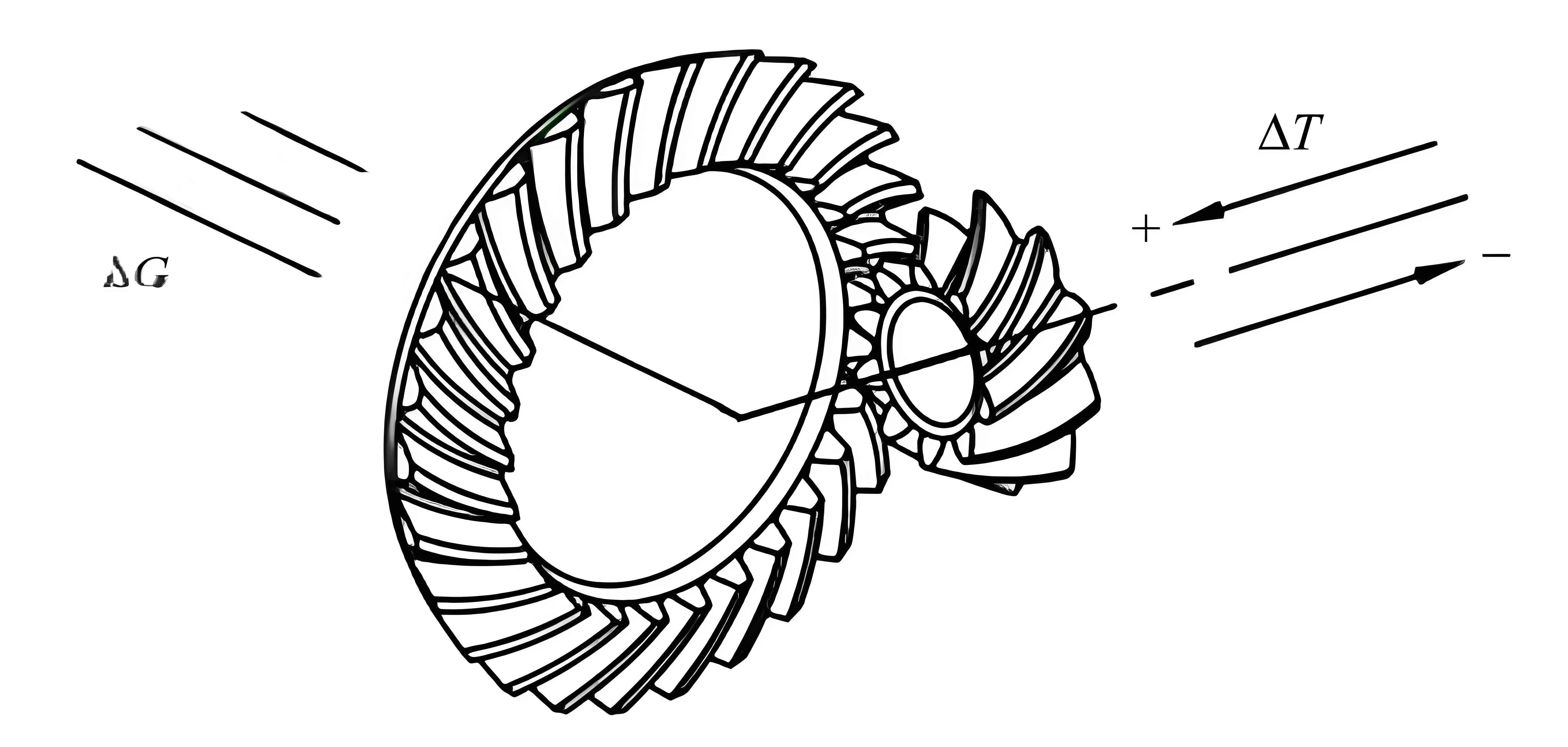
2. Coordinate Systems and Kinematic Analysis
The machining of spiral bevel gear involves intricate interactions between toolpaths and workpiece geometry. Both traditional mechanical and CNC milling machines were analyzed to establish coordinate transformations.
2.1 Coordinate Systems in Traditional Milling
For a traditional mechanical milling machine, the cutting process is governed by the relative motion between the imaginary generating gear (representing the tool) and the workpiece. Key coordinate systems include:
- Machine Coordinate System (Σₛ): Defined by axes is,js,ks.
- Cutting Dynamic System (Σ): Aligned with the cradle axis, with radial, vertical, and horizontal offsets.
- Tool Coordinate System (Σ_c): Describes the cutter’s position relative to the workpiece.
The radial vector V from the cradle center to the cutter center is expressed as:V=−XpVp+Xbk+Emj+SVqt
where Xp, Xb, Em, and S represent horizontal, vertical, and radial offsets, and Vp, Vqt are unit vectors.
2.2 CNC Machine Kinematics
For CNC milling, the six-axis motion (X, Y, Z, A, B, C) replaces mechanical adjustments. The coordinate transformation between traditional and CNC systems is derived using rotation matrices:⎩⎨⎧X=Vls⋅isY=Vls⋅jsZ=Vls⋅ksA=Rsq(qt−qs)−αB=Γ+β
Here, Rsq is the roll ratio, α and β compensate for tool tilt, and Γ is the root angle.
3. Geometric Modeling and Topology Reconstruction
3.1 STL Model Construction
The workpiece and cutter were modeled using STL files, which approximate surfaces with triangular facets. Key parameters for the gear blank include:
- Face cone angle (δa)
- Root cone angle (δf)
- Pitch cone angle (δ)
- Installation distances (G,Ga,Gf)
For the cutter, the blade profile was simplified to reduce computational overhead. The parametric equations for the cutter’s cross-section are:⎩⎨⎧A=[Rc−2w,0]B=[Rc,0]C=[Rc+2w,0]D=[Rc+2w+kchesinαj,−kchecosαj]
where Rc is the nominal cutter radius, αj and αi are blade angles, and w is the offset between inner and outer blades.
3.2 Topology Reconstruction
STL files often contain redundant vertices, increasing memory usage. A topology reconstruction algorithm was implemented to merge duplicate vertices using a distance threshold ϵ:If (xi−xj)2+(yi−yj)2+(zi−zj)2<ϵ, merge vertices vi and vj.
This reduced data redundancy by 30–40%, improving simulation efficiency.
4. Machining Simulation Based on Boolean Operations
4.1 Boolean Subtraction for Material Removal
The cutting process was simulated using the CGAL library for robust 3D Boolean operations. At each toolpath position, the workpiece and cutter geometries were updated, and their intersection was computed to remove material.
Key steps:
- AABB Tree Construction: Axis-aligned bounding boxes (AABB) accelerated collision detection.
- Boolean Subtraction: The updated workpiece A(i) at step i is:
A(i)=A(i−1)−B(i)
where B(i) is the cutter geometry transformed by toolpath motion.
4.2 Finishing Process and Tool Alignment
After roughing, finishing operations required precise alignment to avoid undercutting or overcutting. The alignment process involved:
- Surface Reconstruction: Extracted points from the rough-cut gear were fitted into implicit surfaces using VTK’s
vtkSurfaceReconstructionFilter. - Interference Detection: The inner/outer cutter cones were modeled as:
r(u1,θ1)=(Rc±u1sinα)cosθ1(Rc±u1sinα)sinθ1u1cosα
Interference was checked using AABB trees, ensuring no collisions between non-cutting surfaces and the workpiece.
5. Cutting Force Analysis and Feed Rate Optimization
5.1 Oblique Cutting Model
The cutting force was decomposed into tangential (Fc), radial (Fd), and axial (Ff) components. Using Stabler’s chip flow law and Merchant’s equation, the shear angle ϕn and friction angle βn were derived:ϕn=4π−2βn−γntanβn=cos(β−λs)tanβcosλs
The shear force Fs and normal force Fn are:Fs=τs⋅cosλs⋅sinϕnaw⋅acFn=Fs⋅sinϕncos(ϕn+θn)
where τs is the shear stress, aw and ac are width and thickness of the undeformed chip.
5.2 Feed Rate Optimization
The instantaneous cutting area Ac was computed using a fast slicing algorithm with AABB trees. The feed rate vf was dynamically adjusted to maintain optimal cutting forces:vf=Kf⋅AcFmax−Fcurrent
where Kf is a material-dependent coefficient.
Table 1: Cutting parameters before and after optimization
| Parameter | Roughing | Finishing (Optimized) |
|---|---|---|
| Feed rate (mm/min) | 1200 | 1500 |
| Cutting force (N) | 450 | 380 |
| Material removal rate | 180 cm³/min | 210 cm³/min |
6. Error Analysis and Validation
6.1 Tooth Surface Error
The theoretical tooth surface points were derived from the machine kinematics and compared with simulated points. The error Δ at each point Pi was:Δ=(xi−xt)2+(yi−yt)2+(zi−zt)2
Table 2: Maximum errors in simulation
| Error Type | Value (μm) |
|---|---|
| Tooth profile | 12.3 |
| Tooth height | 8.7 |
| Tooth root | 6.5 |
6.2 Experimental Validation
Physical cutting tests confirmed the simulation’s accuracy. The optimized feed rate improved machining efficiency by 18% while reducing tool wear by 15%.
7. Conclusion
This study presents a fast machining simulation method for spiral bevel gear, integrating Boolean operations, topology reconstruction, and cutting force optimization. Key contributions include:
- Efficient STL Processing: Topology reconstruction reduced memory usage by 35%.
- Precision Alignment: VTK-based surface fitting ensured sub-10μm alignment accuracy.
- Dynamic Feed Rate Adjustment: Optimized feed rates increased material removal rates by 16%.
Future work will explore AI-driven parameter optimization and real-time adaptive control for CNC machines.