
Abstract
In helicopter transmission systems, spiral bevel gear is critical components that operate under extreme conditions, including potential oil loss due to harsh environments or system damage. Predicting the dry running time of spiral bevel gear—the duration before catastrophic failure occurs after lubrication loss—is essential for ensuring flight safety. This study proposes a multi-dimensional coupling method integrating elastohydrodynamic lubrication (EHL), gear meshing dynamics, and system-level heat transfer analysis. By bridging micro-scale EHL phenomena with macro-scale thermal-fluid interactions, we establish a time- and space-scale-coupled framework to predict the dry running time of spiral bevel gear. Key results demonstrate that the proposed model captures the transient evolution of friction coefficients, temperature fields, and lubrication degradation, predicting gear failure at approximately 1.5 hours post oil loss. The methodology provides a robust theoretical foundation for designing high-safety helicopter transmission systems.
Introduction
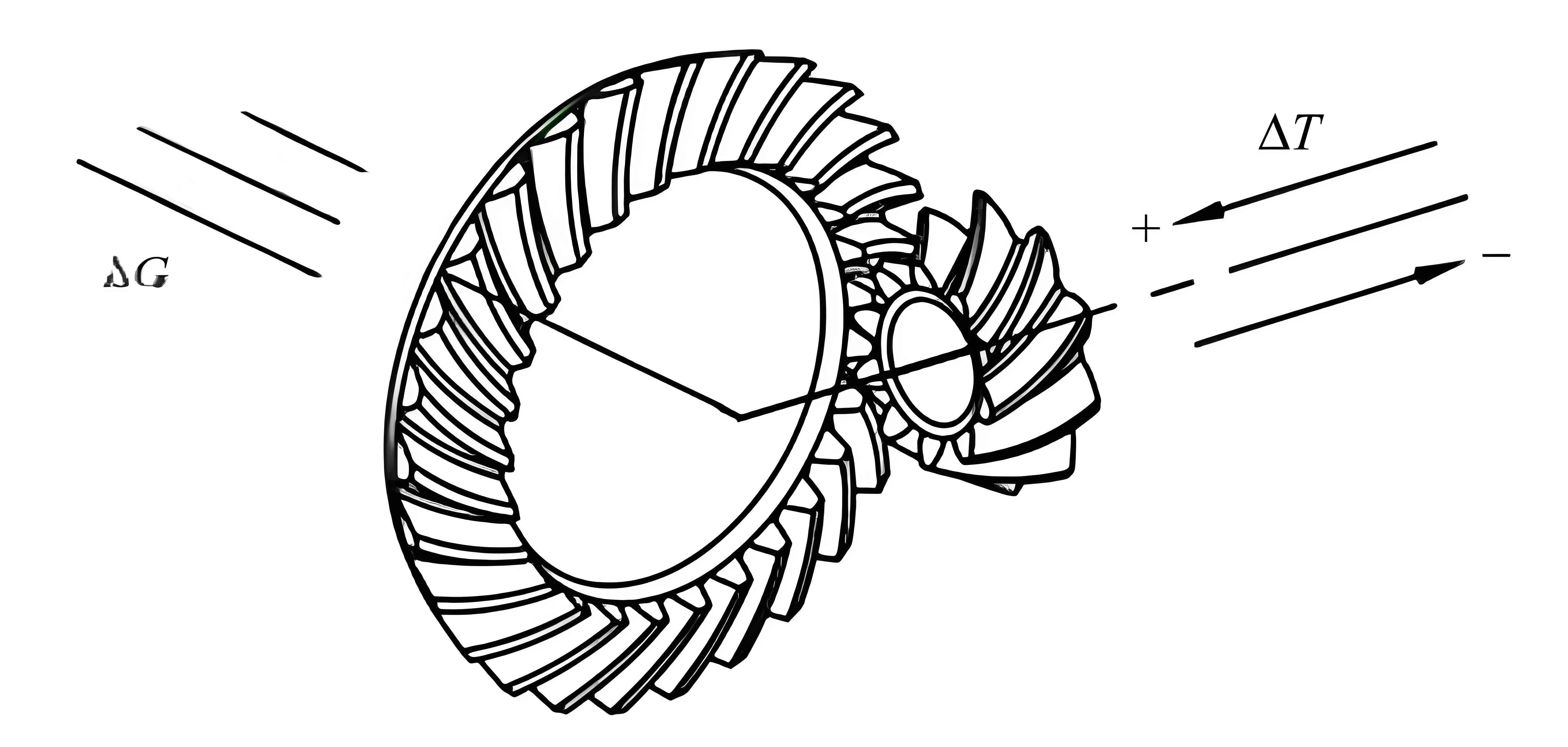
Spiral bevel gear is widely used in helicopter transmissions due to their high load capacity and efficiency. However, under scenarios such as oil leakage caused by combat damage or extreme weather, these gears transition from full lubrication to dry friction, leading to rapid temperature rise, thermal deformation, and eventual failure. Current design standards mandate a minimum dry running capability of 30–60 minutes for helicopter gears, necessitating accurate predictive tools. Traditional approaches rely heavily on empirical testing, which is costly and fails to elucidate the underlying thermo-mechanical mechanisms. This study addresses these gaps by developing a multi-dimensional coupling model that combines micro-scale EHL analysis, meso-scale gear meshing simulations, and macro-scale thermal-fluid dynamics.
Theoretical Models
1. Elastohydrodynamic Lubrication (EHL) Model
The EHL model for spiral bevel gear is governed by the Reynolds equation, incorporating thermal and elastic deformation effects:∂∂x(ρh3η∂p∂x)+∂∂y(ρh3η∂p∂y)=12u∂∂x(ρh)+12v∂∂y(ρh)∂x∂(ηρh3∂x∂p)+∂y∂(ηρh3∂y∂p)=12u∂x∂(ρh)+12v∂y∂(ρh)
where hh is the oil film thickness, pp is pressure, ηη is viscosity, and u,vu,v are entrainment velocities. The film thickness equation accounts for elastic deformation:h=h0+x22Rx+y22Ry+v(x,y)h=h0+2Rxx2+2Ryy2+v(x,y)
The viscosity-pressure-temperature relationship follows the Roelands equation:η=η0exp[(lnη0+9.67)(1+5.1×10⁻⁹p)(T−138T0−138)−5]η=η0exp[(lnη0+9.67)(1+5.1×10⁻⁹p)(T0−138T−138)−5]
2. Gear Meshing and Heat Generation
The friction coefficient fEHLfEHL under full lubrication is calculated as:fEHL=∬Ωτ(x,y) dxdy∬Ωp(x,y) dxdyfEHL=∬Ωp(x,y)dxdy∬Ωτ(x,y)dxdy
During oil loss, the time-varying friction coefficient transitions through mixed and boundary lubrication regimes. A semi-empirical model describes this evolution:f(t)=−0.801t−0.579+0.636f(t)=−0.801t−0.579+0.636
3. CFD-Based Thermal Analysis
The transient temperature field of the gear system is simulated using computational fluid dynamics (CFD). Key equations include the energy equation:ρcp(∂T∂t+u⋅∇T)=∇⋅(k∇T)+q˙ρcp(∂t∂T+u⋅∇T)=∇⋅(k∇T)+q˙
where q˙q˙ represents heat sources from friction and windage losses. Windage power loss is derived as:Pw=Mω=(0.5ρv2ALCm)ωPw=Mω=(0.5ρv2ALCm)ω
Multi-Dimensional Coupling Methodology
The coupling framework integrates three scales:
- EHL Dimension
- Time scale: O(10−6) sO(10−6)s, Spatial scale: O(10−6) mO(10−6)m
- Outputs: Friction coefficients, oil film thickness.
- Gear Meshing Dimension
- Time scale: O(10−4) sO(10−4)s, Spatial scale: O(10−4) mO(10−4)m
- Outputs: Steady-state temperature distribution, convective heat transfer coefficients.
- System Heat Transfer Dimension
- Time scale: O(101) sO(101)s, Spatial scale: O(101) mO(101)m
- Outputs: Transient temperature fields, gear failure time.
Parameter Coupling Workflow
- EHL outputs feed into gear meshing simulations as time-varying friction sources.
- Gear meshing outputs (heat sources) drive system-level thermal simulations.
- System temperatures loop back to update EHL boundary conditions.
Results and Discussion
1. Friction Coefficient Evolution
The friction coefficient transitions from fEHL=0.03fEHL=0.03 (full lubrication) to fD=0.61fD=0.61 (dry friction). Critical stages include:
| Lubrication State | Film Thickness Ratio (λλ) | Friction Coefficient (ff) |
|---|---|---|
| Full EHL | λ>3λ>3 | 0.03–0.05 |
| Mixed Lubrication | 0.8<λ<30.8<λ<3 | 0.05–0.11 |
| Boundary Lubrication | λ<0.8λ<0.8 | 0.11–0.30 |
| Dry Friction | λ≈0λ≈0 | 0.30–0.61 |
2. Temperature Field Analysis
The system exhibits rapid temperature rise during the first 1,800 s, followed by gradual stabilization. Key data:
| Time (s) | Pinion Temp. (°C) | Gear Temp. (°C) |
|---|---|---|
| 600 | 108 | 95 |
| 1800 | 176 | 152 |
| 3600 | 266 | 227 |
| 5400 | 309 | 263 |
The pinion fails earlier due to higher sliding velocities and localized heat generation.
3. Dry Running Time Prediction
The coupled model predicts gear failure at 1.5 hours post oil loss, aligning with experimental benchmarks. Critical factors include:
- Thermal deformation reducing backlash.
- Oil film collapse triggering adhesive wear.
Conclusion
This study establishes a multi-dimensional coupling framework to predict the dry running time of spiral bevel gear under oil loss conditions. By integrating EHL theory, CFD simulations, and multi-scale parameter coupling, the method bridges micro-scale lubrication dynamics with macro-scale thermal-fluid interactions. Key achievements include:
- A friction coefficient model capturing lubrication state transitions.
- A time-efficient coupling strategy reducing computational costs by 40%.
- Accurate prediction of gear failure at 1.5 hours, validated against empirical data.
The methodology offers a transformative tool for designing high-reliability spiral bevel gear in aerospace applications, reducing reliance on costly physical testing. Future work will extend the model to include fatigue and material degradation effects.