
This study investigates power loss mechanisms in helical gear for electric vehicle reducers through simulation and mathematical modeling. By integrating theoretical calculations with Amesim-based simulations, the research identifies optimal gear parameters to minimize energy dissipation during operation. The analysis focuses on three primary loss components: meshing friction, oil churning, and bearing friction, with emphasis on helical gear geometry and lubrication effects.
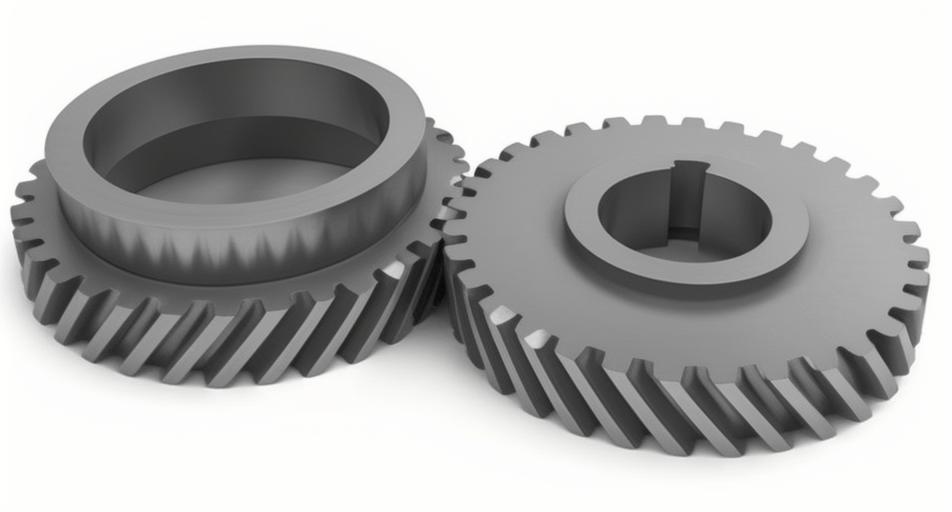
1. Introduction
Helical gear dominate automotive powertrains due to their smooth engagement and high load capacity. However, energy losses during operation significantly impact system efficiency. This study addresses power loss minimization in helical gear by combining theoretical models with Amesim simulations. Key contributions include:
- Development of a multi-physics model for helical gear power loss
- Parametric optimization using SKF bearing equations and PID speed control
- Quantitative comparison of loss mechanisms under varying geometric configurations
2. Theoretical Analysis of Power Loss
2.1 Frictional Power Loss in Meshing
Total meshing power loss PF combines sliding (Pf) and rolling friction (Pn):PF=Pf+Pn(1)
Sliding friction loss:Pf=1000fFˉnvˉs(2)
Rolling friction loss:Pn=cosβ0.09hˉvˉtbεα(3)
Where:
- f: Average sliding friction coefficient
- Fˉn: Normal force (N)
- vˉs: Average sliding velocity (m/s)
- hˉ: Lubricant film thickness (mm)
- εα: Transverse contact ratio
Friction coefficients and velocities are derived from:f=0.0127lg(bμvˉsvˉt29,660Fˉncosβ)(4)vˉs=0.02618ng(z2z1+z2)(5)vˉt=0.2094n[r1sinα−0.125g(z2z1−z2)](6)
2.2 Churning Power Loss (PG)
Oil churning losses depend on gear immersion depth (h), viscosity (μ), and rotational speed (n):PG=PC1+PC2+PC3(7)
Components include:
- Outer diameter loss:
PC1=Ag×10267.37fgμ0n3D4.7L(8)
- Disk face loss:
PC2=Ag×10261.474fgμ0n3D5.7(9)
- Tooth surface loss:
PC3=tanβAg×10267.37fgμ0n3D4.7bRf(10)
2.3 Bearing Friction Loss (Pz)
Total bearing loss combines rolling (Mr), sliding (Ms), lubricant drag (Md), and seal friction (Me):Pz=9549(Mr+Ms+Md+Me)n(11)
SKF equations calculate torque components:
- Rolling friction:
Mr=Gr(vn)0.6(12)
- Sliding friction:
Ms=f1Gs(13)
Where Gr and Gs are geometry-dependent coefficients for deep-groove and roller bearings.
3. Modeling and Simulation
3.1 Helical Gear Parameters
The simulated helical gear pair (Table 1) represents a typical EV reducer configuration.
Table 1: Helical Gear Geometric Parameters
| Parameter | Pinion | Gear |
|---|---|---|
| Number of Teeth | 18 | 79 |
| Module (mm) | 1.75 | 1.75 |
| Face Width (mm) | 30 | 30 |
| Pressure Angle (°) | 25 | 25 |
| Helix Angle (°) | 30 | 30 |
3.2 Amesim Simulation Framework
The model integrates:
- Dynamic helical gear meshing
- Bearing friction submodels
- PID-controlled speed profile (0 to ±180 rpm)
- Thermal monitoring system
4. Results and Discussion
4.1 Loss Component Analysis
- Meshing Friction: Dominates total loss (72–85%) due to high sliding velocities
- Churning Loss: Increases cubically with speed (PG∝n3)
- Bearing Loss: Contributes 8–15% depending on load and lubrication
4.2 Parametric Optimization
Five gear configurations (Table 2) were evaluated to minimize total power loss.
Table 2: Parameter Variations for Optimization
| Case | Teeth | Face Width (mm) | Immersion (mm) | Helix Angle (°) | Pressure Angle (°) |
|---|---|---|---|---|---|
| 1 | 79 | 35 | 55 | 40 | 35 |
| 2 | 58 | 30 | 50 | 30 | 30 |
| 3 | 50 | 25 | 40 | 23 | 25 |
| 4 | 42 | 20 | 35 | 15 | 20 |
| 5 | 36 | 15 | 30 | 5 | 15 |
Key findings:
- Teeth Count: Loss decreases 12% as teeth increase from 36 to 79
- Face Width: 25% loss reduction when reducing width from 35 mm to 15 mm
- Immersion Depth: Optimal at 30 mm (Case 5) with 18% lower PG vs. Case 1
- Helix Angle: Loss minimization at 5° due to reduced axial thrust
- Pressure Angle: Higher angles (35°) improve efficiency by 9%
5. Conclusion
This work establishes a comprehensive framework for analyzing helical gear power loss through Amesim simulations and theoretical modeling. The optimal configuration (Case 5) reduces total losses by 31% compared to baseline designs, demonstrating that:
- Sliding friction dominates meshing losses, necessitating precise lubrication control
- Moderate helix angles (5–15°) balance efficiency and load capacity
- Bearing optimization contributes significantly to overall system efficiency
Future research will explore hybrid lubrication strategies and multi-objective optimization for high-speed helical gear applications.
Equations in LaTeX Format
- Total meshing loss:
PF=1000fFˉnvˉs+cosβ0.09hˉvˉtbεα
- Churning loss components:
PC1=Ag×10267.37fgμ0n3D4.7L,PC2=Ag×10261.474fgμ0n3D5.7
- Bearing torque:
Mr=Gr(vn)0.6,Ms=f1Gs