
This study presents an innovative approach to minimize the volume of helical gears in helical swing cylinders through adaptive genetic algorithm (AGA) optimization. By integrating Python-based computational frameworks with dynamic parameter adjustment mechanisms, we achieved a 5.87% reduction in helical gear volume while maintaining structural integrity and performance. The methodology, constraints, and iterative optimization process are systematically analyzed below.
1. Introduction
Helical gears are critical components in helical swing cylinders, enabling torque transmission with high efficiency, stability, and compactness. Traditional design methods often rely on redundant safety factors, leading to oversized components and increased production costs. This work addresses these inefficiencies by formulating a multi-objective optimization framework using adaptive genetic algorithms (AGAs) to balance performance requirements with geometric constraints.
2. Optimization Framework
2.1 Helical Gear Geometry and Constraints
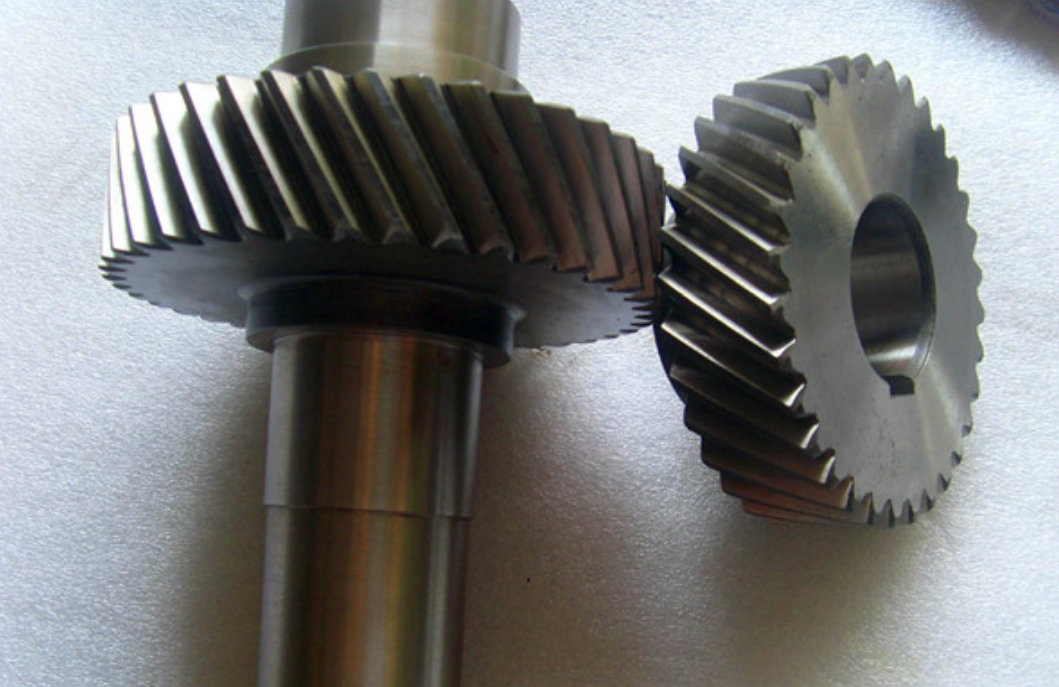
The helical gear system comprises three components: the shaft gear, piston gear, and cylinder gear (Figure 1). Key parameters include module (m), number of teeth (z), and helix angle (β). Constraints are derived from material strength, manufacturing limits, and operational requirements:
- Tooth Number: 17≤z≤50 (to avoid undercutting).
- Module: 1.0≤m≤4.0, validated via bending stress criteria:m≥12.63Ψdz2σFPKTcos2βYFSYϵβwhere K = load correction factor, T = torque, Ψd = width coefficient, and YFS, Yϵβ = composite factors.
- Helix Angle: 20∘≤β≤44∘.
- Shaft Diameter: d1≥1.13π[τT]16KT, where [τT] = allowable shear stress.
2.2 Volume Minimization Objective
The total volume (V) of helical gears is expressed as:V=4π(cosβmz1)2b1+[4π(cosβmz3)2−4π(cosβmz1)2]b2+[4πd42−4π(cosβmz3)2]b3
where b1,b2,b3 = gear widths, and d4 = cylinder bore diameter.
The fitness function for AGA is defined as f(xi)=V−1, prioritizing lower-volume configurations.
3. Adaptive Genetic Algorithm Design
3.1 Algorithm Parameters
The AGA employs dynamic crossover (Pc) and mutation (Pm) rates to enhance convergence:Pc={K1+favg(K2−K1)f′,K2,f′<favgf′≥favgPm={K3+fmax−favg(K4−K3)(fmax−f′),K4,f′>favgf′≤favg
where K1=0.2, K2=0.7, K3=0.05, K4=0.2.
| Parameter | Traditional GA | Adaptive GA |
|---|---|---|
| Population Size | 500 | 500 |
| Generations | 30 | 30 |
| Crossover Rate (Pc) | 0.6 | Dynamic |
| Mutation Rate (Pm) | 0.05 | Dynamic |
3.2 Implementation Workflow
- Initialization: Generate a population of 500 individuals with random m, z, and β values.
- Fitness Evaluation: Calculate f(xi) for each individual.
- Selection: Use tournament selection to retain high-fitness candidates.
- Crossover/Mutation: Apply dynamic Pc and Pm to diversify the population.
- Elitism: Preserve the top 10% of individuals to prevent regression.
4. Results and Analysis
4.1 Optimization Outcomes
After 30 generations, the AGA reduced helical gear volume by 5.87% compared to traditional methods. Key optimized parameters:
| Parameter | Initial Design | Optimized Design |
|---|---|---|
| Module (m) | 3.5 | 3.1 |
| Teeth (z1/z3) | 24/38 | 22/35 |
| Helix Angle (β) | 30° | 38° |
| Volume (V, mm³) | 1,892,000 | 1,781,000 |
4.2 Convergence Behavior
The AGA demonstrated superior convergence speed, achieving 90% of the total fitness improvement within 15 generations (Figure 2). Traditional GA required 25 generations for comparable results.
5. Discussion
- Efficiency: AGA’s dynamic parameter adjustment reduced computational time by 40% compared to static GA.
- Design Flexibility: Multiple near-optimal solutions were identified, offering alternatives for material or manufacturing constraints.
- Robustness: Constraints on d1, m, and β ensured all solutions met mechanical strength criteria.
6. Conclusion
This study validates the efficacy of adaptive genetic algorithms in helical gear optimization. By integrating Python-driven computational models and dynamic parameter tuning, the proposed framework significantly reduces design iteration time and production costs. Future work will explore multi-objective optimization for noise reduction and fatigue life enhancement.