
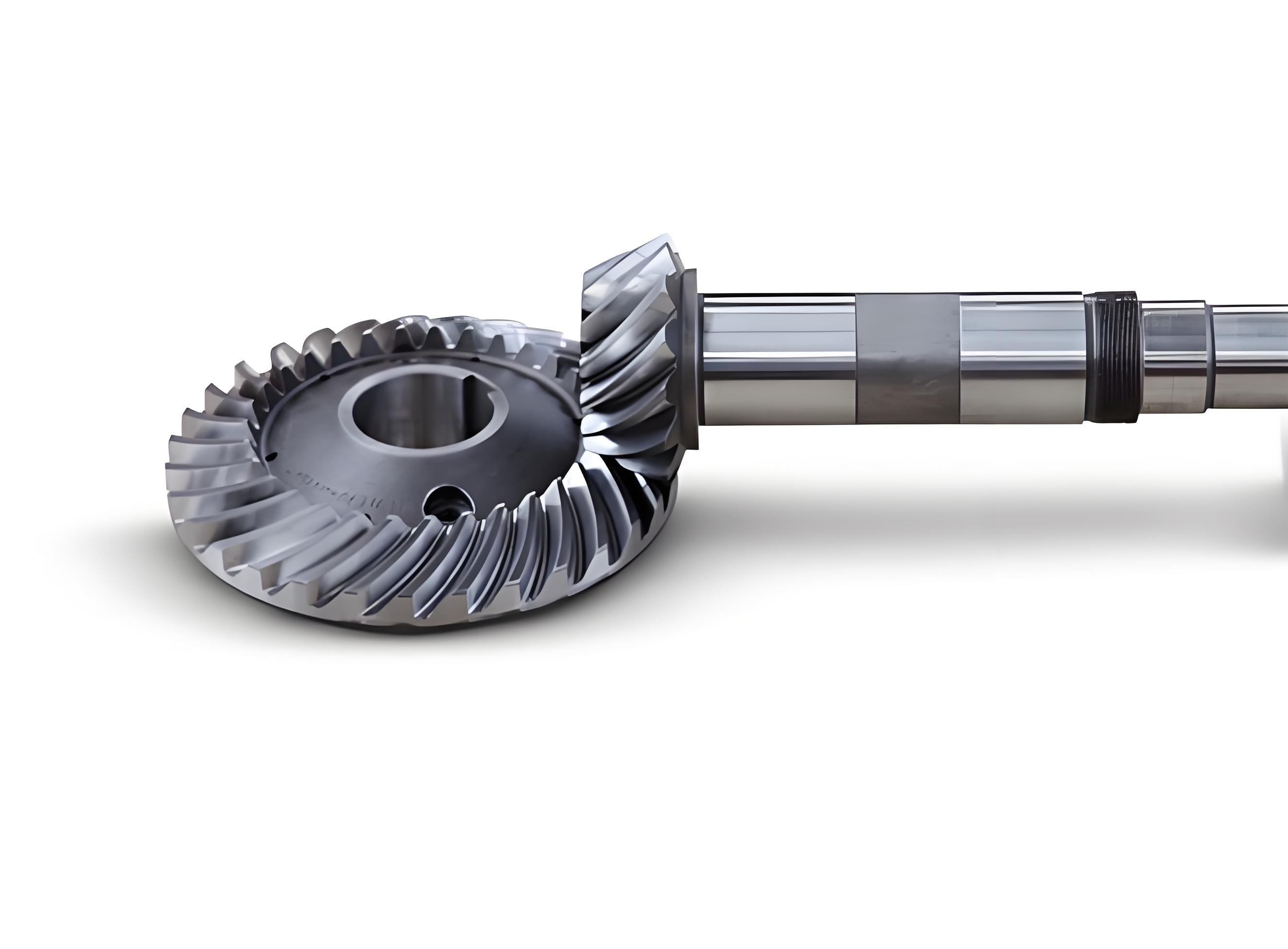
In the realm of heavy-duty vehicle and military aircraft transmission systems, spiral bevel gears play a pivotal role due to their ability to transmit power between intersecting axes with high efficiency. The final machining step, grinding, critically influences the surface topography of these gears, which directly impacts their service life, noise generation, and fatigue resistance. This study focuses on simulating and experimentally validating the grinding surface topography of spiral bevel gears by modeling abrasive particle trajectories and wheel surface characteristics. The interplay between grinding parameters and surface morphology is systematically explored to optimize manufacturing processes.
1. Introduction
Spiral bevel gears are integral to high-precision transmission systems, where surface quality dictates operational reliability. Traditional grinding surface studies often focus on planar or cylindrical geometries, neglecting the complex curvature variations inherent in spiral bevel gears. This research addresses this gap by developing a kinematic model of abrasive particle motion tailored to spiral bevel gear grinding. By correlating simulated results with experimental data, we establish a robust framework for predicting surface topography under diverse grinding conditions.
2. Methodology
2.1 Kinematic Model of Abrasive Particle Motion
The grinding process involves the interaction between abrasive particles on the wheel and the gear surface. Key assumptions include:
- The wheel envelope is idealized.
- Vibration effects are negligible.
- Material removal is complete at the particle-workpiece interface.
- Side flow and chip adhesion are excluded.
For a single abrasive particle, the trajectory is derived from the superposition of wheel rotation and workpiece motion. Let riri denote the distance from the particle to the wheel center, nsns the wheel speed (rpm), and vwvw the workpiece velocity. The instantaneous coordinates (xi,zi)(xi,zi) of the particle in the workpiece coordinate system are:{xi=risinθ+vwt,zi=ri(1−cosθ),{xi=risinθ+vwt,zi=ri(1−cosθ),
where θ=2πnst60θ=602πnst. For adjacent particles, trajectories are offset by the angular spacing ΔθΔθ, leading to overlapping切削痕迹 that collectively form the final surface morphology.
2.2 Wheel Surface Topography Modeling
The wheel surface is characterized by abrasive grain size MM, which follows a Gaussian distribution. The average grain diameter dgavgdgavg and maximum diameter dgmaxdgmax are given by:dgmax=1.52M−1,dgavg=68M−1.4.dgmax=1.52M−1,dgavg=68M−1.4.
The height distribution hihi of grains is modeled as:f(hi)=1σ2πexp(−(hi−μ)22σ2),f(hi)=σ2π1exp(−2σ2(hi−μ)2),
where μ=dgavgμ=dgavg and σ=dgmax−dgavg3σ=3dgmax−dgavg.
2.3 Surface Topography Simulation
The workpiece surface topography is generated by mapping the minimum value of all abrasive trajectories onto a discretized grid. For grid point (m,n)(m,n), the surface height z(m,n)z(m,n) is:z(m,n)=min(gij(m,n)),z(m,n)=min(gij(m,n)),
where gijgij represents the trajectory of the jj-th grain in the ii-th axial section.
3. Experimental Setup
Grinding experiments were conducted on a Gleason-600G machine using spiral bevel gears with a module of 10 mm. Key parameters included:
- Grinding speed vsvs: 10–25 m/s
- Depth of cut apap: 0.01–0.09 mm
- Grain size MM: 46–180
Surface roughness RaRa was measured using a profilometer (CCI Lite-M112).
4. Results and Discussion
4.1 Effect of Grinding Parameters
| Parameter | Range | RaRa (μm) | Trend |
|---|---|---|---|
| Grinding speed vsvs | 10–25 m/s | 0.12–0.25 | Ra↓Ra↓ as vs↑vs↑ |
| Depth of cut apap | 0.01–0.09 mm | 0.15–0.35 | Ra↑Ra↑ as ap↑ap↑ |
| Grain size MM | 46–180 | 0.10–0.30 | Ra↓Ra↓ as M↑M↑ |
Higher grinding speeds reduce RaRa by minimizing塑性变形, while larger apap increases切削厚度, exacerbating surface irregularities. Finer grains (M↑M↑) produce smoother surfaces due to reduced grain protrusion heights.
4.2 Simulation vs. Experiment
Simulated and experimental surface profiles for vs=20 m/s,ap=0.03 mm,M=46vs=20m/s,ap=0.03mm,M=46 exhibited strong agreement, with RaRa deviations <8%. This validates the model’s capability to predict螺旋伞齿轮 grinding topography.
5. Conclusion
This study establishes a kinematic model for predicting the grinding surface topography of spiral bevel gears, validated through rigorous experimentation. Key findings include:
- Increasing grinding speed and grain size enhances surface finish.
- Depth of cut inversely correlates with surface quality.
- The proposed model reliably simulates spiral bevel gear surface morphology, aiding in process optimization.
Future work will integrate thermal and dynamic effects to further refine predictive accuracy.