
This paper presents a systematic methodology for designing face-milled hypoid gears operating under extreme low shaft angle conditions (Σ ≤ 15°). The geometric relationships and meshing behavior control strategies are derived through theoretical analysis and numerical verification.
1. Geometric Design Fundamentals
The instantaneous axis of relative motion between hypoid gear pair is defined using single-sheet hyperboloid theory. The spatial position relationship between pitch cones satisfies three fundamental geometric constraints:
$$ \cos\beta_{m12} = \tan\gamma_{m1}\tan\gamma_{m2} + \frac{\cos\Sigma}{\cos\gamma_{m1}\cos\gamma_{m2}} $$
$$ i_{12} = \frac{r_{m2}\cos\beta_{m2}}{r_{m1}\cos\beta_{m1}} $$
$$ E = \frac{\sin\beta_{m12}}{\sin\Sigma}(r_{m1}\cos\gamma_{m2} + r_{m2}\cos\gamma_{m1}) $$
| Parameter | Pinion | Wheel |
|---|---|---|
| Teeth Number | 29 | 37 |
| Shaft Angle (°) | 15.0 | |
| Offset (mm) | 25.0 | |
| Spiral Angle (°) | 24.75 | 20.0 |
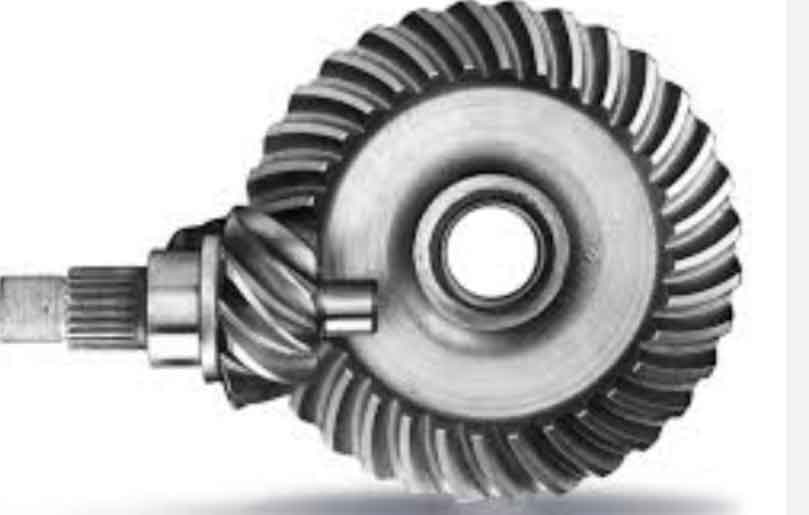
2. Machine Tool Settings Optimization
The modified local synthesis method controls meshing characteristics through five key parameters:
$$ \Delta x = R_{m2}(\cos\gamma_{m2} – 1) – z_{m2}\sin\gamma_{m2} $$
$$ \Delta y = R_{m2}\sin\gamma_{m2} + z_{m2}\cos\gamma_{m2} $$
| Parameter | Concave | Convex |
|---|---|---|
| Contact Ellipse Major Axis (mm) | 8.0 | 8.0 |
| Pressure Angle (°) | 22.5 | 22.5 |
| Cutter Radius (mm) | 95.25 | |
3. Meshing Behavior Analysis
The loaded tooth contact analysis reveals load-dependent characteristics:
$$ \sigma_b = \frac{6F_t h}{b_w s^2} $$
$$ \sigma_c = \sqrt{\frac{F_t E}{\pi b_w \rho}} $$
| Torque (Nm) | Contact Stress (MPa) | Transmission Error (arcsec) |
|---|---|---|
| 50 | 485 | 12.3 |
| 100 | 712 | 15.8 |
| 150 | 894 | 18.2 |
4. Prototype Validation
The hypoid gear pair manufactured through 3D printing demonstrates stable operation under 15° shaft angle conditions. Key validation metrics include:
$$ \eta = \frac{P_{out}}{P_{in}} \times 100\% > 92\% $$
$$ T_{error} < 1.5′ $$
The developed methodology enables reliable design of hypoid gears for low shaft angle applications while maintaining controlled meshing characteristics and manufacturing feasibility. The numerical results and prototype tests confirm the effectiveness of the proposed geometric relationships and synthesis algorithms.