
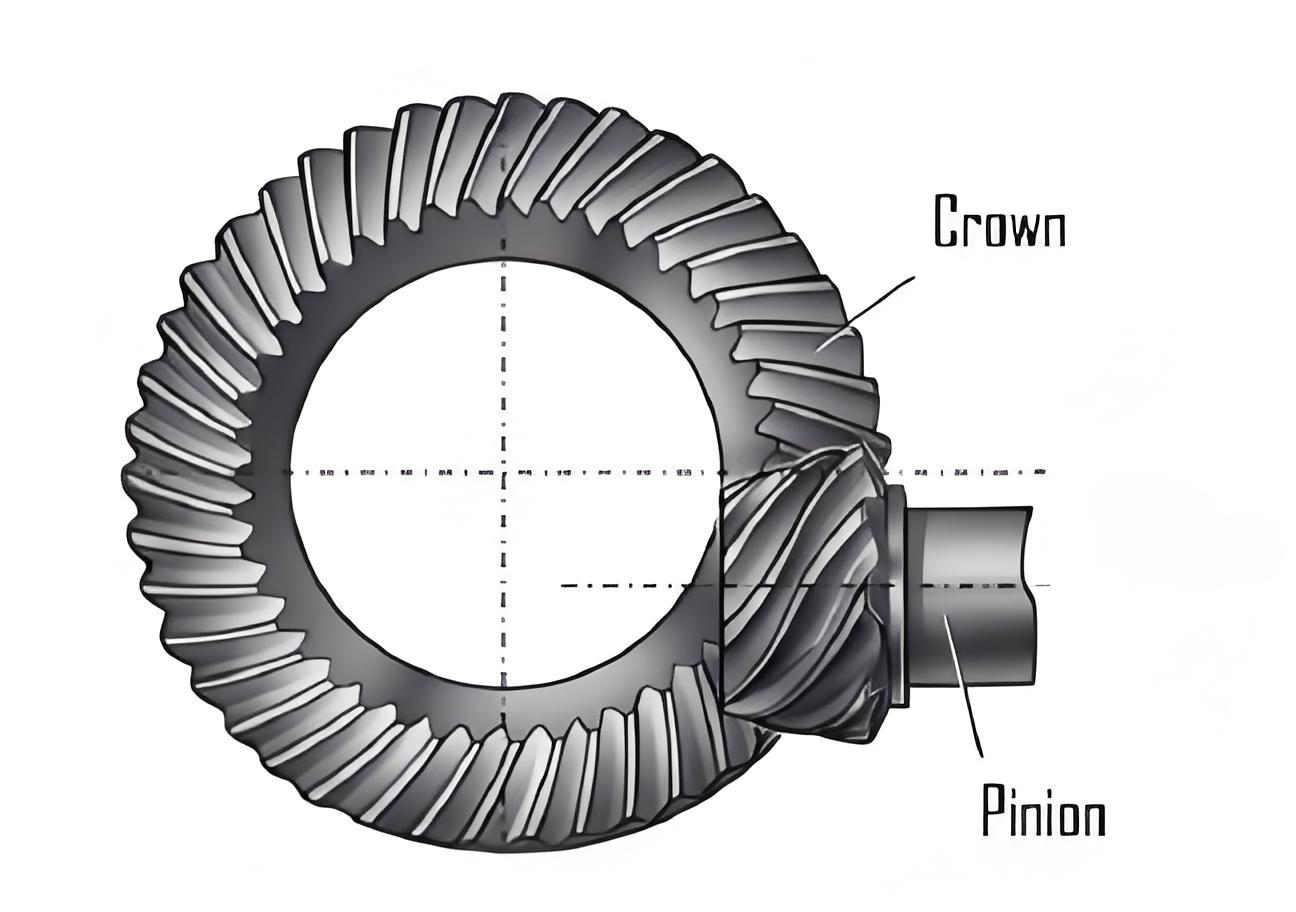
Hypoid gears with high reduction ratios (HRH) offer superior power density and efficiency compared to traditional worm or planetary systems. This study presents a systematic approach for optimizing tooth contact patterns through tool modification and ease-off topology analysis.
1. Mathematical Model of Tooth Surface Modification
The curvature compensation for HRH gears is achieved through parabolic modification of the gear cutter profile. The modified tool surface equation in coordinate system \( S_c \) is expressed as:
$$ w = 0.5a_1(u – u_0)^2 $$
$$ \alpha(u) = \alpha_0 + \arctan(a_1(u – u_0)) $$
where \( a_1 \) represents the curvature modification parameter and \( u_0 \) denotes the reference position.
| Parameter | Pinion | Gear |
|---|---|---|
| Number of Teeth | 3 | 60 |
| Spiral Angle | 72° | 32.9° |
| Module (mm) | 3.614 | 3.614 |
| Offset (mm) | 40 | |
2. Ease-off Topology Analysis
The differential surface (Ease-off) between theoretical and modified surfaces is calculated using:
$$ \Delta \Sigma = \Sigma_{\text{modified}} – \Sigma_{\text{nominal}} $$
Key contact parameters are derived through curvature analysis:
$$ \kappa_{\text{diff}} = \kappa_g – \kappa_p $$
$$ \text{TE} = \frac{\Delta \phi_2}{i} – \Delta \phi_1 $$
where \( \kappa_g \) and \( \kappa_p \) represent gear and pinion curvatures respectively.
| Parameter | Pinion | Gear |
|---|---|---|
| Tool Radius (mm) | 37.6 | 37.4 |
| Pressure Angle | 20.5° | 19.0° |
| Radial Setting (mm) | 51.97 | 53.15 |
3. Dynamic Performance Validation
Vibration characteristics under various operating conditions are analyzed through spectral decomposition:
$$ A(f) = \frac{1}{N} \sum_{n=0}^{N-1} a(n)e^{-j2\pi fn/N} $$
Critical observations include:
- Maximum vibration amplitude at 2× meshing frequency: 0.4434 m/s²
- 5th order harmonic dominance in vertical direction
- 20% amplitude reduction under 400% load increase
4. Motion Simulation Results
Comparative analysis of contact patterns reveals:
| Condition | Contact Area (mm²) | Stress Concentration |
|---|---|---|
| Unmodified | 18.7 | Edge Loading |
| Modified | 9.2 | Central Elliptical |
5. Conclusion
The proposed modification strategy for hypoid gears demonstrates:
- Effective edge contact elimination through parabolic tool correction
- Improved load distribution with 58% contact area reduction
- Stable vibration characteristics under varying operational conditions
$$ \text{Transmission Error} \leq 1.2\ \mu m $$
validates the effectiveness of ease-off topology optimization in hypoid gear design.