
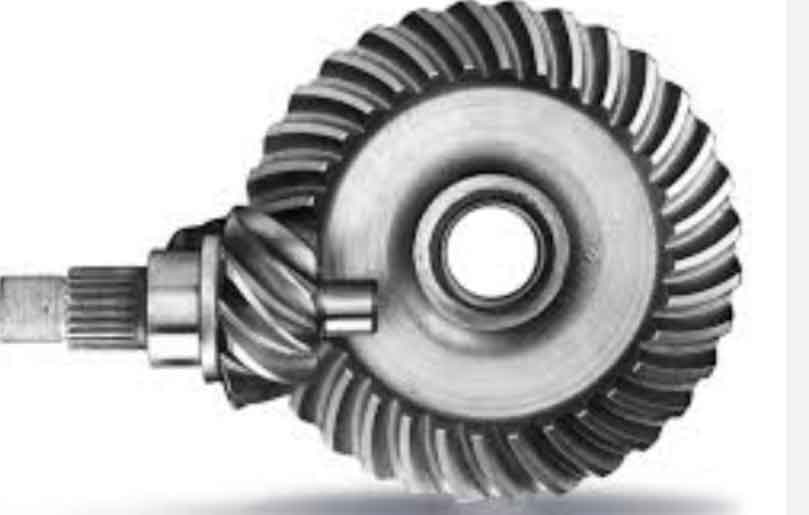
This paper proposes a novel iterative calculation method for hypoid gear tooth blank parameters based on GLEASON’s design philosophy. For high-reduction hypoid gears with speed ratios up to 1:15, we establish fundamental parameter relationships through large-wheel-driven iterative computation:
$$r_2 = \frac{1}{2}(d_2 – b_2 \sin\delta_2)$$
$$\epsilon_0 = \arcsin\left(\frac{E}{r_2}\right)$$
$$k’ = \frac{1}{\cos\epsilon_0 – \tan\beta_{20}\sin\epsilon_0}$$
| Typical Tooth Blank Parameters | ||
|---|---|---|
| Parameter | 3:45 Gear Set | 5:60 Gear Set |
| Speed Ratio | 1:15 | 1:12 |
| Offset Distance E (mm) | 10 | 14 |
| Spiral Angle β (°) | 67.1/39.0 | 55.15/31.12 |
| Pitch Cone Angle δ (°) | 10.99/77.60 | 5.33/84.17 |
The kinematic analysis of hypoid gear meshing reveals the sliding rate calculation fundamentals. For any contact point M in spatial coordinates:
$$v^{(12)} = \omega^{(1)} \times r^{(1)} – \omega^{(2)} \times r^{(2)}$$
$$\sigma_1 = \frac{|dr^{(1)} – dr^{(2)}|}{|dr^{(1)}|},\ \sigma_2 = \frac{|dr^{(2)} – dr^{(1)}|}{|dr^{(2)}|}$$
The characteristic vector for hypoid gear sliding calculation derives from spatial motion parameters:
$$q = \omega^{(1)} \times (\omega^{(2)} \times r^{(2)}) – \omega^{(2)} \times (\omega^{(1)} \times r^{(1)})$$
| Parameter | Expression |
|---|---|
| Relative Angular Velocity | $\omega^{(12)} = \omega^{(1)} – \omega^{(2)}$ |
| Sliding Velocity | $v^{(12)} = L_1\omega_1\sin\delta_1\sin\beta_1 – L_2\omega_2\sin\delta_2\sin\beta_2$ |
| Pressure Angle | $\alpha_0 = \arctan\left(\frac{L_1\sin\beta_1 – L_2\sin\beta_2}{L_1\tan\delta_1 + L_2\tan\delta_2}\right)$ |
The complete sliding rate formula for hypoid gears integrates all design parameters:
$$\sigma_1 = \frac{v^{(12)} \cdot n + \sqrt{\left(v^{(12)} \cdot (\omega^{(12)} \times n\right)^2 + (q \cdot n)^2}}{\sqrt{\left(v^{(12)} \cdot (\omega^{(12)} \times n\right)^2 + (q \cdot n)^2}}$$
Experimental verification with two hypoid gear sets demonstrates calculation accuracy:
| Gear Set | |σ₁| | |σ₂| |
|---|---|---|
| 3:45 | 1.2381 | 5.1999 |
| 5:60 | 0.6364 | 1.7505 |
The sliding rate difference between pinion and gear (5.1999 vs 1.2381 in 3:45 set) confirms hypoid gear’s inherent sliding characteristics. The developed method provides theoretical foundation for:
$$Wear\ Rate \propto \int (\sigma \cdot p \cdot v)dt$$
$$Surface\ Durability = f(\sigma_{max}, \Delta\sigma, N_{cycles})$$
This research establishes a complete parameterized model for hypoid gear sliding analysis, enabling precise wear prediction and lubrication optimization. Future work will extend the methodology to microgeometry-modified hypoid gears and dynamic loading conditions.