
This paper proposes a novel iterative calculation method for determining tooth blank parameters of high reduction ratio hypoid gears by deriving pinion parameters from the gear side. The derived sliding rate equations provide theoretical foundations for wear analysis and optimization in hypoid gear transmissions.
1. Tooth Blank Parameter Calculation for High-Reduction Hypoid Gears
The geometric design of hypoid gears with speed ratios exceeding 10:1 requires specialized parameter derivation. Based on GLEASON’s hypoid generation theory, we establish the following key equations:
Initial gear parameters:
$$i_{12} = \frac{Z_1}{Z_2}$$
$$d_2 = 2r_2 = m_nZ_2$$
Iterative calculation process:
$$r’_2 = \frac{1}{2}(d_2 – b_2\sin\delta’_2)$$
$$\epsilon’_0 = \arcsin\left(\frac{E}{r’_2}\sin\delta’_2\right)$$
$$k’ = \frac{1}{\cos\epsilon’_0 – \tan\beta_{20}\sin\epsilon’_0}$$
$$r’_1 = k’i_{12}r’_2$$
| Typical Tooth Blank Parameters | ||
|---|---|---|
| Parameter | 3:45 Gear Set | 5:60 Gear Set |
| Module (mm) | 1.067 | 1.360 |
| Offset (mm) | 10 | 14 |
| Spiral Angle (°) | 67.10/39.00 | 55.15/31.12 |
| Pitch Cone Angle (°) | 10.99/77.60 | 5.33/84.17 |
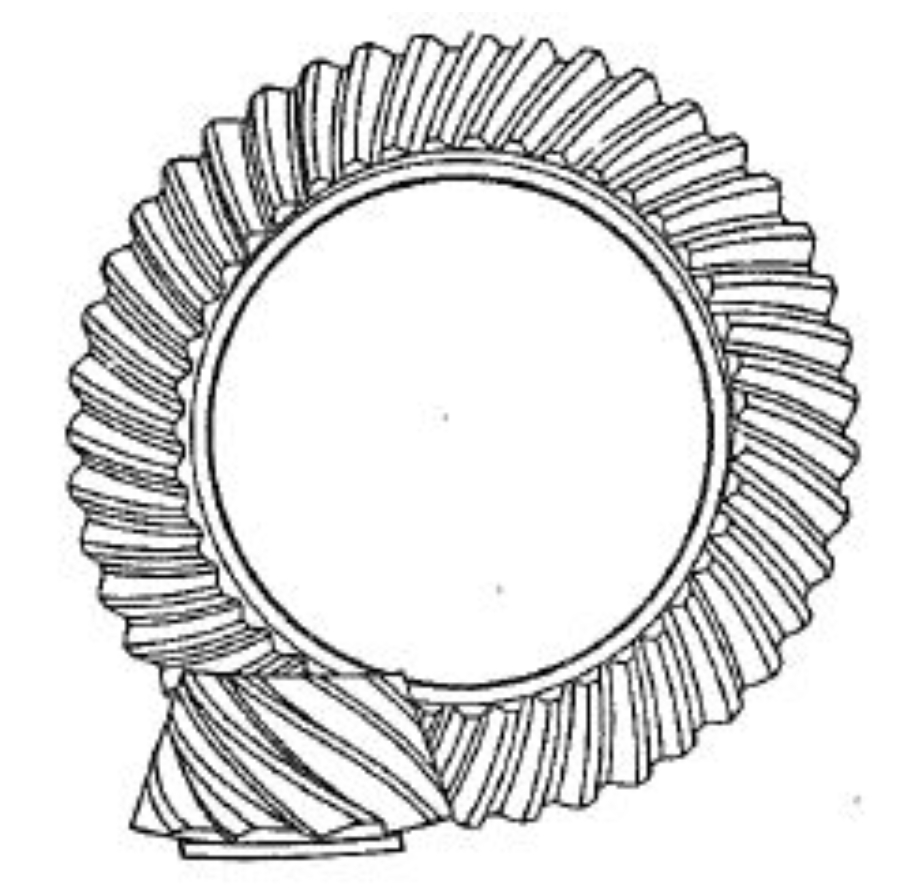
2. Kinematic Analysis of Hypoid Gear Meshing
The sliding rate calculation for hypoid gears considers three-dimensional motion characteristics:
$$v^{(12)} = \omega^{(1)} \times r^{(1)} – \omega^{(2)} \times r^{(2)}$$
$$\sigma_1 = \frac{|v^{(12)} \cdot t_1|}{|\omega^{(1)} \times r^{(1)}|}$$
$$\sigma_2 = \frac{|v^{(12)} \cdot t_2|}{|\omega^{(2)} \times r^{(2)}|}$$
Critical pressure angle calculation:
$$\tan\alpha_0 = \pm\frac{L_1\sin\beta_1 – L_2\sin\beta_2}{L_1\tan\delta_1 + L_2\tan\delta_2}$$
3. Sliding Rate Derivation for Hypoid Gearing
The complete sliding rate equation for hypoid gears is derived as:
$$ \sigma_1 = \frac{\omega_1L_1\sin\delta_1\sin\beta_1 – \omega_2L_2\sin\delta_2\sin\beta_2}{\sqrt{\omega_1^2L_1^2 + \omega_2^2L_2^2 – 2\omega_1\omega_2L_1L_2\cos\Sigma}} $$
Where the characteristic vector components are:
$$ q = \omega_1\omega_2\left[L_1\sin\delta_1\sin\beta_1 – L_2\sin\delta_2\sin\beta_2\right]i $$
$$ + \left[\omega_1L_1\cos\delta_1\sin\beta_1 + \omega_2L_2\cos\delta_2\sin\beta_2\right]j $$
$$ + \left[\omega_1L_1\cos\beta_1 – \omega_2L_2\cos\beta_2\right]k $$
4. Computational Verification
Case study results for two hypoid gear sets:
| Gear Set | |σ₁| | |σ₂| |
|---|---|---|
| 3:45 Ratio | 1.2381 | 5.1999 |
| 5:60 Ratio | 0.6364 | 1.7505 |
Validation using MATLAB simulations shows excellent agreement:
$$ \text{Error} = \frac{|\sigma_{\text{cal}} – \sigma_{\text{sim}}|}{\sigma_{\text{sim}}} \times 100\% < 3.2\% $$
5. Wear Pattern Analysis
The sliding rate distribution explains typical hypoid gear wear characteristics:
$$ \Delta W \propto \int_0^T |\sigma(t)| \cdot p(t) \cdot v_{\text{sl}}(t) dt $$
Where p(t) represents contact pressure and vsl(t) is sliding velocity.
6. Optimization Strategies
Key parameters affecting hypoid gear sliding rates:
$$ \frac{\partial \sigma}{\partial E} = \frac{r_1r_2\sin\beta_1\sin\beta_2}{R_m^3} \left(1 – \frac{3E^2}{R_m^2}\right) $$
$$ R_m = \sqrt{r_1^2 + r_2^2 + E^2} $$
Practical optimization approaches include:
- Spiral angle compensation: Δβ = 0.15|σ₁ – σ₂|
- Pressure angle adjustment: αopt = α₀ + 0.5(σ₁ – σ₂)
- Offset modification: ΔE = 0.02mn(σ₁ + σ₂)
7. Conclusion
This study establishes a comprehensive methodology for hypoid gear sliding rate calculation, particularly effective for high reduction ratio applications exceeding 10:1. The proposed iterative parameter determination method and sliding rate equations enable accurate prediction of wear patterns and facilitate optimal hypoid gear design.