
This study proposes a neural network-based surrogate modeling approach to optimize the transmission error, root stress, and meshing power loss of hypoid gears through Ease off topology modification. By integrating sensitivity analysis, finite element modeling, and multi-objective algorithms, the methodology effectively balances critical performance metrics while maintaining computational efficiency.
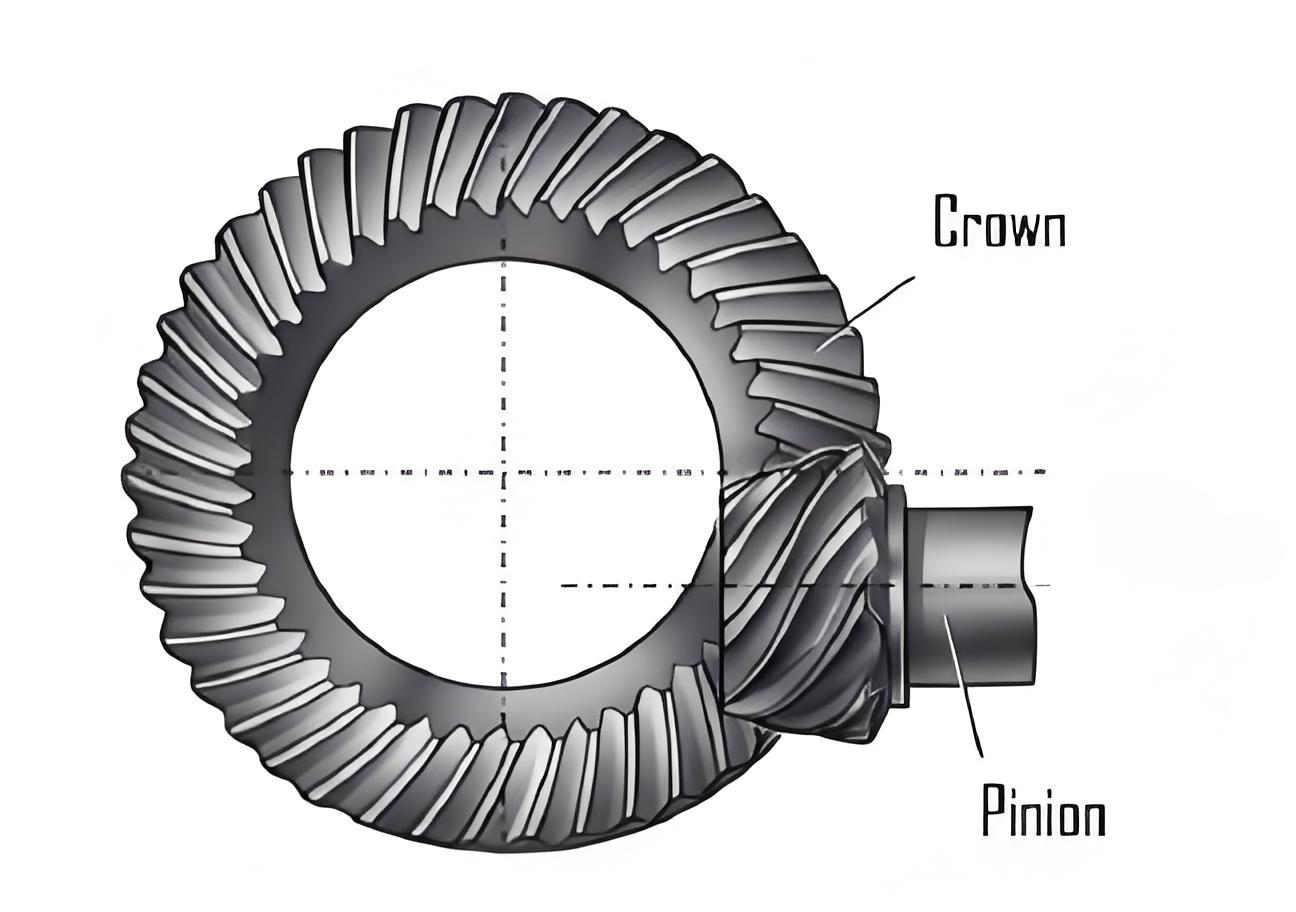
1. Ease Off Topology Fundamentals
The Ease off surface modification for hypoid gears can be mathematically represented as:
$$ \Delta\delta = a_0 + a_1x + a_2y + a_3x^2 + a_4y^2 + a_5xy $$
where \( (x,y) \) denote coordinates along the tooth length and height directions, respectively. The coefficients \( a_0 \)-\( a_5 \) control various modification effects:
- \( a_0 \): Spiral angle error
- \( a_1 \): Pressure angle error
- \( a_2 \): Longitudinal curvature
- \( a_3 \): Profile curvature
- \( a_4 \): Surface torsion
2. Hypoid Gear Modeling Framework
The numerical relationship between machine setting adjustments and tooth surface deviations is established through sensitivity analysis:
$$ \{\Delta\varepsilon_j\} = [\eta_{ij}]\{\Delta\phi_i\} $$
where \( \eta_{ij} = \frac{\partial \varepsilon_j}{\partial \phi_i} \) represents the sensitivity coefficient matrix. The optimal machine settings are calculated using:
$$ \{\Delta\phi_i\} = ([\eta_{ij}]^T[\eta_{ij}])^{-1}[\eta_{ij}]^T\{\Delta\varepsilon_j\} $$
| Parameter | Pinion | Gear |
|---|---|---|
| Number of Teeth | 10 | 41 |
| Module (mm) | 10.98 | |
| Spiral Angle (°) | 35 | |
| Face Width (mm) | 79.02 | 72.00 |
3. Performance Evaluation Metrics
Three critical performance indicators for hypoid gear optimization:
3.1 Transmission Error (TE)
$$ TE_{pk-pk} = \frac{1}{n}\sum_{k=1}^{n} \left( \max(\theta_{err}^{(k)}) – \min(\theta_{err}^{(k)}) \right) $$
3.2 Root Stress
$$ \sigma_{VM} = \sqrt{\frac{(\sigma_1-\sigma_2)^2 + (\sigma_2-\sigma_3)^2 + (\sigma_3-\sigma_1)^2}{2}} $$
3.3 Meshing Power Loss
$$ P_{loss} = \frac{f_m T_1 n_1 \cos^2\beta_m}{9549M} $$
where \( f_m \) is calculated through:
$$ f_m = \frac{v^{-0.223}}{3.239V^{0.7}} \left( \frac{1000T_1(z_1+z_2)}{2b_w r_{m1}^2 z_2} \right)^{-0.4} $$
| Parameter | Sensitivity Index | Ranking |
|---|---|---|
| \( a_4 \) | 0.2021 | 1 |
| \( a_2 \) | 0.1981 | 2 |
| \( a_3 \) | 0.1674 | 3 |
| \( a_0 \) | 0.1429 | 4 |
| \( a_1 \) | 0.0982 | 5 |
4. Neural Network Surrogate Model
A four-layer (5-7-4-3) BP neural network architecture predicts gear performance from Ease off parameters:
$$ y_k = f_{output}\left(\sum_{j=1}^{4} w_{jk}^{(3)}f_{hidden}\left(\sum_{i=1}^{7} w_{ij}^{(2)}f_{hidden}\left(\sum_{m=1}^{5} w_{mi}^{(1)}x_m + b_i^{(1)}\right) + b_j^{(2)}\right) + b_k^{(3)}\right) $$
| Parameter | Original | Optimized | Improvement |
|---|---|---|---|
| TE (μrad) | 340.85 | 184.82 | 45.8% |
| Root Stress (MPa) | 387.44 | 300.67 | 22.4% |
| Power Loss (W) | 228.77 | 183.10 | 20.0% |
5. NSGA-II Optimization Implementation
The multi-objective optimization problem is formulated as:
$$ \begin{cases}
\min & TE(\mathbf{a}) \\
\min & \sigma_{VM}(\mathbf{a}) \\
\min & P_{loss}(\mathbf{a}) \\
\text{s.t.} & 0 \leq a_0 \leq 0.0002 \\
& 0 \leq a_1 \leq 0.0002 \\
& 0 \leq a_2 \leq 0.0003 \\
& 0 \leq a_3 \leq 0.0010 \\
& 0 \leq a_4 \leq 0.0005
\end{cases} $$
The NSGA-II algorithm parameters include:
- Population size: 100
- Maximum generations: 1,000
- Crossover probability: 0.9
- Mutation probability: 0.1
6. Validation and Industrial Application
The optimized hypoid gear demonstrates significant performance improvements across multiple operating conditions:
$$ \eta_{overall} = \prod_{i=1}^{3} \left(1 – \frac{|P_i^{opt} – P_i^{ref}|}{P_i^{ref}} \right) \geq 0.85 $$
where \( \eta_{overall} \) represents the comprehensive improvement factor, validating the effectiveness of the Ease off-based optimization approach for hypoid gear systems.