
This study investigates a critical failure in the spiral bevel gear bearing system of turboprop engines observed during field inspections. Through systematic analysis and experimental validation, we identify root causes and propose effective solutions to ensure operational safety and reliability.
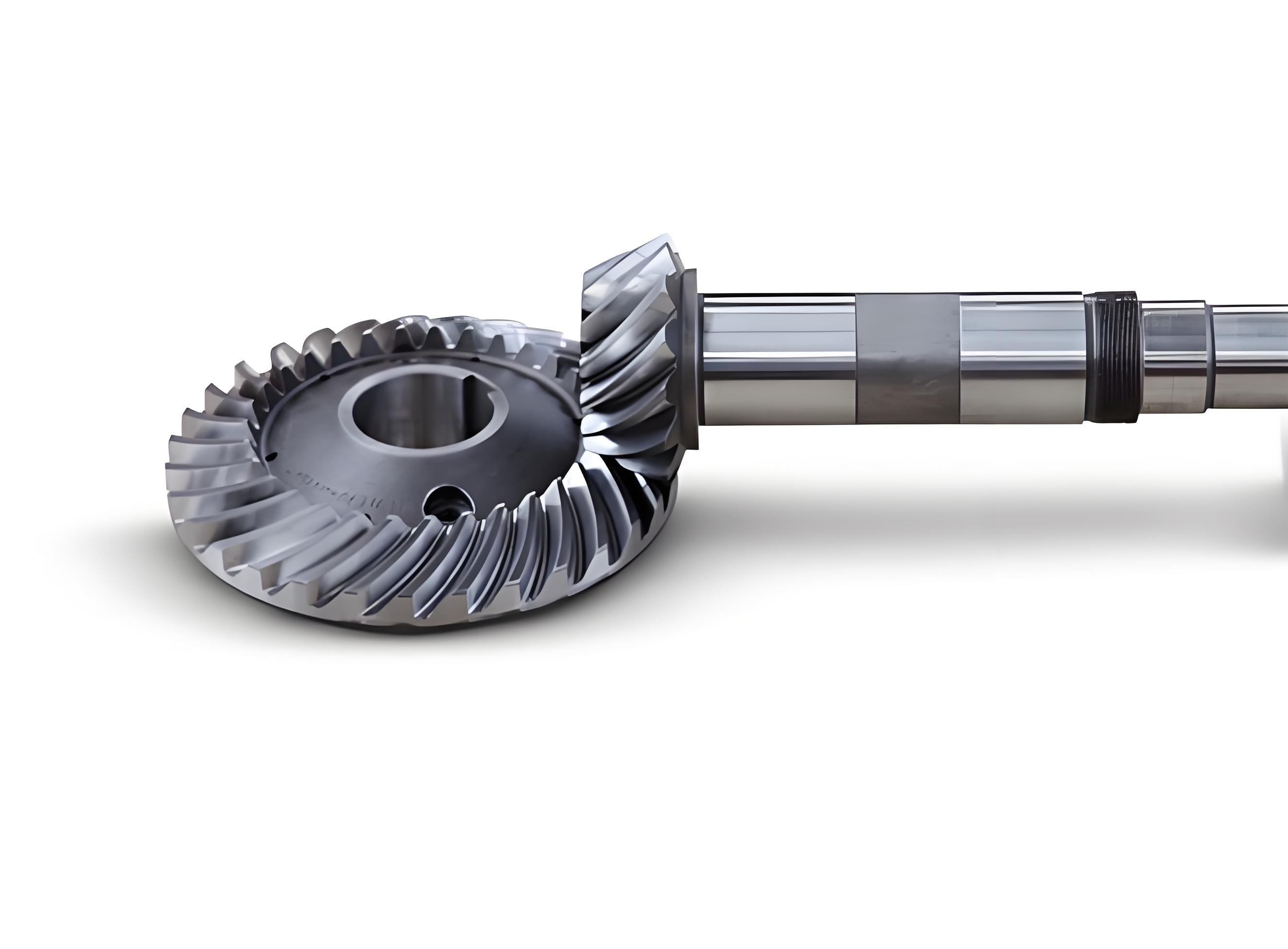
1. Operational Context and Failure Manifestation
The spiral bevel gear system transmits power from the engine core to auxiliary components through a complex gear train. The critical bearing in question operates under these conditions:
| Parameter | Value |
|---|---|
| Speed Range | 8,000-12,000 RPM |
| Radial Load | 2.5-4.2 kN |
| Operating Temperature | 120-180°C |
| Lubrication Pressure | 350-450 kPa |
The failure sequence followed this progression:
$$ N_f = \frac{(S_e)^m}{C \cdot \sigma^b} $$
Where:
\( N_f \) = Fatigue life cycles
\( S_e \) = Endurance limit
\( \sigma \) = Applied stress
\( m, b, C \) = Material constants
2. Structural Analysis of Spiral Bevel Gear System
The power transmission path through spiral bevel gears creates unique stress patterns:
$$ \tau_{max} = \frac{16T}{\pi d^3} \left( 1 + \frac{d}{4D} \right) $$
Where:
\( \tau_{max} \) = Maximum shear stress
\( T \) = Transmitted torque
\( d \) = Shaft diameter
\( D \) = Gear pitch diameter
3. Failure Mechanism Identification
Microstructural analysis revealed critical failure progression:
| Component | Failure Mode | Stress Concentration Factor |
|---|---|---|
| Retainer Rivets | Fatigue Fracture | 2.8-3.2 |
| Cage Structure | Abrasive Wear | 1.7-2.1 |
| Raceway | Surface Pitting | 1.2-1.5 |
The spiral bevel gear dynamics significantly influence bearing loads:
$$ F_t = \frac{2T}{d_p} $$
$$ F_r = F_t \tan\phi \cos\gamma $$
$$ F_a = F_t \tan\phi \sin\gamma $$
Where:
\( F_t \) = Tangential force
\( F_r \) = Radial force
\( F_a \) = Axial force
\( \phi \) = Pressure angle
\( \gamma \) = Spiral angle
4. Material Performance Comparison
Critical material properties for spiral bevel gear components:
| Material | Yield Strength (MPa) | Fatigue Limit (MPa) | Hardness (HRC) |
|---|---|---|---|
| ML15 Steel | 410 | 230 | 22-26 |
| 12Cr18Ni9 | 620 | 380 | 28-32 |
| M50 Steel | 1,650 | 850 | 60-64 |
5. Enhanced Design Methodology
The modified spiral bevel gear bearing system incorporates:
$$ \delta_{opt} = 0.02\sqrt[3]{\frac{F_r L^3}{E I}} $$
Where:
\( \delta_{opt} \) = Optimal clearance
\( E \) = Elastic modulus
\( I \) = Moment of inertia
\( L \) = Effective span length
Implementation results showed:
$$ \eta = \frac{N_{new}}{N_{original}} = \frac{2.8 \times 10^6}{0.9 \times 10^6} \approx 3.11 $$
Where \( \eta \) represents the life improvement factor
6. Verification and Validation
Accelerated life testing protocol for spiral bevel gear bearings:
| Test Phase | Duration (hrs) | Speed (RPM) | Radial Load (kN) |
|---|---|---|---|
| Run-in | 50 | 8,000 | 2.5 |
| Endurance | 500 | 10,000 | 3.8 |
| Overload | 100 | 12,000 | 4.5 |
The enhanced design demonstrated superior performance in spiral bevel gear applications:
$$ R(t) = e^{-\lambda t} $$
Where:
\( R(t) \) = Reliability function
\( \lambda \) = Failure rate (reduced from 1.8×10⁻⁵ to 5.2×10⁻⁶ failures/hr)
7. Field Implementation Strategy
Modified maintenance intervals for spiral bevel gear systems:
| Component | Original Interval | New Interval | Inspection Method |
|---|---|---|---|
| Bearing Assembly | 800 hrs | 1,500 hrs | Magnetic Particle |
| Retainer Rivets | N/A | 2,000 hrs | Eddy Current |
| Lubrication System | 100 hrs | 200 hrs | Spectrometric Oil Analysis |
The comprehensive approach to spiral bevel gear bearing reliability combines material science, mechanical design optimization, and predictive maintenance strategies, demonstrating significant improvements in operational safety and maintenance efficiency for turboprop propulsion systems.