
This paper presents a novel methodology for computing machining parameters of spiral bevel gears through ease-off surface synthesis, addressing the limitations of conventional point-contact parameterization in controlling meshing performance. By leveraging differential geometry and numerical optimization, the proposed approach enables comprehensive pre-control of tooth contact patterns and transmission error characteristics.
Second-order Osculating Surface Theory
For a generic surface $\Sigma^2$ with second-order continuity, the osculating surface $\Sigma_d$ at point $M$ is defined as:
$$ z = \frac{1}{2}k_x x^2 + \tau x y + \frac{1}{2}k_y y^2 $$
where $k_x$, $k_y$ denote principal curvatures and $\tau$ represents the geodesic torsion. The osculating surface shares identical second-order geometric properties with $\Sigma^2$, enabling equivalent contact analysis through quadratic approximation.
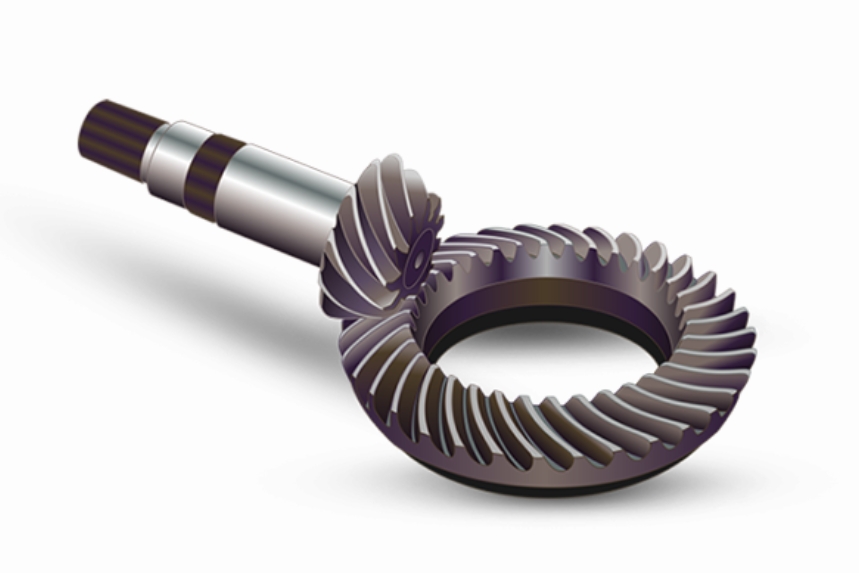
Generative Model of Spiral Bevel Gears
The mathematical model for gear generation considers both pinion and gear manufacturing processes:
| Parameter | Gear | Pinion (Convex) | Pinion (Concave) |
|---|---|---|---|
| Pressure angle $\alpha_i$ (°) | ±20.0 | 18.5 | -21.5 |
| Cutter radius $r_i$ (mm) | 75.2/77.2 | 74.324 | 77.074 |
| Radial setting $S_r$ (mm) | 70.436 | 70.156 | 72.925 |
| Machine root angle $\gamma_m$ (°) | 70.65 | 13.333 | 13.333 |
The gear tooth surface $\Sigma_2$ is generated through kinematic relationships:
$$ \mathbf{r}_2 = \mathbf{M}_{2g} \cdot \mathbf{r}_c $$
$$ \phi_2 = m_{2g} \cdot \phi_g $$
where $\mathbf{M}_{2g}$ represents coordinate transformation matrix and $m_{2g}$ denotes gear ratio.
Ease-off Surface Synthesis
The ease-off surface $\Sigma_d$ between conjugate surfaces is constructed as:
$$ \Delta z = \frac{1}{2}(k_{ax}x^2 + k_{by}y^2) $$
Contact pattern parameters are derived through quadratic analysis:
$$ a = \sqrt{\frac{8\Delta z}{k_a}}, \quad b = \sqrt{\frac{8\Delta z}{k_b}} $$
$$ \tan q = \sqrt{\frac{k_a}{k_b}}, \quad \lambda = \arctan\left(\frac{A_x}{A_y}\right) $$
| Parameter | Designed | Convex | Concave |
|---|---|---|---|
| Length $a$ (mm) | 10.0 | 12.5 | 9.9 |
| Width $b$ (mm) | 4.0 | 3.8 | 4.1 |
| Obliquity $\lambda$ (°) | 30.0 | 32.7 | 25.9 |
Machining Parameter Computation
A constrained optimization framework solves the nonlinear system:
$$ \min \left\| \mathbf{r}_s(u_1,\theta_1) – \mathbf{r}_1(u_0,\theta_0) \right\| $$
$$ \text{subject to: } k_{I,II} = k_{1,2}, \mathbf{e}_{I,II} = \mathbf{e}_{1,2} $$
Key parameters are optimized using sequential quadratic programming with convergence tolerance $10^{-6}$.
Meshing Simulation
The ease-off osculating surface enables complete contact pattern visualization:
$$ TE = \frac{1}{2}k_s s^2 $$
where $k_s$ represents the directional curvature along contact path. Simulation results demonstrate parabolic transmission errors below 15 arcsec under rated load.
Conclusion
The ease-off surface synthesis method provides an effective numerical framework for spiral bevel gear manufacturing parameter computation. By utilizing second-order osculating surfaces, this approach achieves:
- Comprehensive contact pattern control through quadratic parameters
- Numerically stable optimization process
- Accurate prediction of transmission errors
- Improved manufacturing robustness against alignment errors
This methodology significantly advances the digital manufacturing capability for high-performance spiral bevel gears in aerospace and automotive applications.