
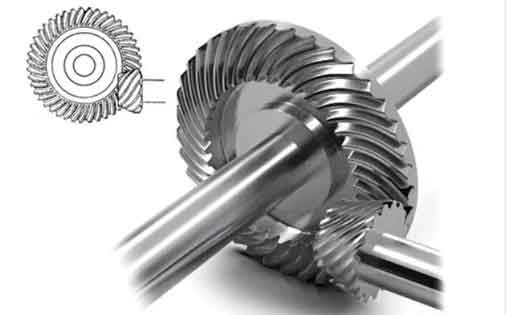
Spiral bevel gears are critical components in helicopter main reduction systems, responsible for transmitting power under extreme operational conditions. These gears must meet stringent requirements for high precision, strength, wear resistance, and lightweight design. However, their complex geometry and thin-walled structures (as thin as 4 mm) introduce significant challenges in controlling heat treatment distortions, particularly after carburizing, quenching, and tempering processes. This article explores deformation compensation strategies for input spiral bevel gears and double spiral bevel gears, focusing on measurement methodologies, thermal process optimization, and machining adaptations.
1. Deformation Measurement and Quantification
Accurate measurement forms the foundation for deformation compensation. For spiral bevel gears, two primary measurement systems are employed:
| Measurement Type | Instrument | Key Parameters |
|---|---|---|
| Tooth Surface Analysis | Gear Measuring Machine | Surface topography, tooth thickness, cumulative pitch error |
| Root Cone Geometry | Coordinate Measuring Machine (CMM) | Root cone distance, installation reference deviations |
The deformation vector $\vec{D}$ can be expressed as:
$$
\vec{D} = \vec{P}_{\text{post}} – \vec{P}_{\text{pre}}
$$
where $\vec{P}_{\text{pre}}$ and $\vec{P}_{\text{post}}$ represent pre- and post-heat treatment geometric parameters respectively.
2. Thermal Deformation Mechanisms
Heat treatment induces three primary deformation modes in spiral bevel gears:
- Radial expansion: $ \Delta r = \alpha \cdot \Delta T \cdot r $
- Axial shrinkage: $ \Delta z = \beta \cdot \sigma_y / E $
- Twist deformation: $ \theta = \gamma \cdot \tau \cdot L / G $
Where:
$\alpha$ = thermal expansion coefficient
$\beta$ = material compressibility factor
$\gamma$ = torsional compliance coefficient
$E$ = Young’s modulus
$G$ = Shear modulus
3. Input Spiral Bevel Gear Compensation
The thin-walled input gear (minimum wall thickness 4 mm) requires multi-stage compensation:
| Compensation Stage | Methodology | Compensation Equation |
|---|---|---|
| Primary Compensation | Pre-heat treatment machining allowance adjustment | $ A_c = k_1 \cdot D_{\text{predicted}} $ |
| Secondary Compensation | Post-heat treatment reference surface modification | $ \Delta S = \frac{\sum_{i=1}^n (m_i – t_i)}{n} $ |
Where $A_c$ represents compensation allowance, $k_1$ the material-specific compensation factor (0.6-1.2 for aerospace steels), and $m_i$, $t_i$ are measured and theoretical dimensions respectively.
4. Double Spiral Bevel Gear Challenges
The dual-gear configuration introduces compounded deformation effects:
$$
D_{\text{total}} = D_{\text{primary}} + D_{\text{secondary}} + D_{\text{interaction}}
$$
Key compensation parameters include:
- Differential carburizing depth control: $ \delta_c = \sqrt{Dt} $ (Fick’s law)
- Phase transformation stress management: $ \sigma_{\text{phase}} = E(\varepsilon_{\text{Austenite}} – \varepsilon_{\text{Martensite}}) $
5. Process Optimization Framework
The developed compensation system follows this analytical workflow:
- Pre-heat treatment prediction:
$$ D_{\text{predict}} = f(\text{material}, \text{geometry}, \text{process parameters}) $$ - In-process monitoring:
$$ \nabla T = \frac{\partial T}{\partial t} + v \cdot \nabla T $$ - Post-treatment compensation:
$$ C_{\text{final}} = C_{\text{nominal}} + \sum_{i=1}^n w_i \cdot \Delta_i $$
6. Implementation Results
Application of these methodologies yielded significant improvements:
| Performance Metric | Before Compensation | After Compensation |
|---|---|---|
| Tooth Profile Accuracy (μm) | 25-35 | 8-12 |
| Radial Runout (mm) | 0.15-0.25 | 0.03-0.05 |
| Scrap Rate (%) | 18-22 | 3-5 |
The spiral bevel gear compensation strategy successfully addresses the conflicting requirements of maintaining carburized layer integrity (HRC60 depth ≥ 0.3 mm) while achieving AGMA 14 precision standards.
7. Conclusion
This systematic approach to spiral bevel gear deformation control integrates thermal process optimization with intelligent machining compensation. Key innovations include:
- Multi-stage predictive compensation models
- Differential carburizing process controls
- Adaptive reference surface correction algorithms
Future developments will focus on real-time distortion monitoring using embedded sensors and machine learning-based compensation prediction systems for spiral bevel gears in next-generation aerospace applications.