
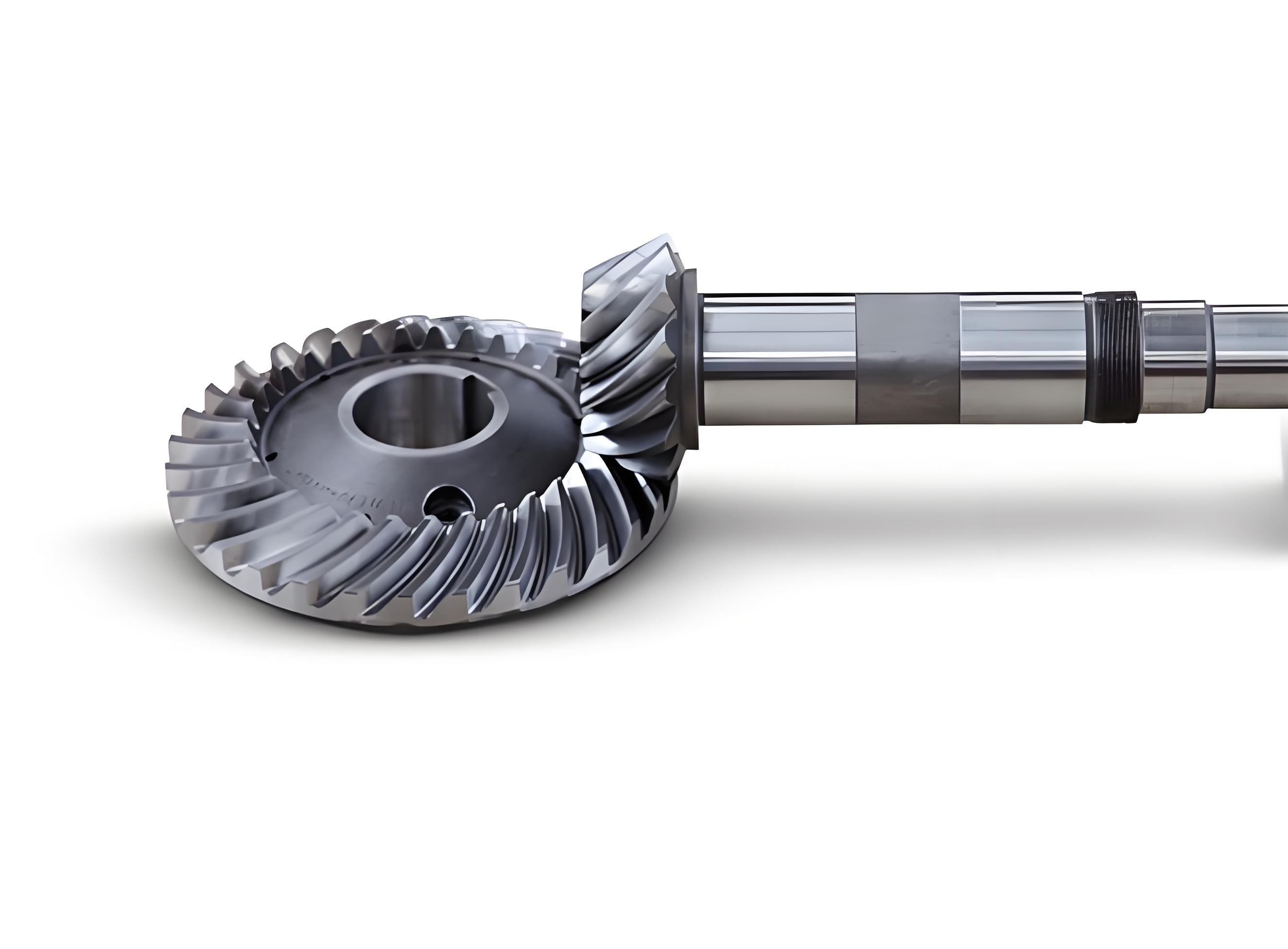
This study proposes a data-driven collaborative optimization framework to enhance the geometric accuracy and load-contact mechanical performance of non-orthogonal spiral bevel gears during face-milling processes. By integrating numerical loaded tooth contact analysis (NLTCA) with adaptive sensitivity-based error correction, the method achieves balanced improvements in both manufacturing precision and operational reliability.
1. Kinematic Modeling of Double Helical Face-Milling
The relative velocity between cutter and workpiece in spiral bevel gear machining is derived as:
$$ \mathbf{v}^{(c-b)} = (\mathbf{\omega}^{(c)} – \mathbf{\omega}^{(b)}) \times \mathbf{r}_{m1b} + \mathbf{O}_1\mathbf{O}_2 \times \mathbf{\omega}^{(b)} + \begin{bmatrix}0\\0\\x_{HL}/R_a\end{bmatrix} $$
where the position vector $\mathbf{r}_{m1b}$ combines machine settings:
$$ \mathbf{r}_{m1b} = M_{m1-p}M_{p-w}M_{w-c}\mathbf{r}_c $$
2. Loaded Contact Mechanics Analysis
The NLTCA formulation considers time-varying meshing stiffness and contact pressure distribution:
$$ \begin{cases}
\sum_{j=1}^N (C_{K(1)j} + C_{K(2)j})F_j + D_K – \Theta \geq 0 \\
\sum_{j=1}^N F_j = T_{IN}/r_K\cos\alpha_K\cos\beta_K
\end{cases} $$
| Parameter | Pinion | Gear |
|---|---|---|
| Number of teeth | 31 | 38 |
| Module (mm) | 5.3 | 5.3 |
| Pressure angle (°) | 22.5 | 22.5 |
| Spiral angle (°) | 35 | 35 |
| Face width (mm) | 32 | 32 |
3. Adaptive Data-Driven Optimization
The multi-objective optimization problem for spiral bevel gears is formulated as:
$$ \min \sum_{j=1}^4 \omega_j F_j^{REL}(G,P,e,\alpha) $$
where relative performance metrics are normalized:
$$ F_j^{REL} = \frac{F_j – F_j^L}{F_j^U – F_j^L} \times 100\% $$
| Metric | Initial | Optimized | Improvement |
|---|---|---|---|
| CPMAX (mm²) | 31.7 | 48.4 | +47.4% |
| LTEMAX (μrad) | 123.5 | 68.1 | -44.9% |
| LCPMAX (MPa) | 1026.9 | 1165.3 | +13.2% |
| LCSMAX (MPa) | 1841.5 | 2095.3 | +13.9% |
4. Sensitivity-Driven Assembly Error Correction
The sensitivity matrix for assembly errors is calculated as:
$$ S_{[I-J]} = \begin{bmatrix}
\frac{\partial h_1}{\partial G} & \cdots & \frac{\partial h_1}{\partial \alpha} \\
\vdots & \ddots & \vdots \\
\frac{\partial h_I}{\partial G} & \cdots & \frac{\partial h_I}{\partial \alpha}
\end{bmatrix} $$
Key sensitivity coefficients for spiral bevel gear optimization:
$$ \begin{cases}
S_P = 0.78 \pm 0.12 \\
S_G = 0.65 \pm 0.09 \\
S_e = 0.41 \pm 0.07 \\
S_\alpha = 0.29 \pm 0.05
\end{cases} $$
5. Implementation Results
The optimized assembly errors demonstrate significant improvement:
$$ \begin{cases}
\Delta G = -0.0968\text{mm} \\
\Delta P = +0.1071\text{mm} \\
\Delta e = +0.0286\text{mm} \\
\Delta \alpha = 0^\circ
\end{cases} $$
Post-optimization ease-off distribution shows 58.7% reduction in maximum deviation and 42.3% improvement in surface consistency compared to initial manufacturing results.
6. Conclusion
This data-driven framework effectively coordinates geometric accuracy and mechanical performance for spiral bevel gears through:
- NLTCA-based load contact pattern prediction
- Pareto-optimal multi-objective optimization
- Sensitivity-guided assembly error correction
The methodology demonstrates superior performance in balancing transmission error reduction (44.9%) with contact pressure uniformity (13.2% improvement), establishing a new paradigm for precision manufacturing of spiral bevel gear systems.