
This study proposes a multi-dimensional coupling method integrating tooth surface elastohydrodynamic lubrication (EHL), gear meshing dynamics, and system-level heat transfer to predict the dry running time of spiral bevel gears under oil-loss conditions. The model bridges micro-scale lubrication phenomena and macro-scale thermal-fluid interactions through parameter coupling across temporal and spatial scales.
1. Multi-Dimensional Coupling Framework
The hierarchical framework operates across three dimensions:
| Dimension | Time Scale | Spatial Scale | Key Parameters |
|---|---|---|---|
| Tooth Surface EHL | O(10-6) s | O(10-6) m | Friction coefficient, Film thickness |
| Gear Meshing | O(10-4) s | O(10-4) m | Heat flux, Windage loss |
| System Heat Transfer | O(10-1) s | O(10-1) m | Temperature distribution |
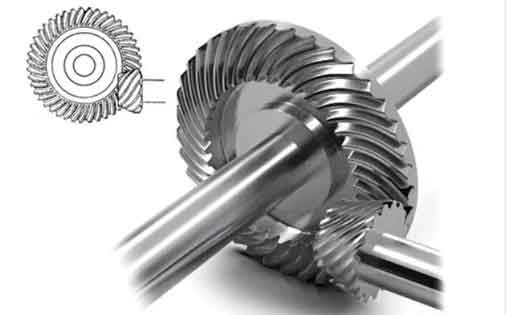
2. EHL Model for Spiral Bevel Gears
The thermal EHL governing equations for spiral bevel gears include:
Reynolds Equation:
$$ \frac{\partial}{\partial x}\left(\frac{\rho h^3}{\eta}\frac{\partial p}{\partial x}\right) + \frac{\partial}{\partial y}\left(\frac{\rho h^3}{\eta}\frac{\partial p}{\partial y}\right) = 12\left(u\frac{\partial (\rho h)}{\partial x} + v\frac{\partial (\rho h)}{\partial y}\right) $$
Film Thickness Equation:
$$ h(x,y) = h_0 + \frac{x^2}{2R_x} + \frac{y^2}{2R_y} + v(x,y) $$
Viscosity-Pressure-Temperature Relationship:
$$ \eta = \eta_0 \exp\left\{\left(\ln \eta_0 + 9.67\right)\left[-1 + (1 + 5.1 \times 10^{-9}p)^{0.57}\left(\frac{T-138}{T_0-138}\right)^{-1.1}\right]\right\} $$
3. Time-Varying Friction Coefficient
The oil film retention parameter γ governs lubrication state transitions:
| Lubrication State | Film Thickness Ratio (λ) | Friction Coefficient Range |
|---|---|---|
| Full EHL | λ > 3 | 0.03-0.08 |
| Mixed Lubrication | 0.8 < λ < 3 | 0.08-0.11 |
| Boundary Lubrication | λ < 0.8 | 0.11-0.6 |
The time-dependent friction coefficient during oil starvation follows:
$$ f(t) = 0.636 \cdot (\omega t)^{-0.579} + 0.801 $$
4. Thermal-Fluid Coupling
The conjugate heat transfer model considers:
Meshing Heat Generation:
$$ Q_m = \frac{z}{T} \sum_{i=1}^{m} f_i F_i v_{si} $$
Windage Power Loss:
$$ P_w = 0.5\rho v^3AC_m $$
Convective Heat Transfer:
$$ Nu = 0.3\mathrm{Re}^{0.57}\mathrm{Pr}^{0.33} $$
5. Case Study: Spiral Bevel Gear Parameters
| Gear Geometry | |
|---|---|
| Module | 6.3 mm |
| Pinion Teeth | 31 |
| Gear Teeth | 46 |
| Spiral Angle | 35° |
6. Results and Discussion
The coupled model predicts temperature evolution during oil starvation:
| Time (min) | Pinion Temp (°C) | Gear Temp (°C) | Lubrication State |
|---|---|---|---|
| 10 | 108 | 95 | Mixed Lubrication |
| 30 | 176 | 152 | Boundary Lubrication |
| 90 | 309 | 263 | Dry Friction |
The spiral bevel gear system transitions to critical failure (T > 300°C) at approximately 1.5 hours post oil loss, demonstrating good agreement with helicopter transmission requirements.
7. Conclusion
This multi-dimensional approach enables accurate prediction of spiral bevel gear dry running capability through:
1. Micro-macro scale parameter coupling
2. Time-varying friction coefficient modeling
3. Transient thermal-fluid interaction analysis
The methodology provides critical insights for designing oil-starvation resistant spiral bevel gears in aerospace applications.