
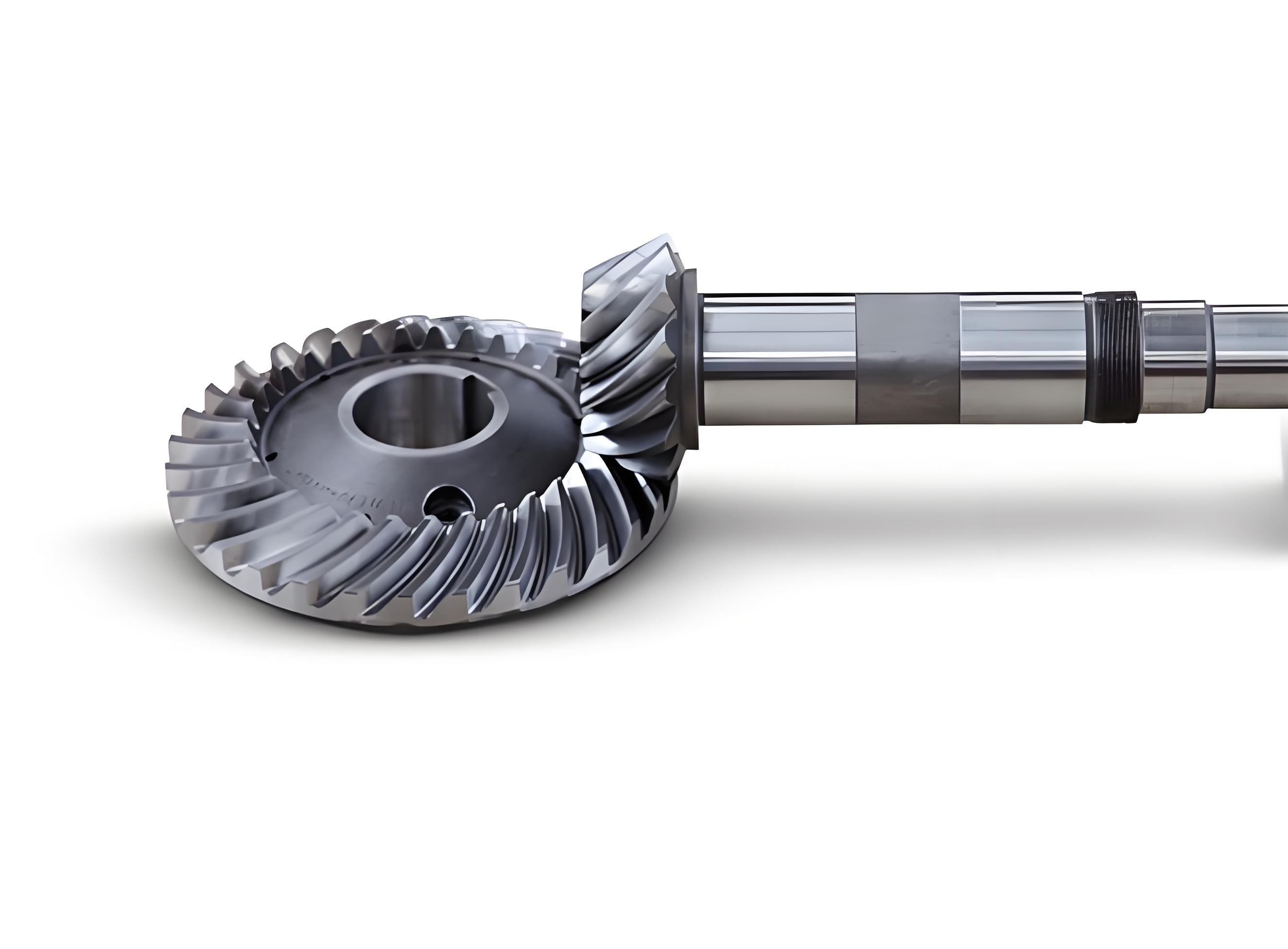
Spiral bevel gears are critical components in heavy-duty machinery due to their high load-bearing capacity and stable transmission ratio. However, their complex vibration signals under harsh working conditions make fault diagnosis challenging. This paper proposes a novel method combining local bispectrum analysis and convolutional neural networks (CNN) to address these challenges effectively.
1. Theoretical Framework
1.1 Convolutional Neural Network (CNN)
A typical CNN architecture includes convolutional layers, pooling layers, and fully connected layers. The forward propagation process is defined as:
$$ a^l_j = \sigma\left(\sum_{i \in M_j} a^{l-1}_i \times \omega^l_{ij} + b^l_j\right) $$
where \(a^l_j\) is the output of the \(j\)-th neuron in layer \(l\), \(\omega^l_{ij}\) represents weights, and \(b^l_j\) denotes biases. The Softmax classifier in the final layer is expressed as:
$$ h(x) = f(b_0 + w_0 x) $$
1.2 Bispectrum Analysis
For a zero-mean stationary signal \(\{x(n)\}\), the bispectrum is derived from the third-order cumulant:
$$ B(\omega_1, \omega_2) = X(\omega_1)X(\omega_2)X^*(\omega_1 + \omega_2) $$
where \(X(\omega)\) is the Fourier transform of \(x(n)\). The local bispectrum retains only the non-redundant upper-left quadrant (Figure 1), reducing computational complexity while preserving critical fault features.
2. Methodology
The proposed diagnostic framework involves:
- Vibration signal acquisition from spiral bevel gears
- Data segmentation into 1024-sample fragments
- Local bispectrum computation and image cropping (128×128 pixels)
- CNN model training and validation
| Layer Type | Feature Maps | Kernel Size | Stride |
|---|---|---|---|
| Input | 1 | – | – |
| Conv1 | 8 | 3×3 | 1×1 |
| Pool1 | 8 | 2×2 | 2×2 |
| Conv2 | 16 | 3×3 | 1×1 |
| Pool2 | 16 | 2×2 | 2×2 |
| Conv3 | 32 | 3×3 | 1×1 |
| Fully Connected | 4 | – | – |
3. Experimental Validation
A spiral bevel gear test rig was used to collect vibration data under four conditions: healthy, 1/3 tooth fracture, 2/3 tooth fracture, and root crack. Key parameters include:
$$ \text{Sampling frequency: } 8192\ \text{Hz} $$
$$ \text{Rotational speed: } 1200\ \text{r/min} $$
The confusion matrix for fault identification demonstrates superior performance:
| Method | Accuracy (%) | Training Time (s) |
|---|---|---|
| Local Bispectrum + CNN | 99.56 | 15 |
| Full Bispectrum + CNN | 99.53 | 78 |
| Raw Signal + CNN | 92.65 | 18 |
| Local Bispectrum + SVM | 98.03 | 2763 |
| Local Bispectrum + BP | 88.91 | 631 |
4. Conclusion
The proposed method achieves 99.56% diagnostic accuracy for spiral bevel gears with significantly reduced computational load. Key advantages include:
- Local bispectrum reduces data redundancy by 75% compared to full bispectrum
- CNN automatically extracts hierarchical features from vibration patterns
- Superior noise immunity through higher-order statistical analysis
This approach provides an effective solution for condition monitoring of spiral bevel gears in industrial applications, particularly in aerospace and heavy machinery sectors where reliability is paramount.