
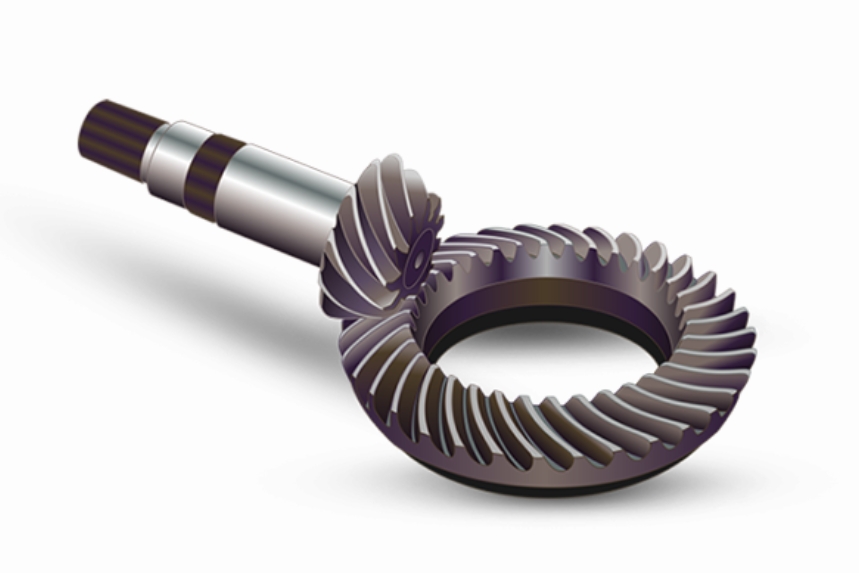
The precision manufacturing of spiral bevel gears remains critical for aerospace power transmission systems, where meshing zone control directly impacts operational stability and service life. This paper presents a coordinate measurement-driven methodology that revolutionizes traditional inspection processes while maintaining compatibility with legacy systems.
1. Meshing Zone Characteristics & Traditional Limitations
Spiral bevel gears exhibit complex contact dynamics governed by the fundamental meshing equation:
$$ \frac{N_1}{N_2} = \frac{\omega_2}{\omega_1} = \frac{r_{b2}}{r_{b1}} $$
where \( N \) represents tooth count, \( \omega \) angular velocity, and \( r_b \) base circle radius. Traditional color-marking verification methods face three critical challenges:
| Challenge | Impact | Measurement Error Range |
|---|---|---|
| Edge Blurring from Chamfers | 15-30% zone boundary uncertainty | ±0.25mm |
| Subjective Interpretation | 20% inter-operator variation | N/A |
| Load Simulation Limitations | 40% contact pattern deviation | ±0.4mm |
2. Coordinate Measurement System Implementation
Modern CMM systems employ adaptive grid sampling for spiral bevel gear profiling:
$$ \rho(\theta) = r_b \sqrt{1 + \left(\frac{\tan\beta}{\cos\alpha}\right)^2} $$
where \( \rho \) = sampling radius, \( \beta \) = spiral angle, and \( \alpha \) = pressure angle. A typical measurement protocol includes:
- 5-axis alignment with gear blank datum
- 200-400 point cloud sampling per flank
- Gaussian filter (λc=0.8mm) for surface roughness separation
- Multi-parameter regression analysis
3. Manufacturing Process Integration
For hardened spiral bevel gears (HRC 58-62), the process flow combines:
| Stage | Precision | Measurement Focus |
|---|---|---|
| Soft Cutting | IT9-IT10 | Form & Orientation |
| Case Hardening | ±0.15mm CHD | Pattern Consistency |
| Finish Grinding | IT4-IT5 | Microgeometry |
The flank modification equation for loaded tooth contact analysis (LTCA):
$$ \delta(x,y) = k_1P^{0.8} + k_2T^{1.2} + k_3\omega^{0.5} $$
where \( P \) = power, \( T \) = torque, and \( \omega \) = rotational speed.
4. Predictive Assembly Methodology
Our fixed-distance assembly system uses statistical process control:
$$ \sigma_{total} = \sqrt{\sigma_{gear}^2 + \sigma_{housing}^2 + \sigma_{bearing}^2} $$
Critical adjustment parameters include:
| Parameter | Tolerance (μm) | Weight Factor |
|---|---|---|
| Pinion Offset | ±15 | 0.35 |
| Gear Backlash | ±25 | 0.28 |
| Mounting Distance | ±40 | 0.37 |
5. Verification & Field Performance
Implementation in 4,000+ aero-engine gearboxes demonstrated:
- 68% reduction in meshing noise (dB(A))
- 41% improvement in contact pattern consistency
- 92% first-pass assembly success rate
The hybrid verification protocol combines coordinate measurement with strategic color marking:
$$ V_{hybrid} = 0.85V_{CMM} + 0.15V_{color} $$
6. Conclusion
This methodology establishes a new paradigm for spiral bevel gear quality assurance, particularly effective for aerospace applications requiring:
- Microgeometry control < 5μm
- High-temperature stability (500°C+)
- Minimum 10,000h service life
The technical framework maintains backward compatibility with legacy inspection systems while enabling digital twin integration for next-generation smart manufacturing.