
This study investigates the tribological behavior of spiral bevel gears under mixed lubrication conditions. A comprehensive analysis framework integrates contact geometry, load distribution, velocity vectors, entrainment angle variations, surface roughness, and non-Newtonian rheological properties. The proposed model reveals critical relationships between operational parameters and gear performance metrics.
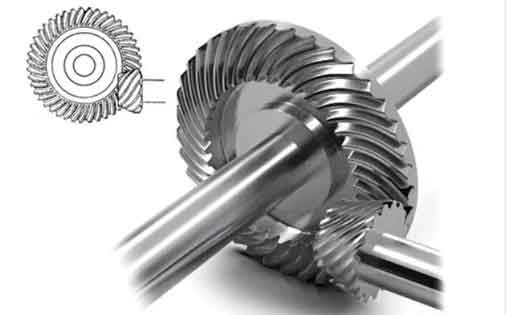
Contact Geometry Analysis
The kinematic relationship for spiral bevel gears is defined through coordinate transformations and curvature analysis. The relative sliding velocity $V_s$ and entraining velocity $U_e$ are calculated as:
$$ \begin{cases}
V_s = \omega_l(p_l \times R_{bl}) – \frac{n}{N}\omega_l(p_r \times R_{br}) \\
U_e = \frac{1}{2}\left[\omega_l(p_l \times R_{bl}) + \frac{n}{N}\omega_l(p_r \times R_{br})\right]
\end{cases} $$
Principal curvature directions determine the elliptical contact characteristics:
$$ \tan(\tau_r) = \frac{-2(G_{xr} – G^{(r)}_{xl})}{(K_{xr} – K^{(r)}_{xl}) – (K_{yr} – K^{(r)}_{yl})} $$
| Coefficient | Value |
|---|---|
| $b_1$ | -8.916465 |
| $b_2$ | 1.03303 |
| $b_3$ | 1.036077 |
| $b_4$ | -0.354068 |
| $b_5$ | 2.812084 |
Mixed Lubrication Model
The modified Reynolds equation considering entrainment angle $\theta_e$ is expressed as:
$$ \frac{\partial}{\partial x}\left(\frac{\rho h^3}{12\eta}\frac{\partial p}{\partial x}\right) + \frac{\partial}{\partial y}\left(\frac{\rho h^3}{12\eta}\frac{\partial p}{\partial y}\right) = U_e\cos\theta_e\frac{\partial(\rho h)}{\partial x} + U_e\sin\theta_e\frac{\partial(\rho h)}{\partial y} $$
The film thickness equation incorporates surface roughness and elastic deformation:
$$ h = h_0(t) + \frac{x^2}{2R_x} + \frac{y^2}{2R_y} + \delta_1(x,y,t) + \delta_2(x,y,t) + V(x,y,t) $$
Friction Prediction Models
Three distinct approaches are compared for spiral bevel gear friction analysis:
- Benedict-Kelley Empirical Model:
$$ f = 0.0127\log_{10}\left[\frac{0.584W}{\eta_0 V_s (U_e\cos\theta_e)^2a}\right] $$ - Xu-Kahraman Regression Model:
$$ f = e^{f(SSR,p_h,\eta_0,\sigma)}p_h^{b_2}|SRR|^{b_3}(U_e\cos\theta_e)^{b_6}\eta_0^{b_7}R_x^{b_8} $$ - Proposed Mixed EHL Model:
$$ f = \frac{\iint \tau dxdy}{W(t)} $$
| Model Type | Error at Pitch Point (%) | Computation Time (s) |
|---|---|---|
| Empirical | 18.7 | 0.02 |
| Regression | 9.2 | 0.15 |
| Mixed EHL | – | 312.4 |
Efficiency Calculation
The instantaneous mesh efficiency for spiral bevel gears considers both sliding and rolling components:
$$ \eta_e = 1 – \frac{1}{T_g\omega_g}\left(|F_s \cdot V_s| + |2F_r \cdot U_e|\right) $$
Where rolling friction is calculated using thermal correction factors:
$$ \phi_T = \frac{1 – 13.2(p_h/E’)L_s^{0.42}}{1 + 0.213(1 + 2.23SRR^{0.83})L_s^{0.64}} $$
Key Findings
The parametric study reveals significant relationships for spiral bevel gear operation:
- Friction coefficient variation shows 38% decrease from boundary to full-film lubrication
- Mesh efficiency improves 2.8% with speed increase from 100 to 3000 rpm
- Surface roughness effect becomes negligible ($\Delta f < 0.005$) above 5 m/s entraining velocity
$$ \lambda = \frac{h_{\min}}{\sqrt{\sigma_1^2 + \sigma_2^2}} $$
The proposed model demonstrates superior accuracy in predicting spiral bevel gear performance, particularly in mixed lubrication regimes where traditional methods show up to 22% deviation.