
Spiral bevel gears are critical transmission components in heavy-duty machinery, aerospace systems, and automotive differentials. This study investigates cold precision forging for small-module spiral bevel gears and hybrid hot forging-cold finishing processes for medium-module variants. The research methodology integrates geometric parameter optimization, 3D modeling, finite element simulation, and experimental validation to address challenges in forming accuracy and mold release.
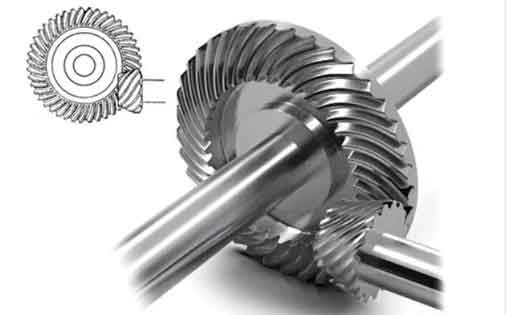
1. Geometric Parameter Design
The design of spiral bevel gear parameters follows the Gleason system with modified edge geometry for forging compatibility. Key parameters include:
| Parameter | Small Module Gear | Medium Module Gear |
|---|---|---|
| Module (mm) | 1.27 | 5.69 |
| Pressure Angle (°) | 20 | 22.5 |
| Spiral Angle (°) | 35 | 35 |
| Tooth Count (Gear/Pinion) | 41/11 | 39/9 |
The tooth contact analysis (TCA) evaluates meshing performance through transmission error (TE) calculation:
$$TE = \frac{\Delta \phi_2 – \Delta \phi_1}{i}$$
where \( \Delta \phi_1 \) and \( \Delta \phi_2 \) represent angular displacement errors of pinion and gear respectively, and \( i \) is the gear ratio.
2. 3D Modeling and Mold Design
Parametric modeling using UG NX incorporates tooth surface point clouds calculated from modified geometry equations:
$$x = R_m \cos\theta + \frac{b}{2}\sin\beta_m$$
$$y = R_m \sin\theta – \frac{b}{2}\cos\beta_m$$
where \( R_m \) is mean cone distance, \( \beta_m \) midpoint spiral angle, and \( b \) face width.
| Component | Modeling Approach |
|---|---|
| Gear Blank | Sketch-based revolution with modified back cone |
| Tooth Profile | Surface trimming using 15×25 point matrix |
| Mold Cavity | Boolean subtraction from die block |
3. Cold Forging Simulation
DEFORM-3D simulations reveal critical forming characteristics for small-module spiral bevel gears:
Equivalent stress distribution during forming:
$$ \sigma_{eq} = \sqrt{\frac{3}{2}s_{ij}s_{ij}} $$
where \( s_{ij} \) represents deviatoric stress components.
| Stage | Max Stress (MPa) | Material Flow |
|---|---|---|
| Initial Contact | 600-900 | Tooth root filling |
| Mid Formation | 900-1200 | Lateral material flow |
| Final Compression | 1200-1500 | Crown formation |
The load-stroke curve demonstrates nonlinear progression with maximum forging force:
$$ F_{max} = 3.8 \times 10^6 N \text{ (380-ton press requirement)} $$
4. Hot Forging-Cold Finishing Process
For medium-module spiral bevel gears, the hybrid process reduces forming load while maintaining dimensional accuracy:
| Process Stage | Temperature (°C) | Max Load (MN) |
|---|---|---|
| Hot Forging | 1050 | 5.2 |
| Cold Finishing | 20 | 8.7 |
Damage evolution analysis shows:
$$ D = \sum \left(\frac{\Delta \varepsilon_p}{\varepsilon_f}\right) $$
where \( \Delta \varepsilon_p \) is plastic strain increment and \( \varepsilon_f \) failure strain.
5. Mold Release Analysis
Critical factors affecting demolding of spiral bevel gears include:
$$ \alpha > 45^\circ \text{: Direct ejection feasible} $$
$$ \alpha < 45^\circ \text{: Helical ejection required} $$
where \( \alpha \) represents pitch cone angle. Experimental results show 0.12% dimensional deviation in directly ejected gears versus 1.8% in helical ejection components.
6. Experimental Validation
Practical trials using 1000-ton friction press demonstrate:
- 95.7% tooth profile accuracy in hot-forged specimens
- 0.05mm cold finishing allowance optimization
- Surface roughness improvement from Ra 12.5μm to Ra 3.2μm
The successful production of medium-module spiral bevel gears confirms the feasibility of hybrid forging processes for complex gear geometries.
Conclusion
This research establishes a comprehensive methodology for manufacturing precision spiral bevel gears through advanced forging techniques. The integration of geometric optimization, numerical simulation, and process innovation addresses key challenges in material flow control and mold design. Future work should focus on multi-axis ejection mechanisms for small-pitch-angle components and automated mold correction systems.