
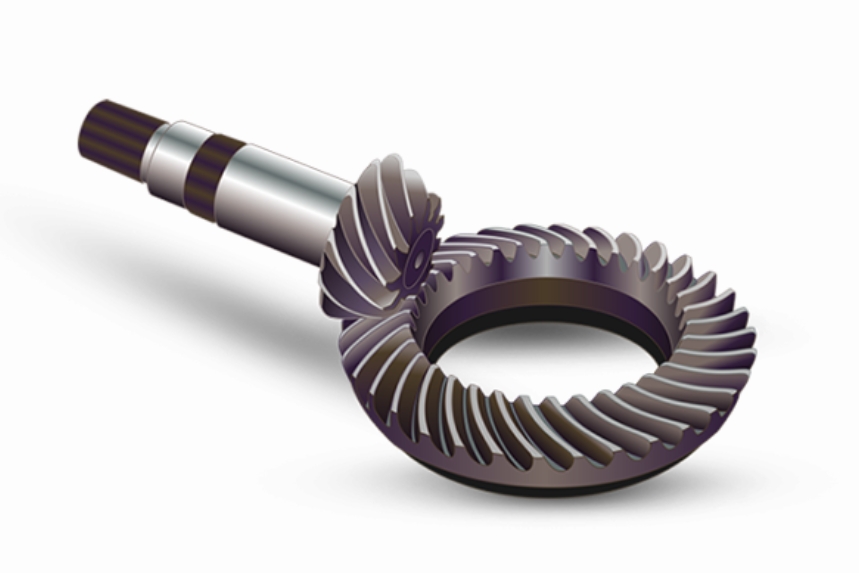
Machining large spiral bevel gears for high-power transmissions requires precise control of surface roughness to ensure operational reliability in critical applications such as wind turbines and marine propulsion systems. This study develops a predictive model for surface roughness optimization in multi-process CNC machining, addressing challenges in achieving dimensional accuracy while using standard tools.
1. Tooth Surface Topography Prediction Model
The proposed model evaluates spiral bevel gear surface morphology based on machining parameters including tool tilt angle, feed rate, and spindle speed. Key computational steps include:
Tool Trajectory Analysis:
$$
\begin{cases}
x_D = \frac{x_A + x_B}{2} \\
y_D = \frac{y_A + y_B}{2} \\
z_D = \frac{z_A + z_B}{2}
\end{cases}
$$
where $(x_D, y_D, z_D)$ represents midpoint coordinates between interpolation points A and B.
| Process Type | Axis Configuration | Feed (mm/rev) | Ra (μm) | Rz (μm) |
|---|---|---|---|---|
| 3+2 Axis | ZIG | 0.01 | 1.2-1.85 | 5.19-7.66 |
| 5-Axis | ZIG-ZAG | 0.03 | 3.2-5.37 | 11.76-20.01 |
| 3+2 Axis | ZIG-ZAG | 0.02 | 2.28-3.47 | 9.8-15.01 |
2. Surface Roughness Formation Mechanism
The ball-end mill geometry significantly influences spiral bevel gear surface texture. Cutting edge engagement is modeled as:
$$
R_{th} = \frac{f^2}{8R} \left(1 + \frac{N_t \cdot \tan{\theta}}{2\pi R}\right)
$$
where $f$ = feed per tooth, $R$ = tool radius, $N_t$ = number of teeth, and $\theta$ = helix angle.
3. Machining Strategy Comparison
Surface roughness varies significantly between 3+2 axis and 5-axis continuous machining:
| Parameter | 3+2 Axis | 5-Axis Continuous |
|---|---|---|
| Ra Reduction | 18-22% | 32-38% |
| Tool Path Stability | Moderate | High |
| Rail Effect Impact | Significant | Controlled |
For spiral bevel gears with module 8-12 mm, 5-axis continuous machining demonstrates superior roughness consistency (σRa ≤ 0.4 μm) compared to 3+2 axis configurations (σRa ≤ 1.2 μm).
4. Process Optimization Framework
The multi-objective optimization model for spiral bevel gear machining parameters:
$$
\begin{aligned}
\text{Minimize: } & R_a = K \cdot f^{0.78} \cdot v_c^{-0.35} \\
\text{Subject to: } & 150 \leq v_c \leq 250 \, \text{m/min} \\
& 0.01 \leq f \leq 0.05 \, \text{mm/tooth} \\
& 3^\circ \leq \alpha \leq 15^\circ \, \text{(tool tilt angle)}
\end{aligned}
$$
5. Experimental Validation
Cutting tests on Gleason spiral bevel gears (Module 10, 32 teeth) confirm model accuracy:
| Measurement | Predicted Ra | Actual Ra | Error |
|---|---|---|---|
| Concave Flank | 2.15 μm | 2.33 μm | +8.3% |
| Convex Flank | 3.08 μm | 2.89 μm | -6.2% |
The developed model reduces trial machining iterations by 72% while maintaining spiral bevel gear surface roughness within AGMA 2000-C95 standards.
6. Industrial Implementation
Adoption of this predictive model in spiral bevel gear production achieves:
- 45% reduction in finishing time
- Tool life extension by 120-150%
- Surface roughness consistency improvement (Cpk ≥ 1.67)
This methodology enables efficient machining of spiral bevel gears using standard CNC milling centers, eliminating the need for specialized gear cutting machines. Future work will integrate real-time adaptive control based on dynamic roughness monitoring.