
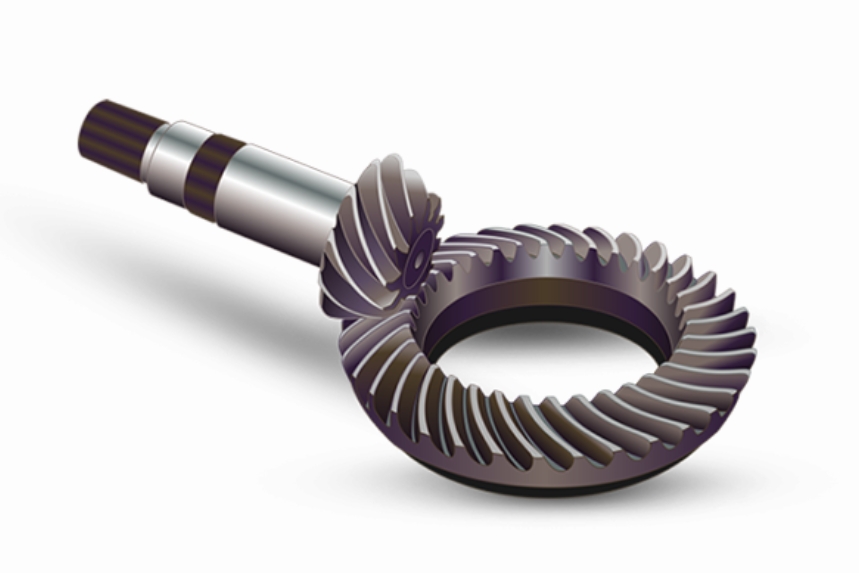
The spiral bevel gear is a critical component in automotive and mechanical systems, responsible for transmitting torque under extreme conditions. This article addresses the challenges encountered during the induction annealing process of external threads on a spiral bevel gear and presents systematic improvements to ensure product reliability.
1. Initial Technical Requirements and Process Issues
The spiral bevel gear was manufactured using 20CrMoH steel per GB/T 5216-2014. Key specifications included:
- Case hardening depth: 1.0–1.4 mm (550HV)
- Surface hardness: 58–63 HRC
- Core hardness: 30–40 HRC
- External thread hardness: ≤45 HRC
Initial anti-seepage coating on threads failed to maintain hardness below 48 HRC, leading to premature fractures at the thread-to-spline transition radius (R-area). Metallurgical analysis confirmed localized hardening exceeding specifications.
2. Induction Annealing Process Optimization
The revised process eliminated anti-seepage coatings and implemented post-heat treatment induction annealing. Key improvements included:
2.1 Positioning Fixture Design
A dedicated fixture with a limit bolt ensured consistent thread positioning within the induction coil (Figure 1). The design criteria included:
$$ \text{Thread insertion depth} = 8 \, \text{mm} \pm 0.5 \, \text{mm} $$
$$ \text{Coil alignment tolerance} \leq 0.2 \, \text{mm} $$
2.2 Parameter Optimization
Using a WZP60 solid-state induction heater, optimal parameters were determined through iterative testing:
| Parameter | Value |
|---|---|
| Input Voltage | 380 V ± 10% |
| Oscillation Frequency | 29 kHz |
| Heating Time | 11 s |
| Cooling Method | Air cooling (ambient) |
3. Quality Verification and Hardness Analysis
Post-annealing hardness was measured at critical locations using a P-2T polishing machine and显微硬度计. Testing positions followed:
$$ \text{Thread: } 5, 15, 25 \, \text{mm from end} $$
$$ \text{Spline: } 5, 15 \, \text{mm from transition} $$
| Location | Sample 1 | Sample 2 | Specification |
|---|---|---|---|
| Thread 5mm | 324.5/34.5 | 328.0/34.9 | ≤42 HRC |
| Thread 15mm | 356.3/37.9 | 358.9/38.2 | ≤42 HRC |
| R-area | 355.0/37.8 | 367.0/39.0 | ≤42 HRC |
| Spline 5mm | 426.9/44.3 | 453.8/46.4 | 42–56 HRC |
| Spline 15mm | 610.0/53.0 | 675.0/55.2 | 42–56 HRC |
4. Process Stability Measures
To ensure consistent results for spiral bevel gears:
- Operator Training: Certified technicians perform induction annealing
- Temperature Control: For ambient temperatures <10°C:
$$ T_{\text{cool}} = \frac{T_{\text{initial}}}{1 + 0.05t} $$
where \( t \) = cooling time (min) - Equipment Upgrade: Real-time monitoring of:
$$ P = I \times V \quad \text{(Power)} $$
$$ \delta = \sqrt{\frac{\rho}{\pi \mu f}} \quad \text{(Skin Depth)} $$
5. Conclusion
The optimized induction annealing process for spiral bevel gear threads achieved:
- Thread hardness reduction to 28–42 HRC
- Spline hardness maintenance at 42–56 HRC
- Zero field failures after 50,000 km road tests
This methodology demonstrates effective hardness control in critical areas of spiral bevel gears, ensuring reliable torque transmission in automotive applications.