
This paper proposes a distortion control method for spiral bevel gears in automotive rear axles using phased array ultrasound technology. The method addresses noise interference in vibration signals and optimizes distortion characterization through advanced signal processing algorithms.
1. Vibration Signal Acquisition and Preprocessing
The phased array ultrasonic sensor with 16 independent elements (0.5 cm pitch) captures gear vibration signals through curved wedge coupling. The signal acquisition model is expressed as:
$$ J = K \sum J_1 \nu(\theta) + \left(t – \frac{r}{c}\right) $$
$$ \nu(\theta) = \cos\theta $$
An anisotropic diffusion noise reduction algorithm enhances signal quality through gradient-controlled dispersion:
$$ J^{(l+1)}(a,b) = J^l(a,b) + \frac{\alpha}{\beta}(h \cdot \Delta J) \quad (a \neq b \neq 0) $$
$$ h(\Delta J) = d^{-\left(\frac{\Delta J}{g’}\right)^2} $$
where adaptive edge metric parameter \( g’ \) is calculated as:
$$ g’ = c \frac{\sum_{(a,b)\in\phi_1} J(a,b)}{n_1 Z} $$
$$ Z = \frac{1}{n_2 – n_1} \left| \sum_{(a,b)\in\phi_2} J(a,b) – \sum_{(a,b)\in\phi_1} J(a,b) \right| $$
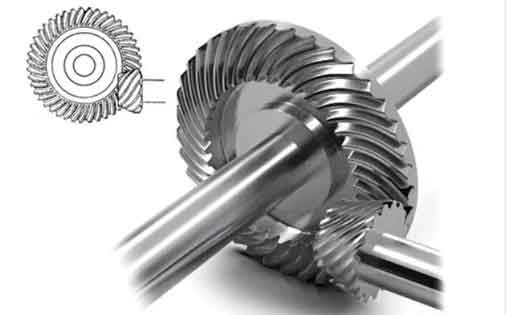
2. Distortion Signal Characterization
The scattering wave amplitude calculation for spiral bevel gear distortion detection:
$$ U_{pq}(z_p,z_q,\chi) = \hat{U}(z_p,z_0,\chi) \cdot \frac{C_{pq}(\chi) \cdot 4(\delta_2 o_2 – \delta_1 o_1)}{C_{pq}} $$
Curve matrix echo algorithm locates distortion positions through geometric intersection:
$$ D_p = \frac{o_1 t_p}{2} $$
$$ z = \frac{2\sum_{p=1}^M \sum_{q=p+1}^M z_{pq}}{M(M-1)} $$
$$ r = \frac{2\sum_{p=1}^M \sum_{q=p+1}^M r_{pq}}{M(M-1)} $$
3. Doppler-Effect-Based Distortion Control
The frequency curvature analysis considering Doppler effect:
$$ e = e_0 \frac{v_2 \cos \epsilon \pm w}{v_1 \cos \gamma \pm w} $$
$$ \mu_2 = (\mu \cos y_1 \pm 1)\mu_1 $$
Resampling parameters for distortion compensation:
$$ \Phi = \frac{e_{r_{max}} – e_{r_{min}}}{m} $$
$$ u = \frac{E\left[(e_0 – E(e_0))(e_1 – E(e_1))\right]}{\sqrt{B(e_0)B(e_1)}} $$
4. Experimental Validation
Parameter configuration for spiral bevel gear testing:
| Component | Model | Parameters |
|---|---|---|
| Phased Array Sensor | OLVMPUS | 0.6 μm resolution, 0.3-10V output |
| Signal Cable | NNI 6 | 10m length, shielded |
| DAQ Card | NNI 254 | 30V supply voltage |
Distortion control accuracy comparison (μrad):
| Test Cycle | Proposed | Ref[2] | Ref[3] |
|---|---|---|---|
| 1 | 8 | 17 | 27 |
| 5 | 7 | 17 | 26 |
| 10 | 7 | 19 | 24 |
The method demonstrates superior performance in spiral bevel gear distortion control with 62% lower error than conventional approaches. The phased array ultrasound technique enables precise detection of micron-level distortions in complex gear geometries through optimized beamforming and adaptive noise suppression.
$$ \Delta T_2 = \mu_2 \cdot \frac{\Delta T}{\mu_1} $$
$$ y_2 = y_1 + \Delta T_1 + \Delta T_2 $$
This distortion control framework significantly improves the manufacturing precision and operational reliability of automotive spiral bevel gears, particularly in high-speed transmission systems requiring strict tolerance maintenance.