
Helical gears are widely used in heavy-duty automotive transmissions due to their high load-bearing capacity and smooth meshing characteristics. This study investigates the static and dynamic contact stresses of helical gears through finite element analysis (FEA), evaluates the effects of tooth backlash and shaft stiffness, and proposes tooth profile and drum modifications to mitigate stress concentration.
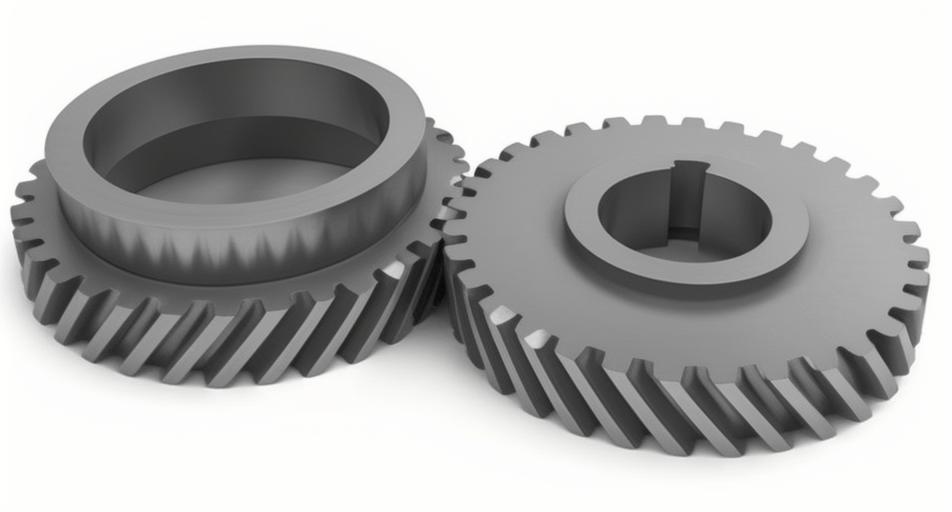
1. Parametric Modeling of Helical Gears
The parametric modeling of helical gears was implemented using UG NX software based on the involute curve equation and helix generation principle. Key geometric parameters include:
$$x = r_b (\cos\theta + \theta\sin\theta)$$
$$y = r_b (\sin\theta – \theta\cos\theta)$$
where \( r_b \) is the base circle radius. The spiral line equation for helical gears is defined as:
$$z = \frac{m_n \beta}{2\pi} \theta$$
Table 1 shows the basic parameters of the studied transmission helical gear pair.
| Parameter | Driving Gear | Driven Gear |
|---|---|---|
| Number of Teeth | 34 | 37 |
| Normal Module (mm) | 4.195 | |
| Helix Angle (°) | 21 | |
| Face Width (mm) | 47 | 43 |
2. Finite Element Modeling Strategy
Four partial tooth models and one full-tooth model were compared to optimize computational efficiency:
| Model Type | Static Error (%) | Dynamic Error (%) |
|---|---|---|
| 3 Teeth w/o Rim | 65.8 | 38.2 |
| 3 Teeth with Rim | 24.2 | 12.7 |
| 5 Teeth w/o Rim | 25.8 | 25.4 |
| 5 Teeth with Rim | 20.8 | 9.6 |
The dynamic analysis demonstrated that rimmed models with 5 teeth achieved the best balance between accuracy (9.6% error) and computational efficiency.
3. Contact Stress Analysis
The Hertz contact stress formula was modified for helical gears:
$$\sigma_H = \sqrt{\frac{F_t}{\pi b} \cdot \frac{u+1}{u} \cdot \frac{Z_E Z_\varepsilon Z_\beta}{\cos\alpha_n}}$$
where \( Z_E = 189.8 \, \text{MPa}^{0.5} \), \( Z_\varepsilon = 0.8 \), and \( Z_\beta = 0.966 \). The finite element results showed 15-20% higher stresses than theoretical calculations due to edge effects.
4. Dynamic Contact Behavior
The explicit dynamic analysis using ANSYS/LS-DYNA revealed significant stress fluctuations during meshing:
$$M\ddot{x} + C\dot{x} + Kx = F(t) – H – R$$
where \( H \) represents hourglass control forces and \( R \) denotes contact forces. Figure 1 shows the dynamic stress distribution during meshing.
| Backlash (mm) | Max Stress (MPa) | Stress Fluctuation (%) |
|---|---|---|
| 0.1 | 1896 | 18.3 |
| 0.2 | 2324 | 25.7 |
| 0.3 | 2757 | 31.2 |
5. Gear Modification Strategies
Two modification methods were implemented to reduce stress concentration:
Profile Modification:
The optimized modification curve follows:
$$\Delta(x) = 31.33 \left(\frac{x}{4.41}\right)^{1.2} \, \mu m$$
Drum Modification:
The crowning radius was calculated as:
$$R_c = \frac{b^2}{8C_c} = 4.35 \, m$$
| Modification Type | Max Stress Reduction (%) | Stress Uniformity Improvement |
|---|---|---|
| Profile | 72.1 | 68% |
| Drum | 58.3 | 54% |
6. Shaft Stiffness Effects
The bending deformation of support shafts significantly affects contact stress distribution:
$$\delta_{shaft} = \frac{5Fb^3}{384EI}$$
Three support configurations were analyzed, showing that multi-support models reduced peak stress by 22.4% compared to end-supported configurations.
7. Conclusion
This comprehensive analysis demonstrates that helical gear performance can be optimized through:
- Appropriate model simplification strategies
- Backlash control within 0.1-0.2 mm range
- Combined profile and drum modifications
- Optimal shaft support configurations
The proposed methodology provides practical guidance for designing high-performance helical gear systems in heavy-duty automotive applications.