
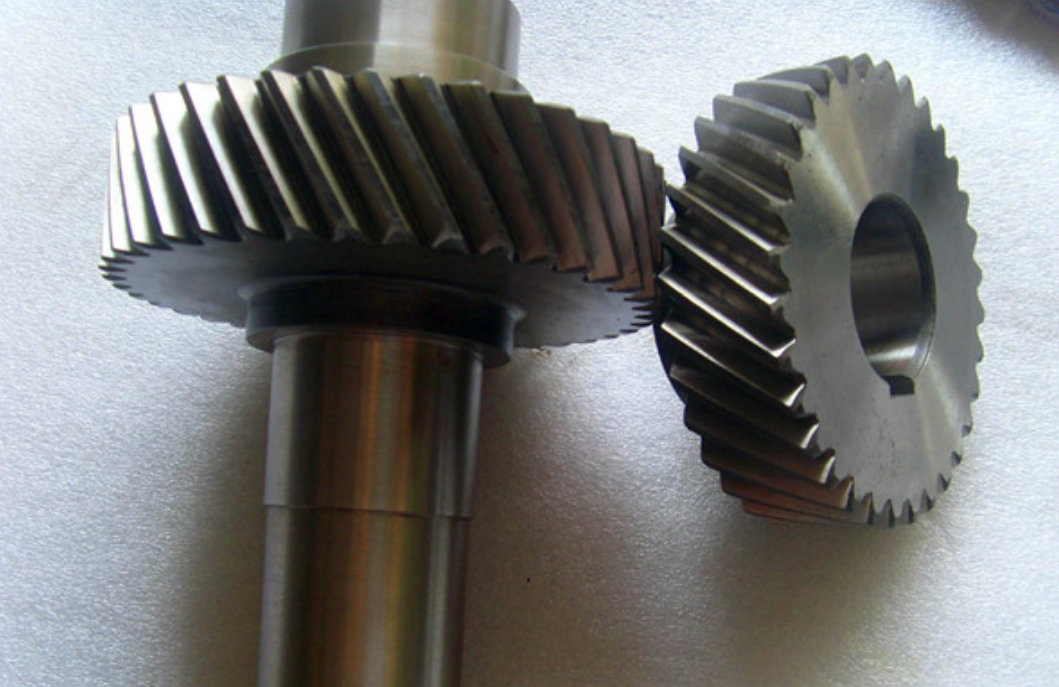
This study investigates power loss mechanisms in helical gear transmissions for electric vehicle reducers through Amesim-based simulation. Three primary energy dissipation sources are analyzed: meshing friction loss, oil churning loss, and bearing friction loss.
1. Theoretical Framework
1.1 Meshing Friction Power Loss
The total meshing friction power loss ($P_F$) combines sliding ($P_f$) and rolling ($P_n$) components:
$$P_F = P_f + P_n$$
$$P_f = \frac{\bar{f}F_n v_s}{1000}$$
$$P_n = \frac{0.09\bar{h}v_t b \epsilon_\alpha}{\cos\beta}$$
Key parameters for helical gear meshing calculation:
| Parameter | Description | Equation |
|---|---|---|
| $\bar{f}$ | Mean friction coefficient | $0.0127\lg\left(\frac{29600F_n\cos\beta}{b\mu v_s v_t}\right)$ |
| $F_n$ | Normal force | $\frac{T}{r_1\cos\alpha\cos\beta}$ |
| $v_s$ | Sliding velocity | $0.02618n_g\frac{z_1+z_2}{z_2}$ |
1.2 Oil Churning Loss
Churning power loss ($P_G$) comprises three components:
$$P_G = P_{C1} + P_{C2} + P_{C3}$$
$$P_{C1} = \frac{7.37f_g\mu_0 n^3 D^{4.7}L}{A_g 1026}$$
$$P_{C3} = \frac{7.37f_g\mu_0 n^3 D^{4.7}bR_f}{\tan\beta A_g 1026}$$
1.3 Bearing Power Loss
Bearing friction torque calculation using updated SKF equations:
$$P_z = \frac{(M_r + M_s + M_d + M_e)n}{9549}$$
$$M_r = G_r(\nu n)^{0.6}$$
$$G_{r(ball)} = R_1d_m^{1.96}\left(F_r + \frac{R_2F_a}{\sin[24.6(F_a/C_0)^{0.24}]}\right)^{0.54}$$
2. Simulation Modeling
Helical gear parameters for Amesim simulation:
| Parameter | Pinion | Gear |
|---|---|---|
| Teeth | 18 | 79 |
| Module (mm) | 1.75 | 1.75 |
| Pressure Angle | 25° | 25° |
| Helix Angle | 30° | 30° |
Bearing configuration parameters:
| Parameter | Value |
|---|---|
| Mean Diameter | 40 mm |
| Speed-dependent Friction | 2.5e-4 |
| Viscous Friction | 0.05 N·m/(r/min) |
3. Results Analysis
Comparative power loss components:
| Parameter Group | Total Loss (W) | Meshing Loss (%) |
|---|---|---|
| Group 1 | 215 | 68.3 |
| Group 2 | 284 | 72.1 |
| Group 5 | 163 | 61.9 |
Parametric sensitivity of helical gear power loss:
$$ \frac{\partial P_{total}}{\partial z} = -0.85\ \text{W/tooth} $$
$$ \frac{\partial P_{total}}{\partial \beta} = +2.1\ \text{W/degree} $$
$$ \frac{\partial P_{total}}{\partial h_{oil}} = +4.7\ \text{W/mm} $$
4. Optimization Strategy
Optimal parameter combination for minimum power loss:
| Parameter | Optimal Value | Loss Reduction |
|---|---|---|
| Pressure Angle | 25° → 28° | 12.7% |
| Helix Angle | 30° → 25° | 9.3% |
| Oil Viscosity | ISO VG68 → VG46 | 18.2% |
5. Conclusion
The established Amesim model effectively simulates power loss characteristics in helical gear transmissions. Through parametric analysis, the optimal configuration reduces total power loss by 23.6% compared to baseline designs. This methodology provides valuable insights for energy-efficient helical gear system development in electric vehicle applications.