
Angular misalignment error represents a critical challenge in helical gear transmission systems, leading to localized stress concentration and accelerated wear. This paper establishes an iterative meshing stiffness model that integrates axial bending and torsional stiffness components caused by angular misalignment errors.
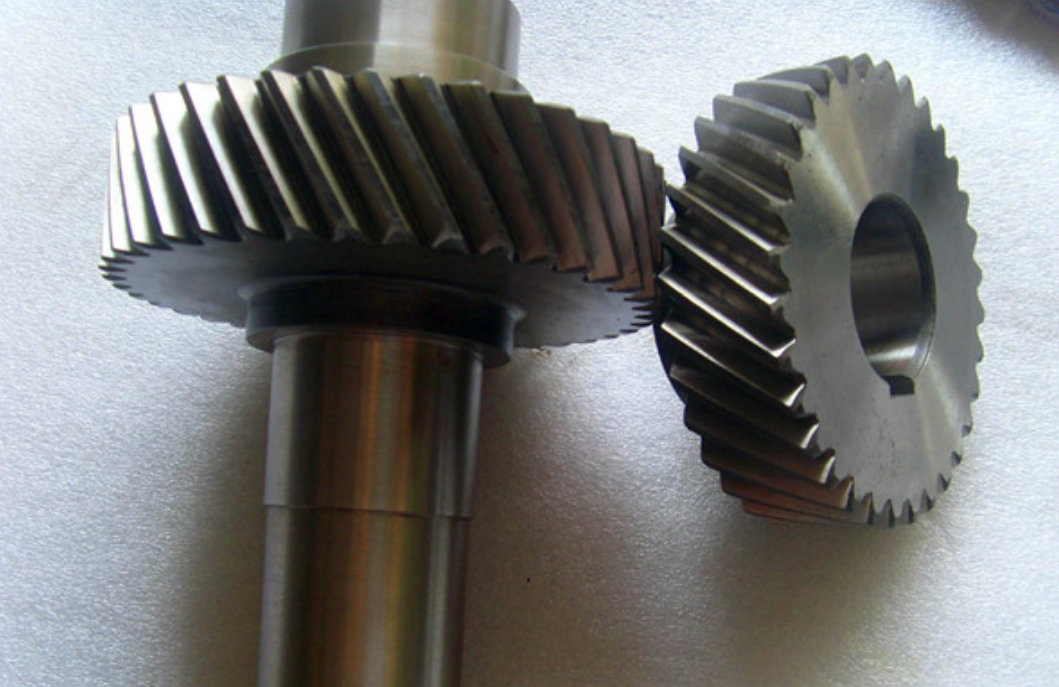
1. Angular Misalignment Characterization
For helical gears, angular misalignment can be decomposed into two orthogonal components:
$$
\begin{cases}
\theta_{POA} = \arctan(\tan\theta_y\sin\alpha_n + \tan\theta_x\cos\alpha_n) \\
\theta_{OPOA} = \arctan(\tan\theta_y\cos\alpha_n – \tan\theta_x\sin\alpha_n)
\end{cases}
$$
where $\alpha_n$ denotes normal pressure angle. The modified helix angle becomes:
$$
\beta_b’ = \beta_b \pm \theta_{OPOA}
$$
2. Meshing Stiffness Components
The total meshing stiffness of misaligned helical gears comprises:
$$
\frac{1}{k_g} = \sum_{i=1}^5\frac{1}{k_i} + \frac{1}{k_{axial}}
$$
| Stiffness Component | Expression |
|---|---|
| Hertzian Contact | $$k_h = \frac{0.9E_eL^{0.8}}{1.275F^{0.1}}$$ |
| Bending | $$k_b = \frac{EW\Delta y^3\cos\alpha_1}{4[(y\sin\alpha_1 + y\cos\alpha_1)^3 – (y\sin\alpha_1)^3]}$$ |
| Shear | $$k_s = \frac{0.6EW\Delta y\cos^2\alpha_1}{(1+\nu)(y\sin\alpha_1 + y\cos\alpha_1 – y\sin\alpha_1)}$$ |
| Axial Compression | $$k_a = \frac{EW\Delta y\sin^2\alpha_1}{y}$$ |
| Axial Bending | $$k_{ab} = \frac{3EWL^3}{4b^3\sin\beta_b’}$$ |
3. Parametric Influence Analysis
The coupling effect between gear slices is quantified through:
$$
F_i = \frac{k_{ci}}{\sum_{j=1}^n k_{cj}}F_{total}
$$
| Angle (°) | X-direction | Y-direction | Combined |
|---|---|---|---|
| 0.01 | 75.80% | 60.09% | 79.38% |
| 0.02 | 82.95% | 71.88% | 85.45% |
| 0.03 | 86.07% | 77.14% | 88.13% |
| 0.04 | 87.95% | 80.27% | 89.73% |
| 0.05 | 89.20% | 82.32% | 90.80% |
4. Load-Dependent Stiffness Behavior
The nonlinear relationship between load and stiffness follows:
$$
k_m = \frac{T_p}{(r_{bp}\theta_p – r_{bg}\theta_g)r_{bp}}
$$
| Load (Nmm) | X-direction | Y-direction | Combined |
|---|---|---|---|
| 50 | 89.20% | 82.32% | 90.80% |
| 100 | 84.73% | 75.09% | 87.05% |
| 150 | 81.34% | 69.46% | 84.11% |
| 200 | 78.48% | 64.82% | 81.69% |
| 250 | 75.98% | 60.63% | 79.55% |
5. Validation and Applications
The proposed model shows excellent agreement with finite element analysis (FEA), with maximum error limited to 2.2% compared to 3.7% for conventional models. This enhanced accuracy stems from comprehensive consideration of:
$$
\begin{cases}
\text{Slice coupling effects} \\
\text{Axial load components} \\
\text{Nonlinear contact deformation}
\end{cases}
$$
For helical gear design optimization, the stiffness iteration algorithm provides critical insights into load distribution uniformity and stress concentration mitigation under angular misalignment conditions.