
This study investigates the mechanical characteristics of double-circular-arc helical gear pump rotors through fluid-structure interaction (FSI) analysis. The research focuses on deformation patterns, stress distribution, and modal response under high-pressure operational conditions.
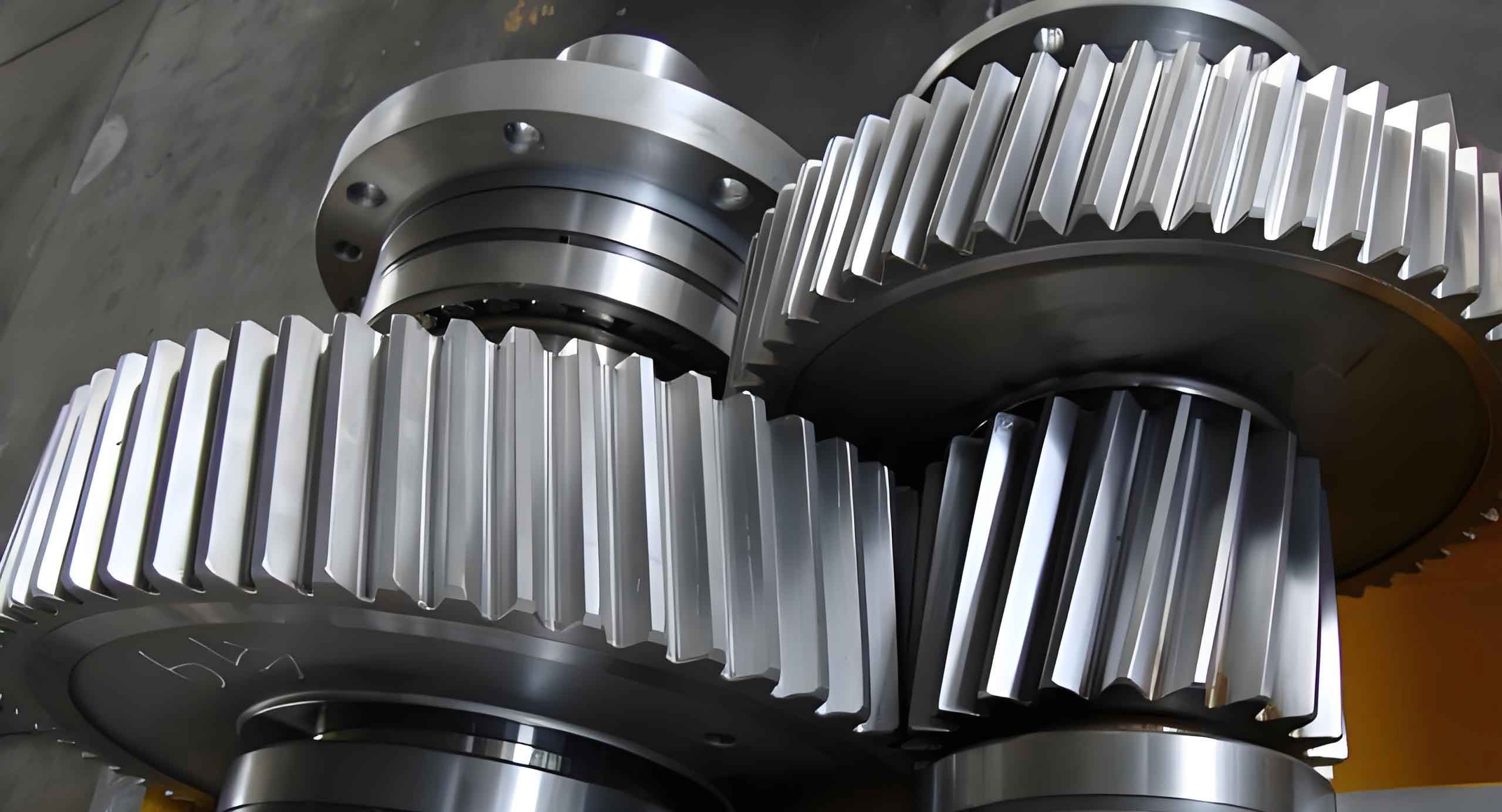
1. Fundamental Theory and Modeling
1.1 Fluid Dynamics Formulation
The governing equations for incompressible viscous flow in helical gear pumps include:
Continuity equation:
$$ \nabla \cdot \mathbf{u} = 0 $$
Navier-Stokes equations:
$$ \rho\left(\frac{\partial \mathbf{u}}{\partial t} + \mathbf{u} \cdot \nabla \mathbf{u}\right) = -\nabla p + \mu\nabla^2\mathbf{u} + \mathbf{f} $$
1.2 Structural Mechanics
The equilibrium equation for rotor deformation:
$$ \nabla \cdot \sigma + \mathbf{F} = \rho\frac{\partial^2 \mathbf{u}}{\partial t^2} $$
| Parameter | Symbol | Value |
|---|---|---|
| Number of Teeth | z | 7 |
| Pressure Angle | α | 14.5° |
| Helix Angle | β | 31.3° |
| Modulus | m | 3 mm |
| Material Yield Strength | σ_y | 1050 MPa |
2. Fluid-Structure Interaction Analysis
2.1 Pressure Distribution Characteristics
The pressure field solution reveals maximum stress concentration at gear meshing zones:
$$ p_{max} = 25 \text{ MPa (discharge side)} $$
$$ p_{min} = 0.1 \text{ MPa (suction side)} $$
2.2 Stress-Strain Relationships
Equivalent stress distribution follows von Mises criterion:
$$ \sigma_e = \sqrt{\frac{1}{2}\left[(\sigma_1-\sigma_2)^2 + (\sigma_2-\sigma_3)^2 + (\sigma_3-\sigma_1)^2\right]} $$
| Condition | Max Stress (MPa) | Max Deformation (mm) |
|---|---|---|
| Uncoupled | 223.15 | 0.01318 |
| FSI Coupled | 405.87 | 0.02924 |
3. Modal Analysis Results
Natural frequency analysis shows sufficient margin from operational excitation frequencies:
$$ f_{pump} = 166.67 \text{ Hz} $$
$$ f_{1st} = 3408.4 \text{ Hz} $$
| Mode | FSI Coupled (Hz) | Uncoupled (Hz) |
|---|---|---|
| 1 | 3408.4 | 3421.7 |
| 2 | 5172.1 | 5193.5 |
| 3 | 6895.3 | 6920.8 |
4. Structural Optimization
Mass reduction strategy for helical gear rotors:
$$ m_{original} = 0.785 \text{ kg} $$
$$ m_{optimized} = 0.563 \text{ kg (28.32% reduction)} $$
Optimization results demonstrate improved safety factor:
$$ n = \frac{\sigma_y}{\sigma_{max}} = \frac{1050}{341.24} = 3.08 $$
5. Conclusion
The FSI analysis reveals critical insights into helical gear pump rotor behavior:
- Maximum deformation (0.02924 mm) occurs at gear rim regions
- Stress concentration (405.87 MPa) appears at tooth engagement zones
- Modal frequencies remain sufficiently above operational range
- Mass optimization achieves 28.32% weight reduction with maintained safety
These findings provide essential guidance for designing high-performance helical gear pumps in aerospace and hydraulic applications.