
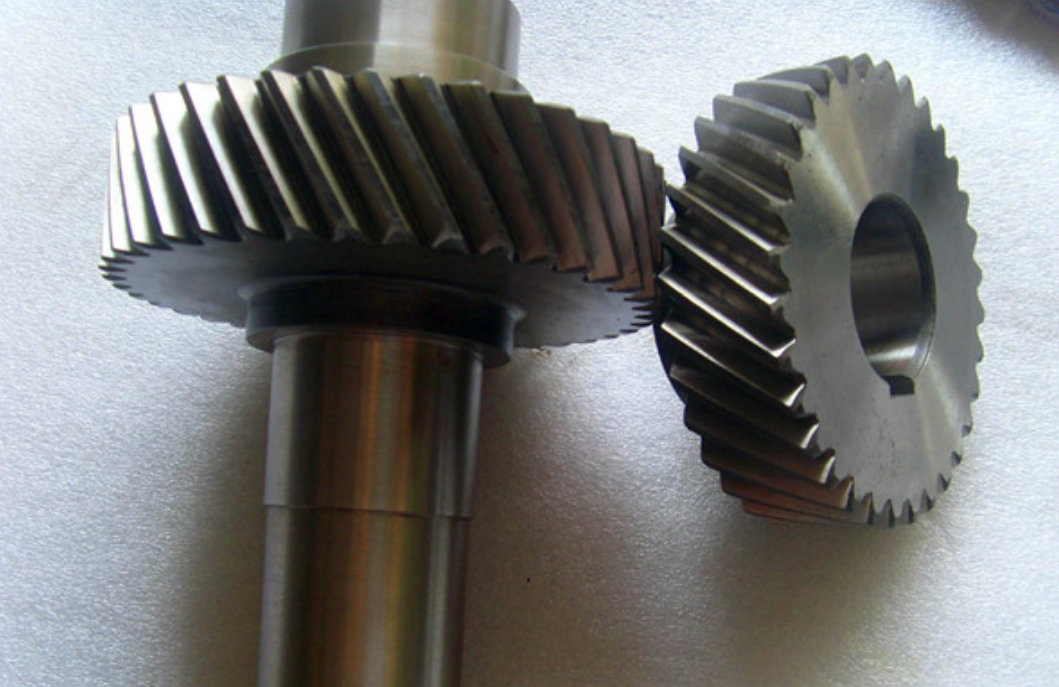
This study investigates the mixing homogeneity of gelatin/water two-phase flow in an external helical gear pump mixer through numerical simulations and structural optimizations. The helical gear mechanism’s unique spiral tooth profile significantly influences fluid dynamics compared to spur gears, as expressed by the axial force equation:
$$F_a = \frac{2\pi T}{d_m \tan\beta$$
where $T$ represents torque, $d_m$ the pitch diameter, and $\beta$ the helix angle. This axial force enhances fluid transport efficiency while reducing pressure pulsations.
1. Numerical Methodology
The VOF multiphase model coupled with the realizable $k-\epsilon$ turbulence model effectively captures interface dynamics:
$$\frac{\partial}{\partial t}(\alpha_w \rho_w) + \nabla \cdot (\alpha_w \rho_w \vec{v}_w) = 0$$
$$\frac{\partial}{\partial t}(\alpha_g \rho_g) + \nabla \cdot (\alpha_g \rho_g \vec{v}_g) = 0$$
Grid independence verification confirmed optimal mesh resolution at 1.75 million cells:
| Case | Grid Count | Mass Flow Rate (kg/s) |
|---|---|---|
| 1 | 1,196,228 | 0.002716 |
| 2 | 1,436,823 | 0.003820 |
| 3 | 1,757,316 | 0.003907 |
| 4 | 2,075,991 | 0.003916 |
2. Operational Parameter Analysis
The helical gear pump’s rotational speed significantly affects mixing homogeneity through enhanced turbulence intensity:
$$Re = \frac{\rho \omega D^2}{\mu$$
where $Re$ is Reynolds number, $\omega$ angular velocity, $D$ gear diameter, and $\mu$ dynamic viscosity. Higher speeds (70 RPM) improved water volume fraction distribution in lean mixing zones by 48% compared to baseline 50 RPM operation.
| Speed (RPM) | Water Fraction (Front) | Water Fraction (Rear) |
|---|---|---|
| 50 | 0.142 ± 0.023 | 0.008 ± 0.002 |
| 70 | 0.156 ± 0.018 | 0.043 ± 0.005 |
| 90 | 0.172 ± 0.021 | 0.029 ± 0.004 |
3. Structural Innovations
The optimized staggered central divider with 20°-45° alternating angles enhanced mixing efficiency by 32%:
$$\eta_{mix} = 1 – \sqrt{\frac{1}{N}\sum_{i=1}^N\left(\frac{C_i – \bar{C}}{\bar{C}}\right)^2$$
where $\eta_{mix}$ represents mixing efficiency, $C_i$ local concentration, and $\bar{C}$ average concentration. Dual inlet configuration with front cover modification achieved 19% better homogeneity than single inlet designs.
4. Viscosity Profile Optimization
The modified helical gear configuration maintained gelatin viscosity within 0.435-0.445 Pa·s across mixing zones, satisfying pharmaceutical coating requirements:
$$\mu_{eff} = \mu_g(1 + 2.5\alpha_w + 10.05\alpha_w^2)$$
where $\mu_{eff}$ is effective viscosity and $\alpha_w$ water volume fraction.
5. Conclusion
This comprehensive analysis demonstrates that helical gear pumps with optimized rotational parameters (70 RPM), staggered dividers (20°-45°), and dual-inlet configurations achieve superior mixing performance. The numerical framework provides valuable insights for designing high-efficiency fluid mixing systems in pharmaceutical applications.