
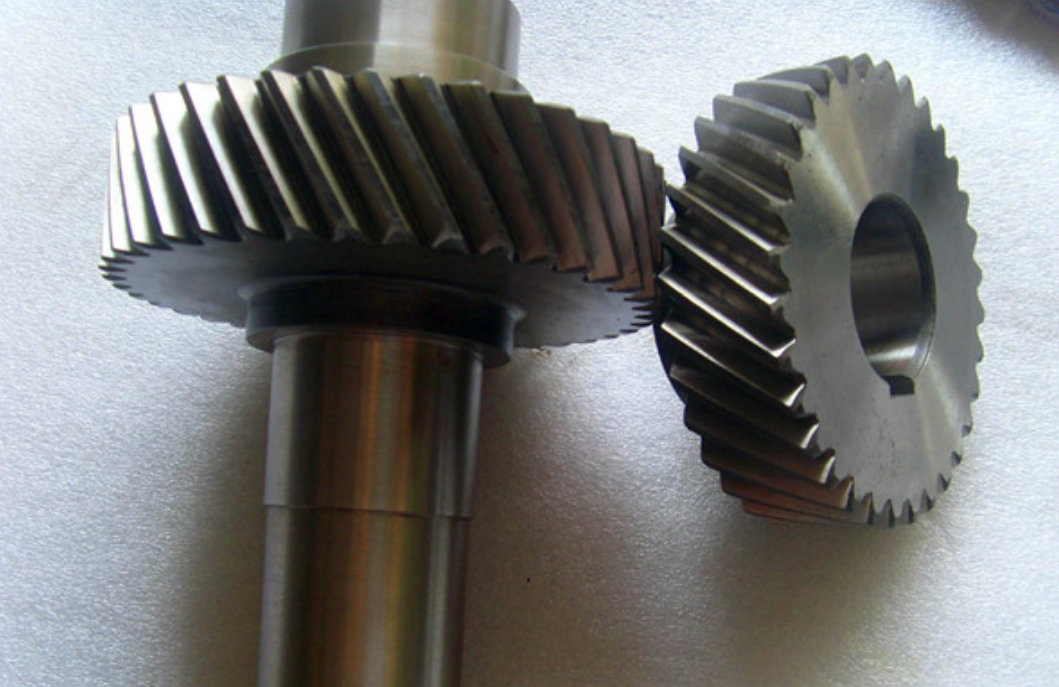
Fatigue pitting on tooth surfaces is a critical failure mode affecting helical gears in automotive transmissions and industrial machinery. This study combines dynamic simulation with experimental validation to establish a diagnostic framework for single-tooth and multi-tooth pitting faults. A helical gear pair from a 7-speed dual-clutch transmission serves as the research object, with parameters listed in Table 1.
| Parameter | Driving Gear | Driven Gear |
|---|---|---|
| Number of Teeth | 17 | 60 |
| Normal Module (mm) | 2.1 | |
| Pressure Angle (°) | 17.5 | |
| Helix Angle (°) | 29 | 19.8 |
| Face Width (mm) | 16.9 | 16.9 |
1. Dynamic Modeling of Pitting Defects
The time-varying meshing stiffness for helical gears with pitting defects is calculated using modified potential energy method:
$$ \frac{1}{K} = \frac{1}{K_b} + \frac{1}{K_s} + \frac{1}{K_a} + \frac{1}{K_f} $$
where \( K_b \), \( K_s \), \( K_a \), and \( K_f \) represent bending, shear, axial compressive, and fillet foundation stiffness components respectively. For pitted gears, the effective contact width reduces according to pitting area ratio \( \eta \):
$$ B_{eff} = B(1 – \eta) $$
2. Fault Feature Extraction
The dynamic response of pitted helical gears exhibits characteristic modulation effects. The vibration signal \( x(t) \) can be expressed as:
$$ x(t) = \sum_{m=1}^M A_m[1 + a_m(t)]\cos(2\pi f_m t + \phi_m) $$
where \( f_m \) denotes meshing frequency harmonics, and \( a_m(t) \) represents amplitude modulation caused by pitting-induced stiffness variations.
| Severity | Pitting Area Ratio | Depth (mm) |
|---|---|---|
| Mild | 5-15% | 0.1-0.3 |
| Moderate | 15-30% | 0.3-0.5 |
| Severe | >30% | >0.5 |
3. Experimental Validation
A dedicated test rig with 2×2 motor configuration was developed for helical gear pitting verification. Key experimental parameters include:
$$ \begin{cases}
\text{Rotational Speed} & 2500\ \text{r/min} \\
\text{Input Torque} & 240\ \text{N·m} \\
\text{Sampling Frequency} & 12\ \text{kHz} \\
\text{Accelerometer Sensitivity} & 100\ \text{mV/g}
\end{cases} $$
| Condition | \( f_r \) Amplitude | \( f_m \) Amplitude | Sidebands |
|---|---|---|---|
| Healthy | 0.12g | 3.45g | None |
| Mild Pitting | 0.35g | 4.12g | 3-5 |
| Severe Pitting | 0.78g | 5.63g | 7-9 |
4. Diagnostic Algorithm
The proposed health indicator (HI) for helical gear pitting assessment combines time-domain kurtosis and frequency-domain energy ratio:
$$ HI = \frac{\beta_4}{\beta_4^{ref}} \cdot \frac{E_{side}}{E_{mesh}} $$
where \( \beta_4 \) represents vibration signal kurtosis, \( E_{side} \) denotes sideband energy within \( f_m \pm 3f_r \), and \( E_{mesh} \) is meshing frequency energy.
5. Multi-Tooth Pitting Analysis
For multiple pitting faults on helical gears, the equivalent stiffness reduction follows:
$$ \Delta K_{total} = \sum_{i=1}^n \Delta K_i \cdot \cos(\beta)\cdot e^{-d_i/L_c} $$
where \( \beta \) is helix angle, \( d_i \) the angular distance between pits, and \( L_c \) the critical load sharing length (typically 1.5×base pitch).
The developed methodology enables accurate diagnosis of helical gear pitting severity and spatial distribution through combined simulation and experimental analysis. The characteristic frequency modulation patterns and energy distribution features provide effective indicators for condition monitoring of helical gear transmission systems.