
1. Introduction
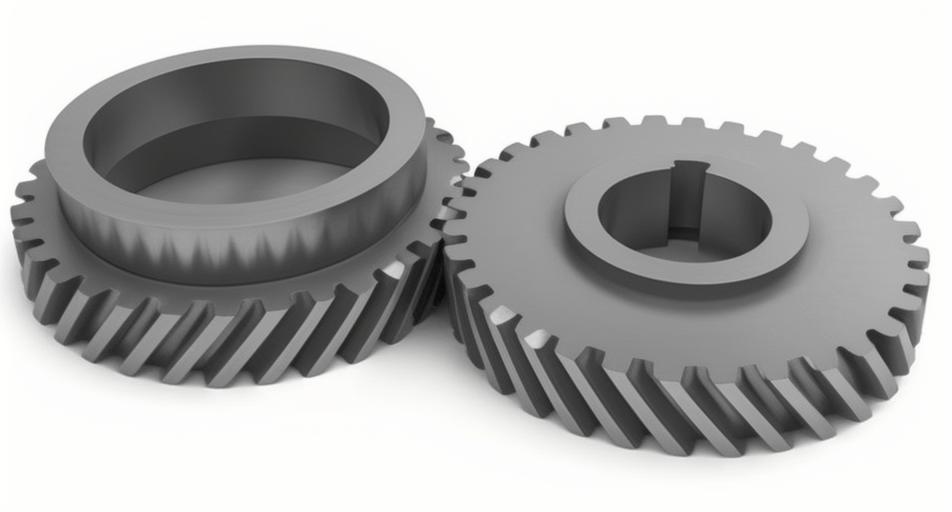
Helical gears are widely used in high-speed transmission systems due to their smooth engagement and high load-bearing capacity. However, tooth breakage faults under harsh operational conditions significantly affect their dynamic performance. This study investigates the time-varying meshing stiffness and vibration characteristics of helical gears with broken teeth, providing critical insights for fault diagnosis and system reliability.
2. Time-Varying Meshing Stiffness Calculation
The total meshing stiffness of helical gears combines Hertz contact stiffness, bending stiffness, shear stiffness, and axial compression stiffness. For gears with tooth breakage, the effective meshing stiffness decreases dramatically in fault regions.
2.1 Potential Energy Method
The energy storage components are calculated as:
$$ U_h = \frac{F^2}{2k_h}, \quad U_b = \int_0^{x_c} \frac{[F(d-x) – M]^2}{2EI_{xc}}dx $$
$$ U_s = \int_0^{x_c} \frac{1.2F^2}{2GA_{xc}}dx, \quad U_a = \int_0^{x_c} \frac{F_a^2}{2EA_{xc}}dx $$
where $k_h$ represents Hertz contact stiffness:
$$ k_h = \frac{\pi EL}{4(1-\nu^2)} $$
2.2 Stiffness Components
Key stiffness components for helical gears are derived as:
$$ \frac{1}{k_{total}} = \frac{1}{k_{h}} + \frac{1}{k_{b1}+k_{s1}+k_{a1}} + \frac{1}{k_{b2}+k_{s2}+k_{a2}} $$
| Parameter | Pinion | Gear |
|---|---|---|
| Number of teeth | 19 | 48 |
| Module (mm) | 3.175 | |
| Pressure angle | 20° | |
| Helix angle | 14° | |
3. Dynamic Model of Helical Gear System
The torsional vibration dynamics considering time-varying meshing stiffness $k(t)$ and damping $c(t)$ is established:
$$ I_p\ddot{\theta}_p + c(t)r_{b1}^2(\dot{\theta}_p – \dot{\theta}_g) + k(t)r_{b1}^2(\theta_p – \theta_g) = T_p $$
$$ I_g\ddot{\theta}_g – c(t)r_{b2}^2(\dot{\theta}_p – \dot{\theta}_g) – k(t)r_{b2}^2(\theta_p – \theta_g) = -T_g $$
Where $r_b$ represents base circle radius and $\beta$ denotes helix angle.
4. Results and Discussion
4.1 Meshing Stiffness Variation
Tooth breakage reduces meshing stiffness by 30-50% in fault regions. The periodic stiffness variation exhibits characteristic patterns:
$$ k_{fault}(t) = k_{healthy}(t) \times [1 – 0.4e^{-5(t-t_0)^2}] $$
4.2 Dynamic Response Characteristics
Key observations from numerical simulations using Runge-Kutta method:
| Condition | Dynamic Transmission Error (μm) | Peak Acceleration (m/s²) |
|---|---|---|
| Healthy | 8.2 | 4.1 |
| Broken Tooth | 15.7 | 6.7 |
The frequency spectrum reveals sideband modulation around meshing frequency:
$$ f_{sideband} = f_m \pm nf_r $$
where $f_m$ is meshing frequency and $f_r$ represents rotational frequency.
4.3 Parametric Influences
Critical parameter effects on helical gear dynamics:
$$ \text{Vibration Level} \propto \frac{T^{0.8}}{n^{0.6}} $$
where $T$ denotes torque and $n$ represents rotational speed.
5. Conclusion
This investigation establishes that tooth breakage in helical gears causes significant meshing stiffness reduction (40-60% in fault regions) and induces characteristic vibration signatures. The periodic impacts in time-domain responses and sideband modulation in frequency spectra provide effective indicators for fault diagnosis. The derived parametric relationships enable predictive maintenance strategies for helical gear transmission systems.