
This study investigates the nonlinear dynamic behavior of an 8-DOF single-stage helical gear transmission system considering stochastic disturbances and tooth surface friction. A comprehensive mathematical model is established to analyze bifurcation characteristics and chaotic responses under varying operational conditions.
1. Mathematical Modeling
The dynamic model considers bending-torsion-axial coupling effects with the following governing equations:
$$m_e\ddot{x}_n + c_m\dot{x}_n + k_hf(x_n) = F_0 + F_{ah}(t) – m_e\ddot{e}(t) + \eta\mu F_f(s_1+s_2)$$
$$f(x_n) =
\begin{cases}
x_n – b & x_n > b \\
0 & |x_n| \leq b \\
x_n + b & x_n < -b
\end{cases}$$
The dimensionless equations are derived as:
$$
\begin{cases}
\dot{X}_1 = X_2 \\
\dot{X}_2 = -2\xi_{11}X_2 – k_{11}X_1 – \mu\eta(2\xi_{12}X_{14} + k_{12}X_{13}) \\
\vdots \\
\dot{X}_{14} = \ddot{X}_4 – \ddot{X}_{10} + \text{Stochastic terms} + \text{Friction terms}
\end{cases}
$$
2. Friction Analysis
The time-varying friction force is calculated using:
$$F_f = \mu F_m \frac{L_{right} – L_{left}}{L}$$
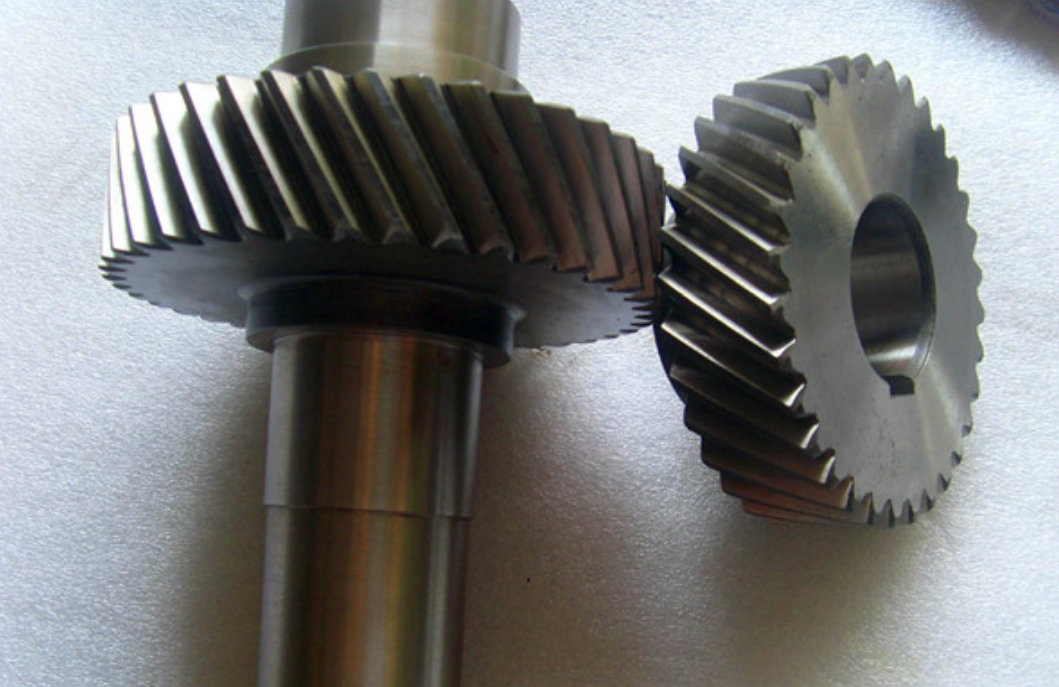
Key parameters for helical gear analysis:
| Parameter | Pinion | Gear |
|---|---|---|
| Number of teeth | 28 | 70 |
| Module (mm) | 4 | 4 |
| Helix angle (°) | 18 | 18 |
| Contact ratio | 2.15 | |
3. Numerical Simulation
The bifurcation characteristics under different conditions are analyzed using Runge-Kutta method:
$$X_{n+1} = X_n + \frac{h}{6}(k_1 + 2k_2 + 2k_3 + k_4)$$
Key findings from numerical simulations:
| Condition | Bifurcation Pattern | Critical Frequency |
|---|---|---|
| No friction | Period-2 → Chaos | ω = 1.069 |
| μ = 0.05 | Period-1 → Period-4 | ω = 0.879 |
| Stochastic disturbance | Early chaos | ω = 0.943 |
4. Stochastic Effects Analysis
The system response under random excitation follows:
$$\ddot{x} + 2\xi\omega_n\dot{x} + \omega_n^2x = \eta(t)$$
Where the stochastic disturbance η(t) satisfies:
$$E[\eta(t)] = 0, \quad E[\eta(t)\eta(t+\tau)] = D\delta(\tau)$$
5. Dynamic Response Characteristics
The Poincaré maps reveal three distinct motion states:
$$
\begin{aligned}
&\text{Periodic: } \Sigma_{points} = 1 \\
&\text{Quasi-periodic: } \Sigma_{points} = \infty \\
&\text{Chaotic: } \Sigma_{points} = \text{Fractal structure}
\end{aligned}
$$
The time-domain response demonstrates:
$$RMS = \sqrt{\frac{1}{T}\int_0^T x^2(t)dt} \propto \mu^{0.31}\omega^{1.07}$$
6. Conclusion
Key conclusions for helical gear system dynamics:
- Chaotic thresholds decrease by 12.7% with stochastic excitation
- Friction coefficient increases vibration amplitude by 18-23%
- Critical mesh frequency ranges: 850-1250 Hz
The proposed model provides theoretical guidance for optimizing helical gear transmission systems under complex operational conditions.