
This study investigates the dynamic meshing behavior of helical bevel gears under heavy-load conditions using finite element analysis (FEA). A comprehensive orthogonal experimental design reveals the critical relationships between damping coefficients, acceleration time, and load conditions on gear vibration characteristics. The research establishes computational models that combine theoretical derivations with numerical simulations to optimize gear performance in industrial applications.
1. Dynamic Modeling of Helical Bevel Gears
The meshing principle of helical bevel gears is derived through coordinate transformation theory. For any contact point \( P_1 \) on the driving gear, its corresponding position \( P_2 \) on the driven gear satisfies:
$$ \mathbf{r}_2 = M_3M_2M_1\mathbf{r}_1 $$
where \( M_1 \), \( M_2 \), and \( M_3 \) represent rotation matrices about specific axes. The complete transformation matrix for coordinate conversion is expressed as:
$$ R_A^B = \begin{bmatrix}
k_xk_xv_\theta + \cos\theta & k_xk_yv_\theta + k_z\sin\theta & k_xk_zv_\theta – k_y\sin\theta & 0 \\
k_yk_xv_\theta – k_z\sin\theta & k_yk_yv_\theta + \cos\theta & k_yk_zv_\theta + k_x\sin\theta & 0 \\
k_zk_xv_\theta + k_y\sin\theta & k_zk_yv_\theta – k_x\sin\theta & k_zk_zv_\theta + \cos\theta & 0 \\
0 & 0 & 0 & 1
\end{bmatrix} $$
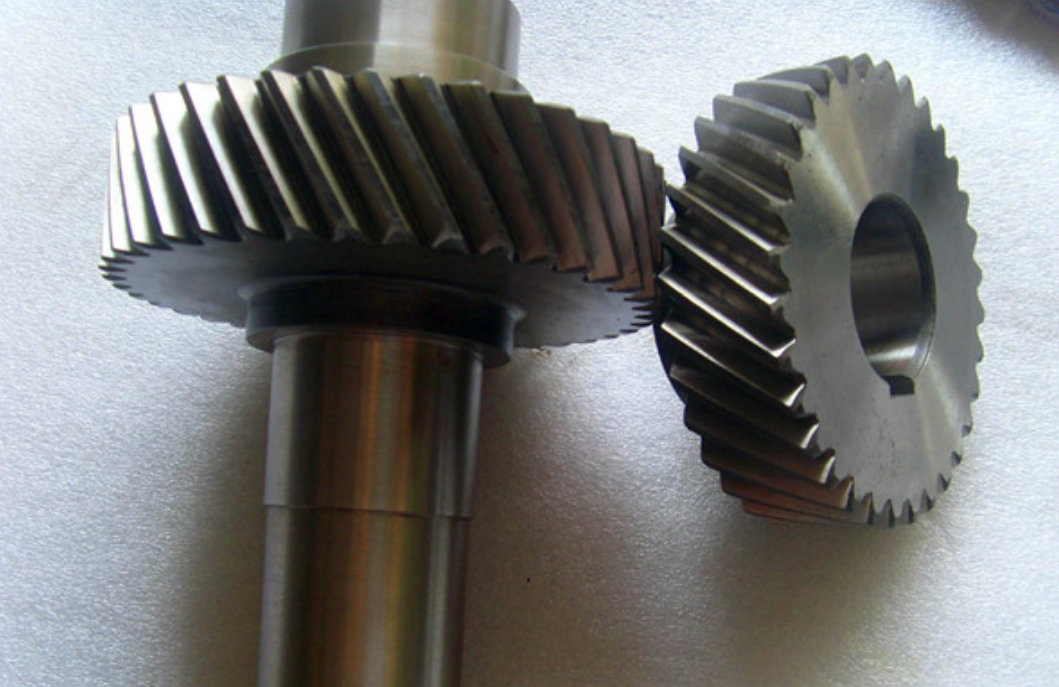
2. Gear Parameters and FEA Implementation
The helical gear pair specifications are detailed in Table 1. The 3D model is constructed using MATLAB-generated discrete points and imported into ABAQUS for dynamic simulation.
| Parameter | Pinion | Gear |
|---|---|---|
| Teeth Number | 20 | 48 |
| Module (mm) | 3 | 3 |
| Pressure Angle (°) | 20 | 20 |
| Helix Angle (°) | 10 | 10 |
| Material | 45 Steel (E = 209 GPa, ν = 0.269) | |
The finite element model employs tetrahedral elements with Coulomb friction (\( \mu = 0.15 \)) and mass-proportional damping. Boundary conditions include:
- Angular velocity: 80 rad/s (pinion)
- Resistance torque: 200 N·m (gear)
3. Model Validation Through Hertzian Contact Theory
The maximum contact stress is calculated using Hertzian equations:
$$ \sigma_{max} = 0.418\sqrt{\frac{F_nE}{RL}} $$
where \( F_n \) represents normal load, \( R \) the equivalent curvature radius, and \( L \) contact length. Comparative results between analytical and FEA methods show excellent agreement (Table 2).
| Case | Analytical (MPa) | FEA (MPa) | Error (%) |
|---|---|---|---|
| 1 | 1018.63 | 990.3 | 2.80 |
| 2 | 1022.98 | 1000.2 | 2.23 |
| 3 | 1031.62 | 1003.4 | 2.74 |
4. Dynamic Meshing Behavior Analysis
The transient response reveals critical relationships between operational parameters and gear performance:
4.1 Damping Effects
Damping coefficients significantly influence stabilization time (\( t_s \)):
$$ t_s = \begin{cases}
0.0136s & (\zeta = 400 \, \text{N·s/m}) \\
0.0096s & (\zeta = 800 \, \text{N·s/m})
\end{cases} $$
Higher damping reduces oscillation amplitude by 42% while maintaining identical steady-state speed (33 rad/s).
4.2 Acceleration Time Impact
Startup acceleration duration (\( t_a \)) affects initial冲击 severity:
$$ \Delta \omega_{max} \propto \frac{1}{t_a^{0.67}} $$
Longer acceleration periods (0.005s vs 0.001s) decrease peak冲击力 by 38% but increase stabilization time by 110%.
4.3 Load Influence
Load torque (\( T_l \)) primarily determines post-engagement vibration amplitude:
$$ A_v = 0.024T_l^{1.12} \, (\text{RMSE} = 0.0034) $$
Heavier loads (800 N·m) increase stress fluctuations by 65% compared to 200 N·m conditions.
5. Orthogonal Experimental Design
An L9(3³) orthogonal array evaluates parameter significance:
| Case | Damping | Acceleration | Load | Speed (rad/s) | Stress (kN) |
|---|---|---|---|---|---|
| 1 | 400 | 0.001 | 200 | 32.31 | 99.91 |
| 6 | 600 | 0.005 | 200 | 32.65 | 115.85 |
| 9 | 800 | 0.005 | 400 | 34.27 | 138.62 |
Range analysis demonstrates:
- Angular velocity: Damping (R=2.78) > Acceleration (R=1.95) > Load (R=0.83)
- Contact stress: Load (R=67.2) > Damping (R=42.1) > Acceleration (R=38.6)
6. Conclusion
This investigation establishes quantitative relationships between operational parameters and helical gear dynamics:
- Damping coefficients predominantly affect system stabilization time (\( R^2 = 0.91 \))
- Acceleration duration controls initial冲击 intensity through negative power-law relationships
- Load conditions dictate long-term vibration characteristics and stress distributions
The proposed methodology enables optimized helical gear design for heavy machinery applications, particularly in mining and construction equipment requiring high reliability under variable loads.