
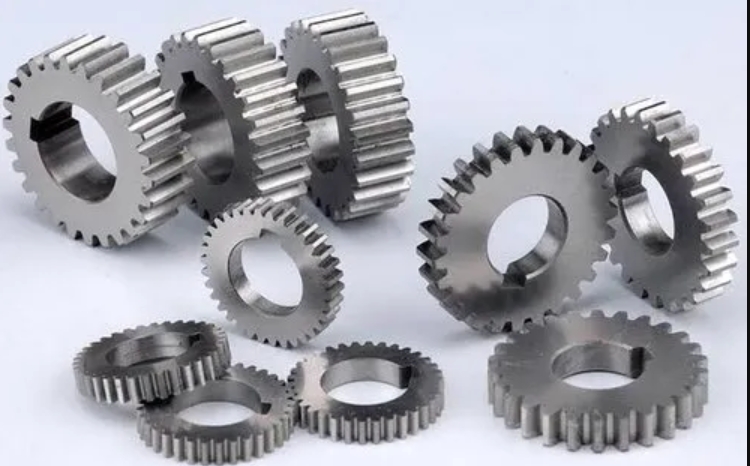
1. Fundamental Principles of Spur Gear Design
Spur gears with high contact ratio (HCR ≥ 2.0) achieve enhanced load distribution through modified geometric parameters:
$$ \varepsilon_\alpha = \frac{z_1}{2\pi} \left( \sqrt{\left(\frac{d_{a1}}{d_{b1}}\right)^2 – 1} + \sqrt{\left(\frac{d_{a2}}{d_{b2}}\right)^2 – 1} \right) – \frac{z_1}{\pi} \tan\alpha $$
| Parameter | Standard Gear | HCR Spur Gear |
|---|---|---|
| Pressure Angle (α) | 20° | 14.5°-17° |
| Addendum Coefficient | 1.0 | 1.25-1.4 |
| Contact Ratio (ε) | 1.2-1.8 | 2.0-2.5 |
2. Load Distribution Characteristics
The multi-tooth engagement mechanism of spur gears significantly improves load sharing:
$$ K_H = \frac{F_t}{b} \cdot \frac{Z_E Z_H Z_\varepsilon}{\sigma_{Hlim}} $$
| Performance Metric | Standard Spur Gear | HCR Spur Gear |
|---|---|---|
| Bending Stress Reduction | Baseline | 15-25% |
| Contact Stress Reduction | Baseline | 20-30% |
| Vibration Amplitude | 100% | 60-75% |
3. Dynamic Behavior Analysis
The dynamic model for spur gear systems considers time-varying mesh stiffness:
$$ m\ddot{x} + c\dot{x} + k(t)x = F_m + F_{exc} $$
Where time-dependent stiffness for spur gears follows:
$$ k(t) = \sum_{i=1}^{N} k_i \cdot u(t-\tau_i) $$
4. Aerospace Implementation Challenges
| Technical Barrier | Current Status | Required Advancement |
|---|---|---|
| Heat Treatment Control | ±0.05mm case depth | ±0.02mm precision |
| Profile Modification | Linear tip relief | Optimized 3D crowning |
| Lubrication Efficiency | 85% at 20,000rpm | 93% target |
5. Fatigue Life Prediction Model
Modified Lewis equation for spur gear bending fatigue:
$$ \sigma_F = \frac{F_t}{b m_n} Y_F Y_S Y_\varepsilon Y_\beta $$
Where load sharing factor for spur gears:
$$ Y_\varepsilon = 1.0 – 0.25(\varepsilon_\alpha – 2.0) $$
6. Manufacturing Tolerances
Critical quality requirements for aerospace spur gears:
| Parameter | Commercial | Aerospace |
|---|---|---|
| Profile Error (μm) | 8-12 | 2-4 |
| Lead Error (μm) | 10-15 | 3-5 |
| Surface Roughness Ra | 0.8 | 0.2 |
The ongoing development of high-performance spur gears continues to push the boundaries of helicopter transmission technology, with particular focus on achieving optimal balance between power density and operational reliability. Future research directions emphasize intelligent lubrication systems and adaptive profile modification techniques for spur gear applications in next-generation VTOL aircraft.