
This study investigates the combined effects of tooth profile shift, tooth surface friction, and geometric eccentricity on the time-varying mesh stiffness (TVMS) of spur gear pairs. A comprehensive analytical model is developed using the potential energy method, incorporating nonlinear Hertzian contact stiffness, modified tooth geometry parameters, and structural coupling effects.
1. Analytical Model for Spur Gear Mesh Stiffness
The total mesh stiffness $k_m$ of spur gears consists of four components:
$$ \frac{1}{k_m} = \frac{1}{k_H} + \frac{1}{k_b} + \frac{1}{k_a} + \frac{1}{k_s} + \frac{1}{k_f} $$
Where:
$k_H$ = Hertzian contact stiffness
$k_b$ = Bending stiffness
$k_a$ = Axial compressive stiffness
$k_s$ = Shear stiffness
$k_f$ = Fillet foundation stiffness
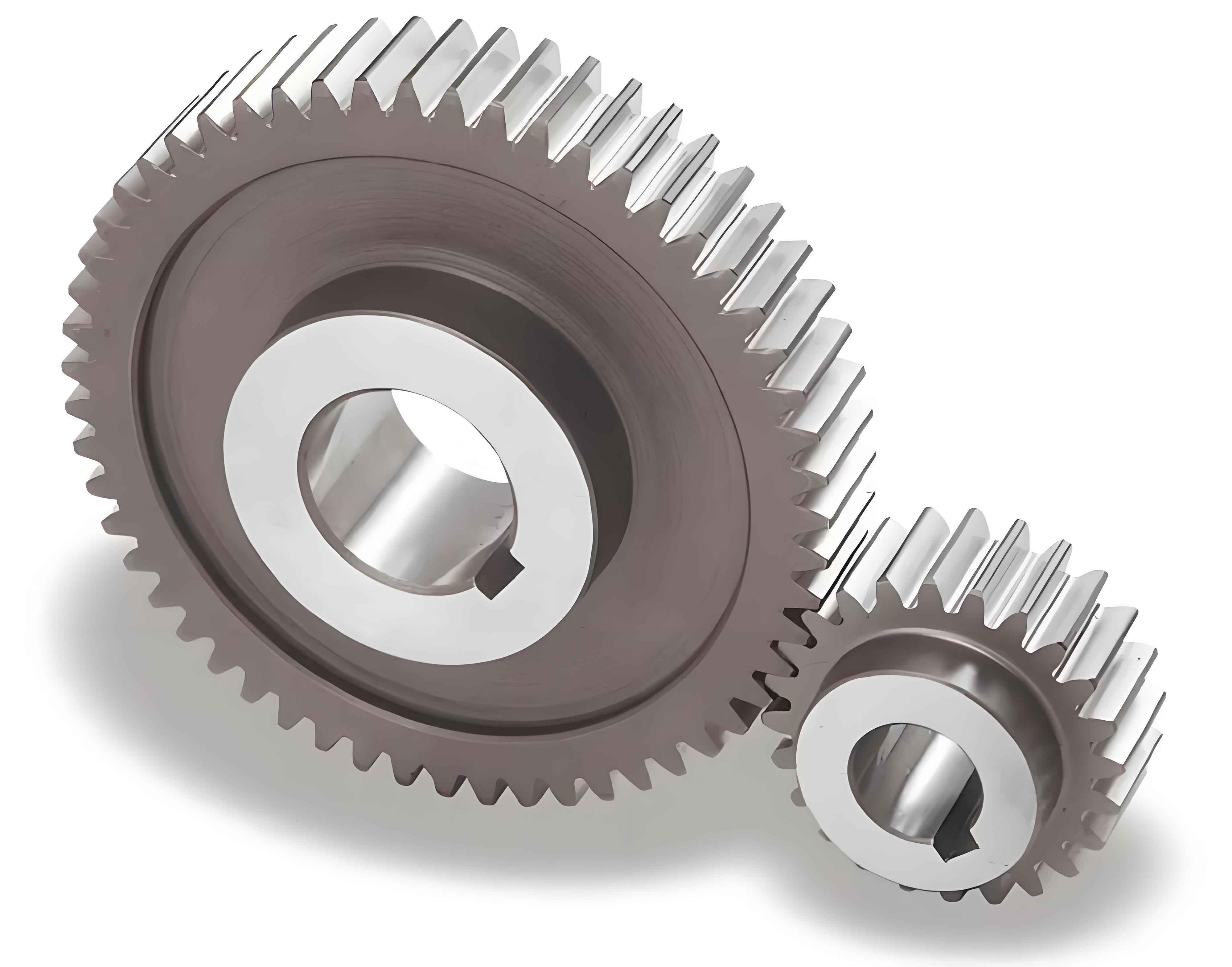
1.1 Modified Parameters for Profile-Shifted Spur Gears
Key geometric parameters are revised for profile-shifted spur gears:
$$ \theta_b = \frac{\pi}{2Z} + \tan\alpha_0 – \alpha_0 + \frac{2x\tan\alpha_0}{Z} $$
$$ R_c = \sqrt{[r_b\tan\alpha_0 – (h_a^* – x)m/\sin\alpha_0]^2 + r_b^2} $$
| Parameter | Driving Gear | Driven Gear |
|---|---|---|
| Number of teeth | 55 | 75 |
| Module (mm) | 2 | 2 |
| Pressure angle | 20° | 20° |
1.2 Friction-Influenced Stiffness Components
Frictional forces modify the stiffness components:
$$ \frac{1}{k_b} = \int_{\alpha}^{\pi/2} \frac{[(\cos\beta \mp \mu\sin\beta)(y_{\beta}-y_1)-x_{\beta}(\sin\beta \pm \mu\cos\beta)]^2}{EI_{y1}} \frac{dy_1}{d\gamma}d\gamma $$
$$ \frac{1}{k_f} = \frac{(\cos\beta_1 \mp \mu\sin\beta_1)}{BE\cos\beta_1} \left[L\left(\frac{u}{s}\right)^2 + M\frac{u}{s} + P(1+Q\tan^2\beta_1)\right] $$
2. Eccentricity Effects on Mesh Stiffness
Geometric eccentricity modifies the instantaneous center distance:
$$ L(t) = \sqrt{[a_w – e_1\cos(\omega_p t + \theta_p) – e_2\cos(\omega_g t + \theta_g)]^2 + [e_2\sin(\omega_g t + \theta_g) – e_1\sin(\omega_p t + \theta_p)]^2} $$
| Eccentricity Condition | Stiffness Fluctuation | Sideband Characteristics |
|---|---|---|
| No eccentricity | 0.82×10⁸ N/m | None |
| Driving gear 0.1mm | 1.15×10⁸ N/m | $f_m ± f_p$ |
| Both gears 0.1mm | 1.47×10⁸ N/m | $f_m ± |f_p – f_g|$ |
3. Combined Effects Analysis
The interaction between profile shift and friction direction reversal is critical:
$$ \beta = \tan^{-1}(\alpha_p(t)) – \frac{\theta_b}{2} $$
Where the reversal point shifts based on profile shift coefficients:
| Profile Shift | Single-tooth Stiffness | Double-tooth Stiffness |
|---|---|---|
| X = -1.0 | 4.2×10⁸ N/m | 7.8×10⁸ N/m |
| X = +1.0 | 5.9×10⁸ N/m | 9.1×10⁸ N/m |
4. Key Findings
1. Profile shifting increases spur gear mesh stiffness by 18-27% while reducing contact ratio by 12-22%
2. 0.1mm eccentricity amplifies stiffness fluctuations by 40-80%
3. Friction effects reverse stiffness trend when profile shift exceeds ±0.5
4. Combined eccentricity generates unique sideband components at $f_m ± |f_p – f_g|$
The developed model enables accurate prediction of spur gear dynamics under complex operating conditions, particularly for high-precision transmission systems requiring profile modification and tolerance control.