
This study focuses on the hot rolling process of spur gears based on the generating principle. By establishing coordinate systems for spur gear machining and solving meshing equations, a mathematical model of spur gear tooth surfaces is derived. The model serves as the foundation for developing a finite element simulation of the hot rolling process using DEFORM-3D software. The formation mechanism of rolling defects (lugs) is analyzed through numerical simulations, with orthogonal experiments conducted to optimize key process parameters including temperature, rotational speed, feed rate, and roller chamfer.
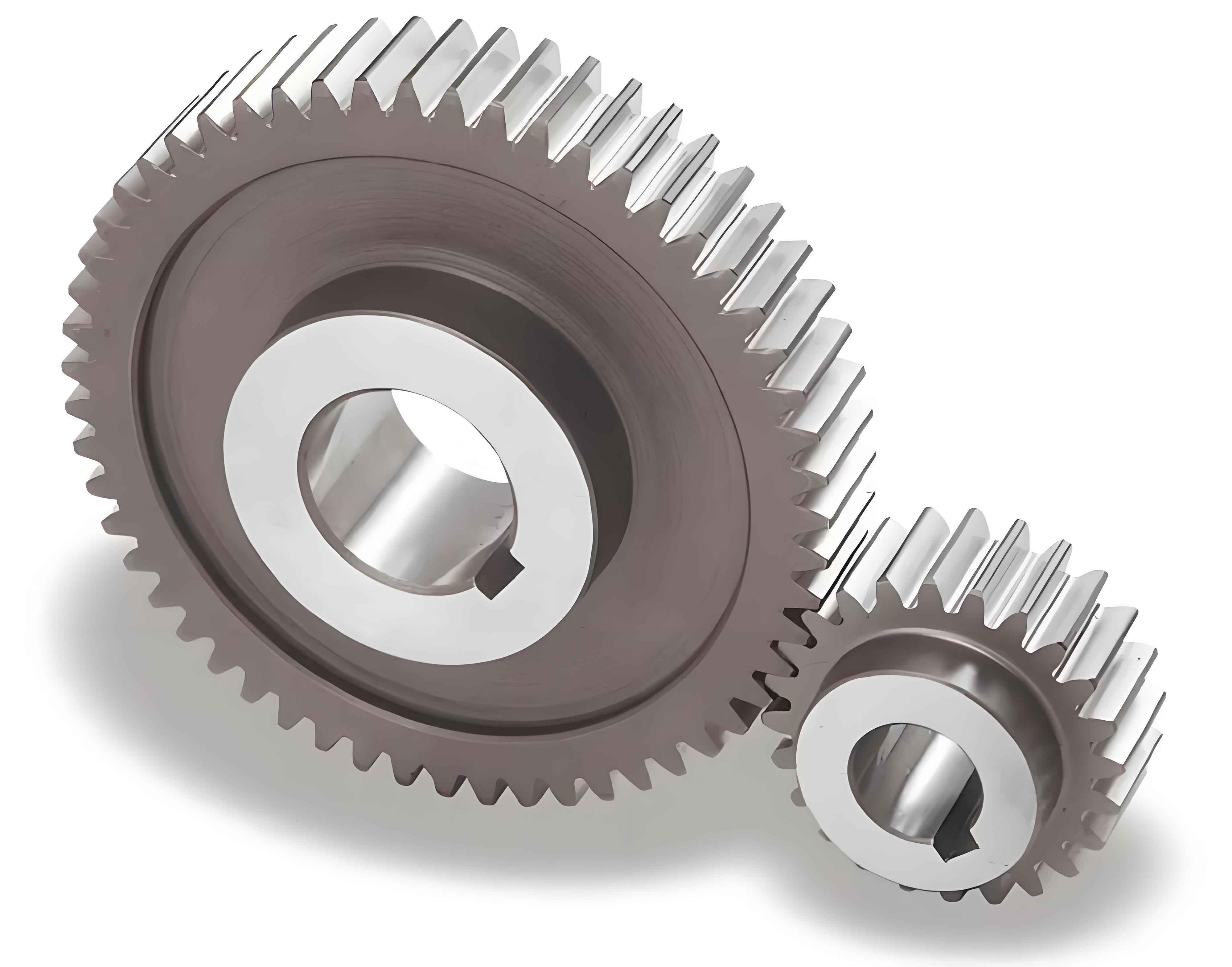
1. Mathematical Modeling of Spur Gear Tooth Surface
The coordinate systems for spur gear machining are established as shown below:
$$
\begin{cases}
\text{Tool coordinate system: } S_m(O_m-x_my_mz_m) \\
\text{Gear coordinate system: } S_1(O_1-x_1y_1z_1) \\
\text{Rotating coordinate systems: } S_s \text{ and } S_1
\end{cases}
$$
The transformation matrices between coordinate systems are derived as:
$$
M_{1s} = M_{1f}M_{fm}M_{ms}
$$
$$
L_{1s} = L_{1f}L_{fm}L_{ms}
$$
The tooth surface equation of the spur gear is obtained through meshing theory:
$$
r_s(u_s, \theta_s) = \begin{bmatrix}
r_{bs}\left(\sin(\theta_m + \theta_s) – \theta_s\cos(\theta_m + \theta_s)\right) \\
r_{bs}\left(\cos(\theta_m + \theta_s) + \theta_s\sin(\theta_m + \theta_s)\right) \\
u_s \\
1
\end{bmatrix}
$$
The meshing equation is formulated as:
$$
f(u_s, \theta_s, \phi_s) = u_s\cos\phi_s – r_{bs}i_{s1}\phi_s = 0
$$
2. Hot Rolling Process Parameters
Key geometric parameters for spur gear rolling:
| Parameter | Spur Gear | Rolling Tool |
|---|---|---|
| Module (mm) | 1.35 | 1.35 |
| Pressure Angle (°) | 20 | 20 |
| Number of Teeth | 42 | 17 |
| Face Width (mm) | 4.4 | 6 |
3. Orthogonal Experiment Design
Four critical parameters with three levels each are investigated:
| Level | A: Temperature (°C) | B: Speed (rad/s) | C: Feed (mm/s) | D: Chamfer (mm) |
|---|---|---|---|---|
| 1 | 900 | 3.14 | 0.1 | 0.5 |
| 2 | 1000 | 6.28 | 0.15 | 1.0 |
| 3 | 1100 | 9.42 | 0.2 | 1.5 |
Experimental results for lug formation analysis:
| Exp. | A | B | C | D | Lug Ratio (%) |
|---|---|---|---|---|---|
| 1 | 900 | 3.14 | 0.1 | 0.5 | 18.62 |
| 2 | 900 | 6.28 | 0.15 | 1.0 | 17.26 |
| 3 | 900 | 9.42 | 0.2 | 1.5 | 16.35 |
| 4 | 1000 | 3.14 | 0.15 | 1.5 | 14.28 |
| 5 | 1000 | 6.28 | 0.2 | 0.5 | 15.30 |
| 6 | 1000 | 9.42 | 0.1 | 1.0 | 21.19 |
| 7 | 1100 | 3.14 | 0.2 | 1.0 | 12.03 |
| 8 | 1100 | 6.28 | 0.1 | 1.5 | 17.33 |
| 9 | 1100 | 9.42 | 0.15 | 0.5 | 16.50 |
4. Parameter Optimization
The range analysis reveals optimal parameters for spur gear rolling:
$$
\begin{cases}
\text{Temperature: } 1100^\circ C \\
\text{Rolling speed: } 3.14\ \mathrm{rad/s} \\
\text{Feed rate: } 0.2\ \mathrm{mm/s} \\
\text{Chamfer size: } 1.5\ \mathrm{mm}
\end{cases}
$$
Verification experiments demonstrate significant improvement:
| Parameter Set | Lug Ratio Reduction |
|---|---|
| Initial Parameters | 18.62% → 8.03% |
| Optimized Parameters | 76.8% Reduction |
5. Conclusion
The proposed methodology effectively addresses spur gear rolling challenges:
- Established mathematical model accurately predicts spur gear tooth geometry
- Finite element simulation successfully reveals material flow patterns
- Orthogonal experiment identifies optimal parameter combination
- Lug formation reduced by 76.8% through parameter optimization
This research provides theoretical guidance and practical solutions for high-precision spur gear manufacturing using hot rolling technology. The optimized parameters significantly improve product quality while reducing material waste and production costs.