
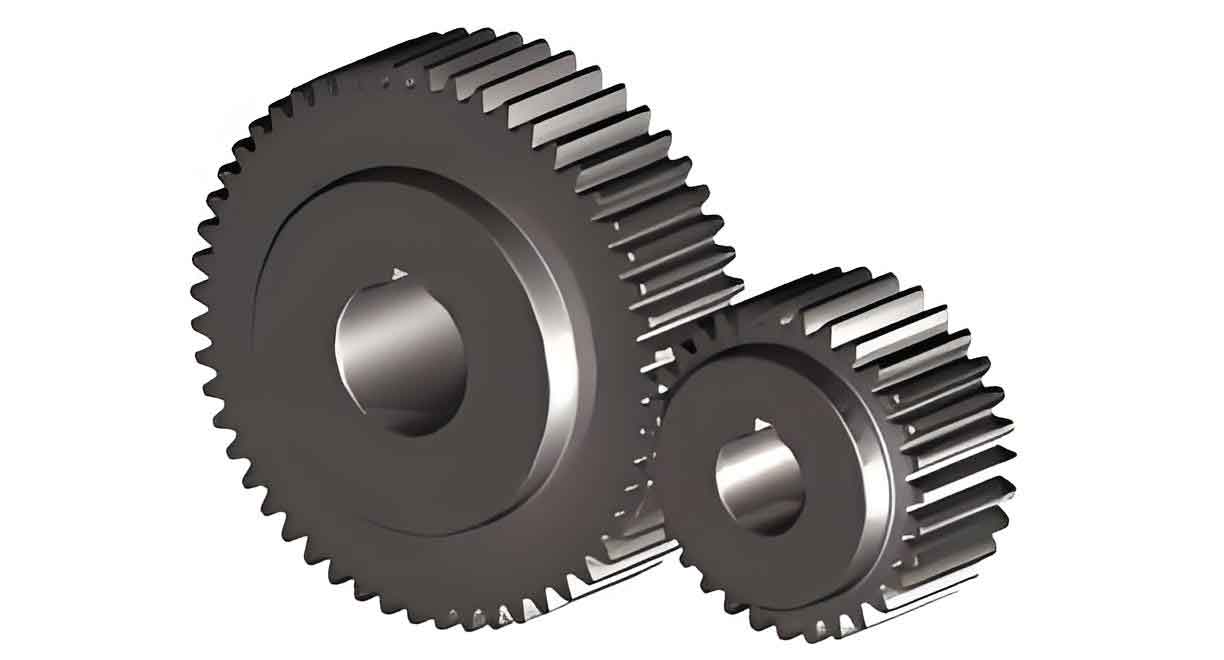
This study investigates the vibration characteristics of spur gear pairs under spalling failure while considering tooth surface flash temperature effects. A comprehensive model integrating thermal deformation and time-varying mesh stiffness is established to analyze the dynamic response of spur gear systems.
1. Time-Varying Mesh Stiffness Calculation
The total mesh stiffness of spur gear pairs consists of bending stiffness $k_b$, shear stiffness $k_s$, axial compressive stiffness $k_a$, and Hertzian contact stiffness $k_h$. For gears with spalling defects:
$$U_b = \int_0^d \frac{[F_b (d – x) – F_a h]^2}{2 E I_s} dx = \frac{F^2}{2k_b}$$
$$I_s = \begin{cases}
\frac{(2h_x L)^3}{12}, & \text{healthy} \\
\frac{(2h_x L)^3 – h_s^3 a_s}{12}, & \text{spalled}
\end{cases}$$
| Parameter | Pinion | Gear |
|---|---|---|
| Module (mm) | 2 | 2 |
| Number of teeth | 19 | 48 |
| Pressure angle (°) | 20 | 20 |
| Young’s modulus (GPa) | 206 | 206 |
2. Flash Temperature Model
The total contact temperature $\Delta T$ consists of bulk temperature $\Delta_M$ and flash temperature $\Delta_f$:
$$\Delta T = \Delta_M + \Delta_f$$
$$\Delta_f = \frac{\mu f_m f_e (v_{ct1} – v_{ct2})}{(\sqrt{\pi \rho_1 c_1 v_{ct2}} + \sqrt{\pi \rho_2 c_2 v_{ct2}}) B}$$
| Friction coefficient | 0.01 |
| Thermal conductivity (W/m·K) | 46.47 |
| Specific heat capacity (J/kg·K) | 481.48 |
| Linear expansion coefficient | 1.16×10⁻⁵ |
3. Dynamic Model Formulation
The 8-DOF dynamic model for spur gear pairs considers both torsional and translational vibrations:
$$m_1 \ddot{x}_1 + c_{s1} \dot{x}_1 + k_{s1} x_1 = F_f$$
$$I_1 \ddot{\theta}_1 – c_{f1} (\dot{\theta}_{f1} – \dot{\theta}_1) – k_{f1} (\theta_{f1} – \theta_1) = -r_{b1} F_M$$
| Pinion mass (kg) | 0.96 |
| Gear mass (kg) | 2.88 |
| Bearing stiffness (N/m) | 6.56×10⁷ |
| Mesh frequency (Hz) | 570 |
4. Vibration Characteristics Analysis
The vibration response of spur gear pairs exhibits distinct features under spalling failure:
- Impulsive impacts at shaft rotational frequency $f_r$ (30 Hz)
- Sideband modulation around mesh frequency $f_m$ (570 Hz)
- Amplitude modulation depth proportional to spalling size
$$K_{total} = \frac{K_M K_T}{K_M + K_T}$$
where $K_M$ represents mechanical mesh stiffness and $K_T$ denotes thermal stiffness.
5. Conclusion
This investigation reveals that spur gear pairs with spalling failure exhibit unique vibration signatures when considering flash temperature effects. The thermal-structural coupling significantly reduces mesh stiffness (15-20% decrease) and modifies dynamic response characteristics. The findings provide critical insights for condition monitoring of spur gear transmissions in heavy-duty applications.
$$PSD(f) = \sum_{n=1}^\infty \left[ \frac{A_n}{2} \right]^2 \delta(f – nf_m) + \sum_{k=1}^\infty S_k(f \pm kf_r)$$
where $A_n$ represents harmonic amplitudes and $S_k$ denotes sideband components.